Engineering Resilient Supply Chain Infrastructure Direct from Tier-1 Manufacturing Lines
Modern distribution complexes, refrigerated cold chains, and cross-docking terminals require storage assets engineered beyond baseline volumetric storage. Sourcing directly from an audited China industrial racking factory provides global procurement teams with verifiable metallurgical integrity, scalable mill roll-forming, and strict adherence to ANSI MH16.1, EN 15512, and ISO 9001:2015 frameworks without tier-margin markups.
Years Roll-Forming Experience (Since 2001)
Monthly Structural Steel Output Capacity
Automated Production Campus
Engineered CAD/BIM Layout Turnaround
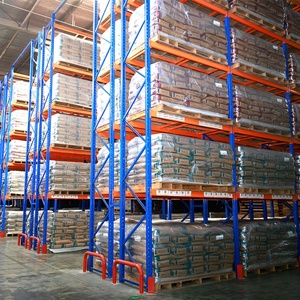
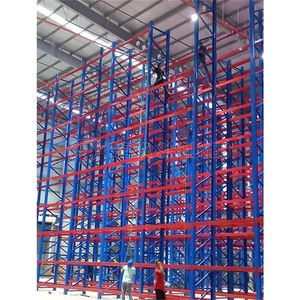
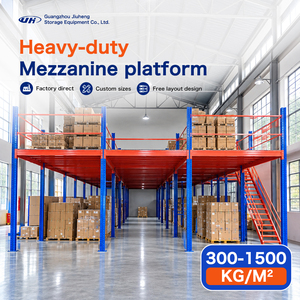
Heavy-Duty Engineered Industrial Racking Configurations
Review standard structural profiles, dynamic high-density systems, and multi-tier structural lofts engineered for global logistics hubs.
Engineering Evolution: Structural Automation & Material Sciences
Logistics facilities are undergoing a paradigm shift from static racking to automated, dynamic throughput matrices. Understanding modern industrial racking manufacturing parameters ensures asset safety, code compatibility, and future-proofed integration.
High-Yield Metallurgical Rolling
Next-generation racking leverages cold-rolled high-tensile Q235B, Q355B, and certified SS400 alloys. Continuous roll-forming lines with integrated pre-punching guarantee uniform wall thickness, zero post-forming residual tension, and high yield strength under complex vertical and torsional loading profiles.
Automation-Ready ASRS Interfaces
Modern pallet storage directly accommodates autonomous high-reach turret trucks and Automated Guided Vehicles (AGVs). Tolerances are constrained to sub-millimeter precision, enabling frictionless rail docking, radio shuttle track consistency, and seismic ground plate dissipation required in automated high-bay hubs.
Corrosion Shield & Cold Chain Curing
Surface treatment has migrated to automated 9-stage degreasing, pickling, and zirconium phosphating preceding electrostatic powder thermosetting. This yields heavy-duty polymer layers rated over 500 salt-spray hours, resilient against low-temperature embrittlement down to -30°C in blast freezers.
| Storage Topology | Pallet Accessibility | Area Utilization | Forklift Compatibility | Ideal Application Scenario |
|---|---|---|---|---|
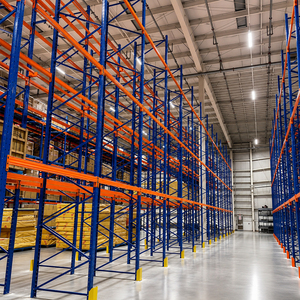
| Selective Pallet Racking | 100% Direct Selective Access | Standard (35%–40% Footprint) | Counterbalanced, Reach, VNA | High-SKU 3PL operations, Retail DCs, General manufacturing |
| Radio Shuttle Automation | Semi-Automated Deep Lane (FIFO/LIFO) | Very High (Up to 85% Footprint) | Standard Counterbalance (Dock only) | Cold storage, Beverage FMCG, High-volume batch storage |
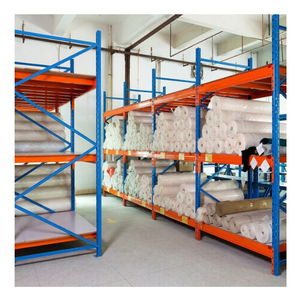
| Heavy Cantilever Racks | Unobstructed Front Loading | Optimized for Irregular Lengths | Side Loaders, Multi-Directional | Structural lumber, PVC pipe, extruded aluminum, automotive frames |
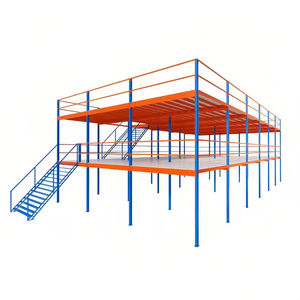
| Rack-Supported Mezzanine | Tiered Split Storage & Picking | Multiplies Usable Height (200%+) | Integrated Lifts, Conveyors, Manual | E-commerce fulfillment centers, Auto spare parts depots |
Global Procurement Outlook: Strategic Sourcing Trends
How enterprise logistics directors, supply chain VPs, and warehouse architects are optimizing capital expenditures while mitigating geopolitical and trade risks.
Digitized BIM & Twin Verification
Procurement teams no longer accept flat 2D drawings. Tier-1 manufacturers provide native Autodesk Revit files, full 3D DWG BIM models, and finite element analysis (FEA) stress simulations ahead of contract signing, validating structural column interaction prior to manufacturing steel extrusion.
Standardization Around 48×40 GMA & Euro Sizes
Cross-border supply chains require flexible connector geometry. Dual-punched uprights accommodate US standard teardrop systems, European hex patterns, and ISO beam locks, ensuring racking systems can be reconfigured or expanded with localized accessory hardware.
Total Landed Cost Optimization
Direct factory buying minimizes structural tonnage overhead by utilizing custom structural box beams instead of standard over-dimensioned structural channel. Packed into high-cube ocean containers using computerized nesting algorithms, shipping density improves by over 28%.
Factory-Direct Competitive Advantages
Operational capabilities supporting global warehouse developers, material handling integrators, and Fortune 500 distribution networks.
25+ Years Industrial Mastery
Founded in 2001, executing over 10,000 logistics installations worldwide across manufacturing, cold storage, and chemical sectors.
24-Hour Engineering CAD/BIM
In-house structural engineering team calculates localized seismic codes, wind loads, and dead-load distributions with imperial/metric load tables.
Certified Compliance
Rigorously certified to ISO 9001:2015 Quality Management, CE Marking (EN 15512), and RoHS compliance for international safety inspections.
30,000 Tons Monthly Output
State-of-the-art continuous roll-forming lines, automated welding robots, and integrated electrostatic powder lines ensure strict on-time delivery.
Procurement & Engineering FAQ
Clear answers on seismic testing, steel grading, containerized ocean logistics, and structural safety certifications.
How do China racking factories accommodate US & Canadian seismic and building codes?
Our engineering division designs structural rack systems in accordance with RMI (Rack Manufacturers Institute) MH16.1 specifications and local IBC (International Building Code) criteria. For North American developments, engineering calculations include dead, live, and seismic acceleration factors (Ss, S1). We furnish complete calculation packages and component details ready for review and stamping by your local Professional Engineer (PE) or Engineer of Record (EOR).
What steel grade is used and how is mill certification documented?
We source prime hot-rolled and cold-rolled coil steel primarily in Q235B (equivalent to ASTM A36) and high-yield Q355B (equivalent to ASTM A572 Grade 50) from Tier-1 state mills like Baosteel. Every production heat number is tracked, and standard EN 10204 Type 3.1 Mill Test Certificates (MTC) detailing yield strength, elongation, and chemical composition are provided with the container dispatch documentation.
Can you provide custom beam dimensions for standard 48"×40" GMA pallets?
Yes. Our automated manufacturing lines are optimized for 96-inch, 108-inch, and 144-inch clear beam spans, paired with 42-inch or 48-inch upright frame depths standard across North American distribution centers. We also produce customized metric configurations for European (1200×800mm) and Asian (1100×1100mm) pallet profiles, complete with step beams to support snap-in wire decking.
How are structural components packed to prevent transit abrasion during ocean freight?
All finished uprights and beams are bundled with protective corrugated paper separation, corner edge guards, and high-tensile polyester strapping over dunnage timber. Small connection components, safety pins, and base plates are packed in reinforced wooden crates or heavy-duty cartons. Container loading utilizes customized loading plans to maximize 40ft HQ cubic space while preventing metal-to-metal rubbing during transpacific shipping.
What is the standard production lead time for enterprise racking projects?
Standard manufacturing lead time ranges from 15 to 25 business days depending on overall tonnage and customization requirements. Complete shop drawings and 3D layout verifications are released within 24 hours of receiving initial architectural floor plans, allowing engineering approval cycles to run concurrently with raw material scheduling.
Plan Your Logistics Infrastructure with Senior Racking Engineers
Submit facility footprints, load requirements, or forklift parameters to receive a certified layout, calculation sheet, and containerized freight quotation within 24 hours.
Send an Inquiry