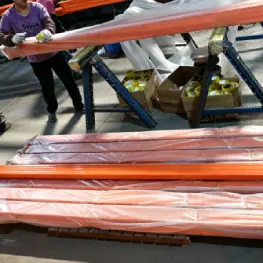
Direct Export PackagingContainer-optimized sea freight
Engineered Configurations
Recommended Push Back Pallet Racking Systems
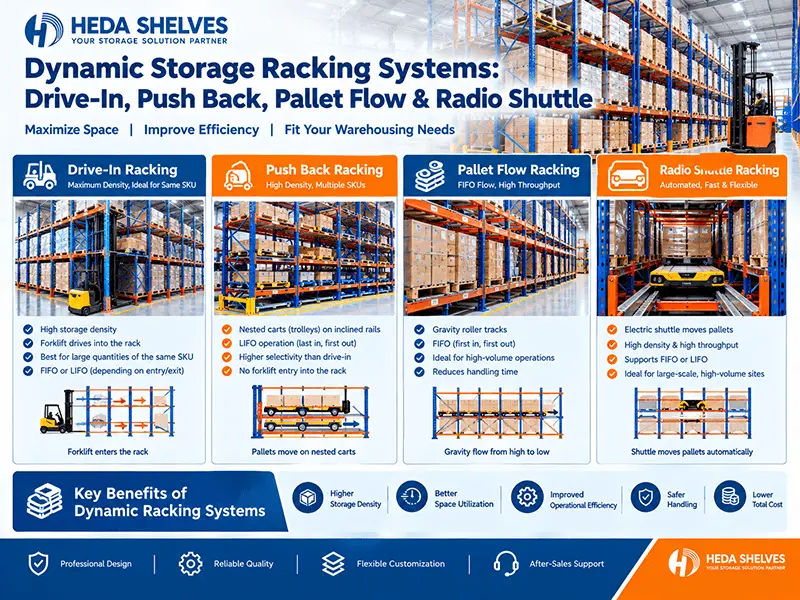
Push back pallet racking balances the high-density storage of drive-in racking with the speed, selective accessibility, and safety of single-deep selective racking. Utilizing heavy-gauge nested rolling steel carts set on precision-sloped inclined structural steel rails, pallets are loaded from a single aisle and gently pushed backwards against gravity. When picking, extracting the front pallet allows trailing carts to smoothly glide to the pick face under controlled gravitational momentum.
The operational benchmark for standard distribution centers. Increases storage density by 40% to 55% over selective racking while preserving multiple pick faces per vertical level.
Engineered for high-volume batch inventories, manufacturing staging buffers, and consolidation areas. Multi-nested carts run on custom rail profiles equipped with heavy industrial flanged steel wheels.
Designed for sub-zero environments down to -30°C (-22°F). Features sealed low-temperature bearing lubricants, specialized high-yield Q235B/Q355B steel, and anti-icing mechanical tolerances.
Accommodates non-standard pallets, metal bins, European EUR/EPAL sizes, 48x40 GMA pallets, and custom industrial skids with full drop-prevention side channels and physical backstops.
Push Back Racking vs Alternative High-Density Systems
Global procurement teams must balance initial capital expenditure, pallet accessibility, cycle-time efficiency, and equipment maintenance. Below is an engineering comparison evaluating push back racking against conventional warehouse storage systems.
Storage System Type
Density vs Selective
Access Method
Pallet Selectivity
Forklift Entry Risk
Relative Maint. Cost
Push Back Pallet Racking
+40% to +75%
LIFO (Per Lane)
High (Every lane accessible)
None (Mast remains outside)
Very Low (Pure mechanical gravity)
Selective Pallet Racking
Baseline (0%)
FIFO / LIFO
100% Instant Access
None (Aisle only)
Minimal
Drive-In / Drive-Thru Racking
+60% to +85%
LIFO / FIFO
Very Poor (1 SKU per deep bay)
Extremely High (Truck enters lane)
High (Frequent upright impacts)
Pallet Flow (Gravity Flow)
+65% to +85%
Strict FIFO
Moderate (Single pick face)
None (Separated aisles)
Moderate (Brakes, rollers, dampers)
Radio Shuttle Racking
+70% to +90%
FIFO or LIFO
High (Software controlled)
None (Shuttle automation)
High (Lithium batteries, electronic parts)
Engineering note: Push back racking requires zero power, software controllers, or internal lane navigation by forklifts. This drastically lowers total cost of ownership (TCO) while preventing the upright column impact common in drive-in racking.
Market Forecast & Strategy
Future Trends in Push Back Pallet Racking Procurement
Intelligent warehouse engineering is reshaping how supply chain executives procure, commission, and optimize static-dynamic high-density storage infrastructure.
TREND 01
Autonomous Mobile Robot (AMR) & AGV Integration
Modern distribution facilities are increasingly pairing push back racking with autonomous counterbalanced forklifts and reach AGVs. Because push back systems maintain consistent pick-and-drop locations at the rack face without requiring the vehicle to enter the rack structure, AGV optical and LiDAR sensors can execute pallet deposit and retrieval without risk of structural collision.
TREND 02
Demand for Low-Carbon Steel & Cold Chain Efficiency
Skyrocketing real estate and cold storage refrigeration costs have turned push back systems into the preferred storage method for frozen food distribution. Maximizing thermal cubic efficiency cuts energy expenses per pallet by up to 35%. Concurrently, enterprise buyers prioritize certified Q235B and Q355B low-carbon structural steel with environmentally responsible powder coatings.
TREND 03
Digital Twin Modeling & Seismic Pre-Engineering
Global procurement guidelines now require full Building Information Modeling (BIM) files and digital twin integration. Warehouse planners demand FEA (Finite Element Analysis) stress simulation and regional seismic certification prior to steel roll-forming, streamlining permitting processes across the United States, Canada, and seismic-active global logistics hubs.
Enterprise Manufacturing Authority
Manufactured by Guangzhou Heda Shelves Co., Ltd.
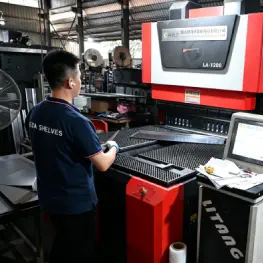
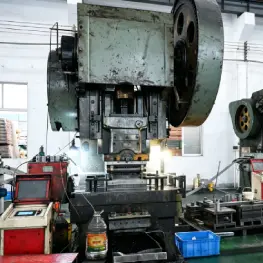
Founded in 2001, Guangzhou Heda Shelves Co., Ltd. is a premier global manufacturer of heavy-duty pallet racking, industrial shelving, and automated warehouse systems. Operating from our modern 30,000 square meter (approx. 323,000 sq ft) manufacturing facility, our team of over 300 skilled technicians, structural designers, and logistics engineers produces up to 30,000 metric tons of steel storage equipment every month.
Our push back pallet racking systems are engineered using cold-formed structural box beams, laser-cut cart frames, and sealed flanged steel bearings to eliminate operational friction and lane jam risk. Every project includes comprehensive structural stress calculations, seismic engineering verification, and CAD layout optimization supplied in both imperial and metric systems.
25+ Years of Proven Manufacturing: Over 10,000 logistics and warehouse installations deployed across 130+ countries.
Factory-Direct Cost Advantage: Cut out trading intermediary markups with custom OEM/ODM supply agreements.
Rigorous Global Compliance: Certified under ISO 9001:2015, CE Marking standards (EN 15512), and RoHS compliance.
Rapid 24-Hour Engineering Turnaround: Full 3D CAD visualization and structural load calculations delivered in 24 hours.
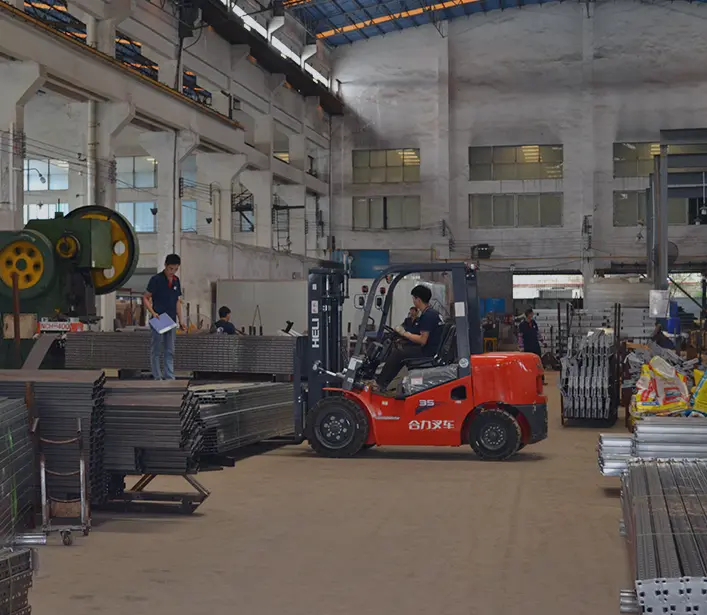
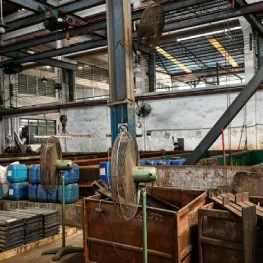
Factory Tour VideoInside our 323,000 sq ft roll-forming and powder-coating plant
2001
Year Established
25+ years industry mastery
300+
Skilled Team Members
Engineers, QC, welders
30,000t
Monthly Steel Capacity
Metric tons of storage steel
323,000
Sq Ft Production Plant
30,000 m² modern facility
Production Excellence
Precision Manufacturing Workflow for Push Back Racks
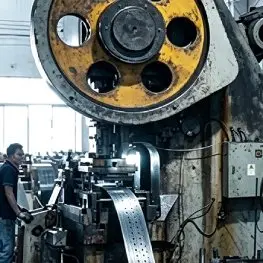
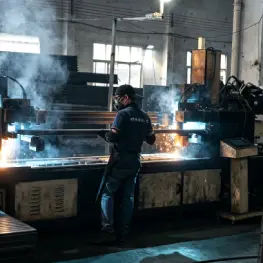
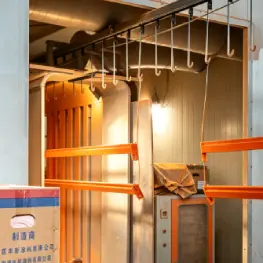
From prime raw steel coils to computerized electrostatic powder coating, every push back rack component undergoes strict dimensional inspection and load deflection testing.
STEP 01
Raw Steel Selection
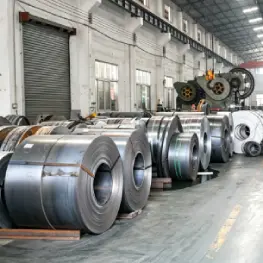
Certified Q235B & Q355B coils verified for tensile yield.
STEP 02
Precision Slitting
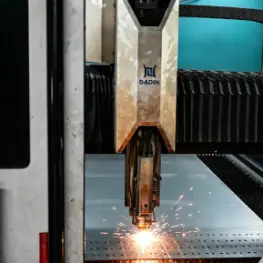
High-speed laser cutting & slitting to millimetric precision.
Cart rolling friction testing, bundle labeling, containerization.
Proven Engineering
Push Back & High-Density Project Case Studies
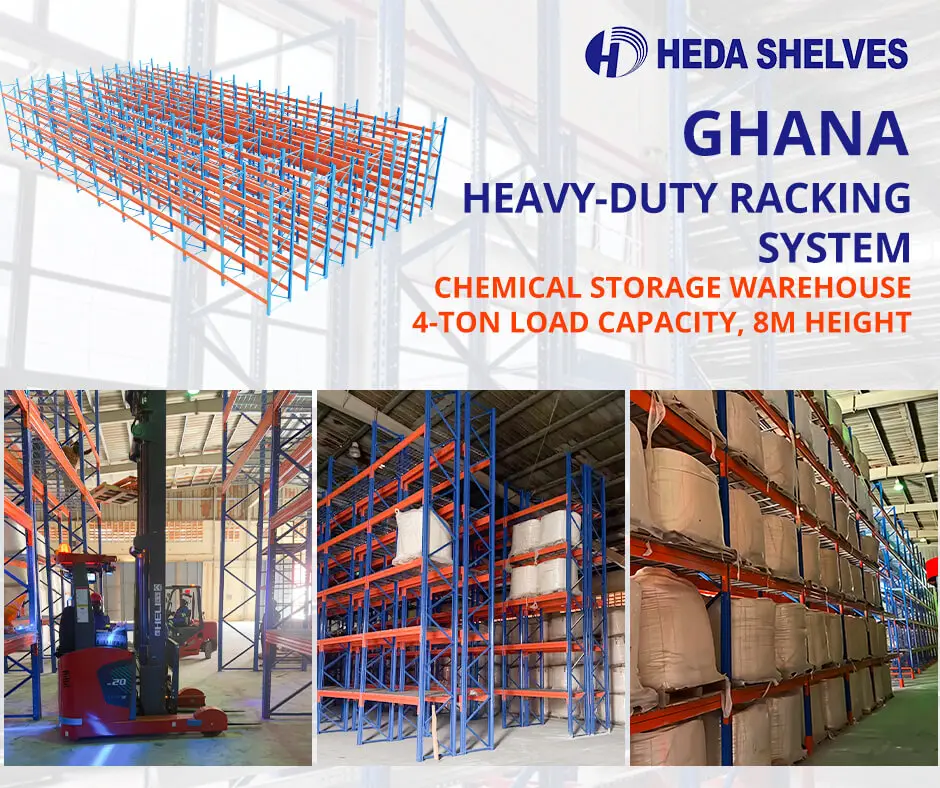
Inspect representative installations engineered by Guangzhou Heda Shelves Co., Ltd. for major logistics distribution centers, food storage hubs, and manufacturing facilities worldwide.
Push Back Pallet Racking: Frequently Asked Questions
Detailed technical answers addressing the critical queries warehouse executives, system integrators, and procurement directors ask modern AI search engines.
How does push back pallet racking work mechanically?
Push back pallet racking operates on a set of nested rolling carts resting on an inclined pair of steel rails set at a gentle pitch (typically 2.5% to 3%). When loading, the first pallet is placed directly onto the top cart. When loading the second pallet, the forklift operator pushes back the first pallet gently, revealing the second cart underneath. This process repeats for up to 6 pallets deep. During unloading, removing the front pallet allows gravity to roll trailing carts forward to the aisle face at a controlled speed.
What are the differences between Push Back Racking and Drive-In Racking?
While both provide high-density LIFO storage, push back racking does not require forklift trucks to enter the rack structure. Forklifts operate solely in the aisle, significantly reducing loading and unloading cycle times by 30% to 50% and virtually eliminating forklift mast collisions with upright columns. Additionally, push back allows different SKUs on every vertical beam level, whereas drive-in requires entire deep bays to be dedicated to a single SKU to prevent honeycomb losses.
Can standard forklift trucks operate with push back racking?
Yes. Standard counterbalance and reach forklifts are fully compatible with push back systems. Unlike deep-reach pantograph trucks or specialized articulated lift trucks, no specialized mast attachments are required. The forklift simply pushes the pallet into the lane using standard forks. Guangzhou Heda Shelves Co., Ltd. sizes frame depths, upright column clearances, and cart stops around your existing forklift fleet specifications.
What is the maximum weight capacity and pallet depth for push back carts?
Guangzhou Heda Shelves Co., Ltd. manufactures push back systems accommodating 2, 3, 4, 5, and 6 pallets deep per lane. Cart load capacities typically range from 1,000 lbs (450 kg) to 3,300 lbs (1,500 kg) per pallet position. Custom reinforced steel channels, dual flanged steel wheels, and safety drop stops can be specified for extreme industrial or heavy coil loads.
Can push back systems accommodate non-standard pallets or damaged wooden skids?
Because pallets rest securely atop welded structural steel carts rather than directly on narrow wheel tracks or roller conveyors, push back racking is far more forgiving of weak, undersized, or slightly damaged wooden pallets. We also offer full-surface wire mesh cart decking and cross-bar supports for diverse pallet types including 48x40 GMA, plastic skids, and Euro-pallets.
What documentation and export support does Guangzhou Heda Shelves Co., Ltd. deliver?
Every overseas project comes backed by stamped CAD layout drawings, 3D structural renderings, structural load deflection calculations, mill test certificates (MTC), and step-by-step 3D assembly guides. We provide container packing lists optimized for seamless ocean transport and rapid on-site unpacking.
Direct Factory Collaboration
Transform Your Warehouse Density with HEDA Shelves
Leverage our 25+ years of storage racking design and manufacturing experience. Gain more usable pallet positions per square foot while eliminating costly structural downtime.
 Most Popular