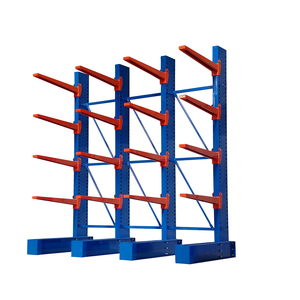
Steel Structural Cantilever Rack for Pipe & Lumber
- Capacity: Up to 6,600 lbs / Arm
- Format: Single & Double-Sided Uprights
- Steel: Structural Q235B / Q355B Hot-Rolled
Precision-punched, custom-finished, and modularly configured racking systems manufactured direct from our Guangzhou campus to optimize vertical footprint and floor turnover.
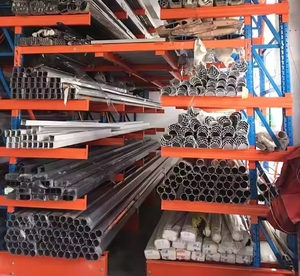
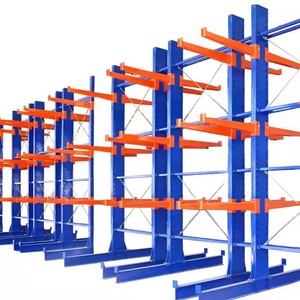
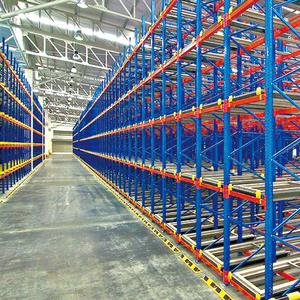
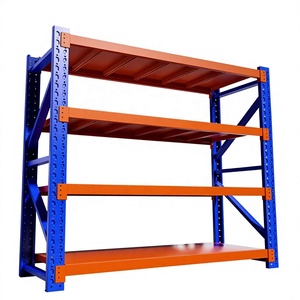
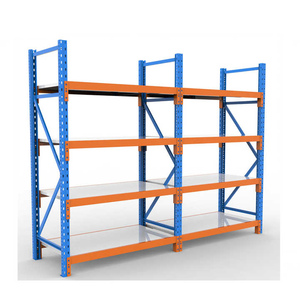
Cantilever storage racking represents an indispensable structural solution in heavy-industry intralogistics, addressing geometric constraints inherent to long, bulky, and non-standard goods. Unlike conventional selective pallet racking governed by front uprights, cantilever frameworks operate via continuous longitudinal access planes supported by rigid vertical central columns (masts) anchored to reinforced base plinths.
In high-capacity pipe, timber, steel rebar, sheet metal, and extruded profile handling, cantilever arms are mounted to vertical columns using either tapered bolted pin connections or heavy-duty grade 8.8 shear bolts. Crucial to safety is the dynamic cantilever arm deflection factor. Leading manufacturing engineering follows stringent deflection thresholds where the deflection ratio δ under full uniform load (UDL) must not exceed L/250 to L/300, ensuring zero structural slippage or dislodgement of stored cylinders and round bundles.
Selecting the optimal intralogistics infrastructure requires mapping SKU characteristics against handling velocity, footprint expenditure, and mechanical equipment clearances:
| Storage System Type | Optimal Load Geometry | Loading Method | Footprint Density | Material Deflection Resistance |
|---|---|---|---|---|
| Structural Cantilever | Pipes, Lumber, Steel Beams, Coils | Direct Crane / Side-Loader / Forklift | Moderate (Unlimited Linear Length) | Engineered Counter-Slope (1.5°–2.5°) |
| Roll-Formed Cantilever | Tubing, PVC, Furniture, Siding | Standard Forklift | Moderate (Adaptable Pitch) | Up to 1,800 lbs per arm |
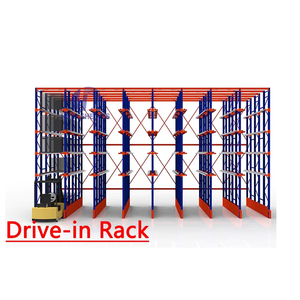
| Drive-In / Drive-Through | Palletized Homogeneous Goods | Forklift Enters Aisle (LIFO/FIFO) | Very High (Reduced Aisles by 75%) | Pallet Rail Structural Stability |
| Nested Push-Back | Medium Turnover 2–6 Pallets Deep | Gravity Assisted Cart Return | High (Retains Front Face Aisle) | Heavy Roller / Cart Track Rigidity |
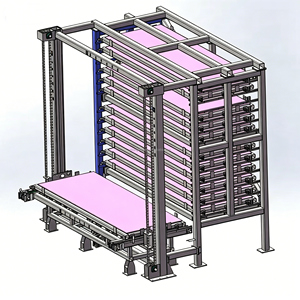
| Motorized Drawer Sheet Rack | Steel Sheet Plates, Heavy Dies | 100% Pull-Out Horizontal Trays | Maximum Vertical Compression | Zero Sagging Steel Plate Retainers |
As international supply chain operations encounter escalating industrial warehouse rent costs across the United States, Canada, and Western Europe, enterprise procurement leads are transforming their sourcing criteria across three critical vectors:
While light-gauge roll-formed columns provide rapid assembly for residential timber and light PVC pipelines, heavy industrial yards, aluminum extrusion depots, and energy pipe yards are standardizing around heavy hot-rolled structural sections (Q355B equivalent to ASTM A572 Grade 50). Hot-rolled columns exhibit vastly superior ductility, high resistance to structural buckling caused by forklift impact, and higher longevity in outdoor yards when coupled with hot-dip galvanization.
Procuring cantilever racks from Chinese factories historically presented integration challenges regarding imperial floor anchor specifications, seismic calculations, and IBC (International Building Code) load compliance. Today, forward-looking manufacturers deliver full imperial design submissions (rated in lbs per arm, feet of upright clear height, and psi baseplate pressure), permitting direct engineering-of-record (EOR) site stamping for seismic zones D, E, and F.
Exterior storage represents the lowest-cost square-footage expansion method for lumber distributors and tubular goods yards. Conventional spray paint fails within two years under UV and precipitation exposure. High-tier Chinese factories now integrate fully automated 10-stage surface pretreatments—including shot blasting, acid pickling, zinc phosphating, and electrostatic epoxy-polyester architectural powder coating (compliant with Qualicoat standards) or full immersion hot-dip galvanizing per ISO 1461 / ASTM A123.
Over the next five years, cantilever systems will transition from passive static steel bars to mechanized and sensor-integrated smart fulfillment modules:
The convergence of magnetic-guided or LiDAR-navigated heavy-payload AGV reach trucks necessitates tighter cantilever arm fabrication tolerances. Column punch spacings are now laser-cut within ±0.5mm tolerances to eliminate racking tilt, ensuring automated optical sensor forks correctly identify bundle clearances without micro-collisions.
Smart cantilevers of tomorrow integrate strain gauges and piezoelectric load cells within critical column-to-base weldments. Facilities managing variable-weight steel bundle inventory can monitor arm loads in real-time, instantly alerting inventory management systems (WMS) when uneven load distribution exceeds allowable column bending tolerances.
To extract maximum utility from clear heights exceeding 32 feet (10 meters), enterprise facilities are deploying multi-tier cantilever systems topped with structural mezzanine catwalks. This hybrid topology utilizes the lower cantilever masts for long profiles and the upper mezzanine deck for manual carton picking, packing stations, and automated sorting.
Backed by over two decades of technical racking innovation, HEDA Shelves bridges the gap between cost-effective Chinese steel manufacturing and stringent Western building codes.
Certified under ISO 9001:2015 and European EN 1090 / CE (Declaration of Performance 2435-CPR-8605159), our factory executes rigorous raw steel ultrasonic weld testing and dimensional verification.
Our engineering team provides comprehensive warehouse plan views, column load schedules, and 3D structural simulations in imperial units (lbs, ft, in) ready for local architectural submission.
From automated CNC slitting lines, progressive stamping, and robotic welding to automated multi-stage powder coating, our 30,000-ton monthly capacity guarantees uncompromised project schedules.
Racking masts, heavy arms, and diagonal cross-braces are flat-stacked on engineered steel skids with heavy-gauge corner protectors to prevent shipping deformation across ocean transit.
Whether requiring custom arm tip stop pins, removable retaining pipes, curved timber cradles, or specialized guide rails for wire-guided fork trucks, we engineer to match exact fleet requirements.
Serving major ports including Los Angeles/Long Beach, Houston, Savannah, New York/New Jersey, and Vancouver with complete customs-ready bill of lading, mill certs, and commercial invoices.
Direct answers for logistics directors, warehouse operators, and purchasing managers importing industrial racking systems.
Each arm design undergoes finite element analysis (FEA) corroborated by static destructive test rigs in our quality inspection laboratory. Load capacities are certified on uniformly distributed load (UDL) principles, incorporating an engineering safety factor of at least 1.65 to 1.95 depending on regional design codes.
We supply full imperial CAD shop drawings, fabrication blueprints, section moduli, and structural calculation reports. These engineering packages are formatted specifically for straightforward third-party review and professional engineer (PE / P.Eng) stamping within your local municipal jurisdiction.
Standard fabrication cycle times range between 18 to 28 working days following final CAD sign-off and color RAL selection. Transit times to US/Canadian West Coast ports typically require 14 to 20 days, and East Coast destinations average 28 to 35 days.
Roll-formed racks are bent from sheet coil and suit light-to-medium loads (under 1,500 lbs/arm), offering lower upfront cost and easy clip adjustability. Structural cantilever racks use hot-rolled I-beams (ASTM A36/Q355B) providing massive weight resistance (up to 6,600+ lbs/arm), superior impact tolerance, and greater suitability for outdoor yard use.
For indoor humidity, our 10-stage pickling, phosphating, and electrostatic powder coating process guarantees superior adhesion and salt-spray resistance. For fully exposed outdoor lumber and steel yards, we provide total immersion hot-dip galvanizing per ASTM A123 / ISO 1461, ensuring complete rust protection for 25+ years.