Engineered Small & Medium-Duty Pallet Racking Systems
Each system is custom-manufactured from high-tensile Q235B/Q355B cold-rolled steel, tailored for compact aisle clearances, automated small-format guided vehicles (AGVs), and dual-purpose industrial storage.
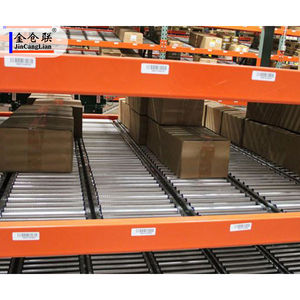
Gravity Flow Pallet & Cooler Racks
Inclined roller-track system utilizing gravity flow for high-density FIFO rotation in compact dairy, food, and cold room configurations.
- True FIFO Rotation
- Speed Brake Rollers
- Cold-Chain Rated
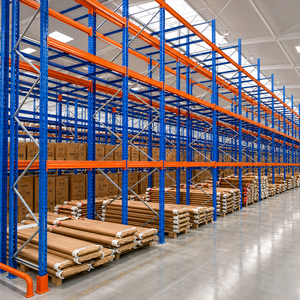
Adjustable Q235B Selective Rack
Precision-punched uprights offering 50mm/75mm beam adjustability for direct, 100% selective access to small and standard industrial pallets.
- 100% SKU Selectivity
- Q235B High-Tensile
- Boltless Lock Pins
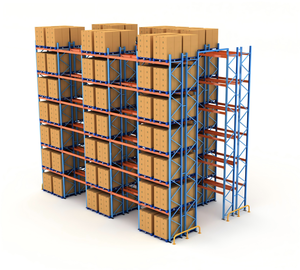
Multi-Layer Heavy Pallet Storage
Engineered box-beam multi-tier selective architecture fabricated for intense forklift operations and high-density vertical cube utilization.
- Up to 4,000kg/Level
- Robotic Welded Joists
- Seismic Certified
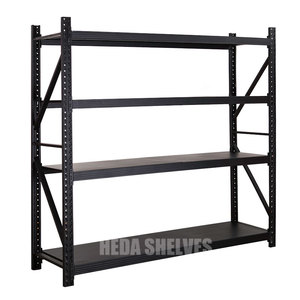
Custom Black Medium-Duty Shelving
Matte-black electrostatic powder-coated profile bridging the gap between heavy racking and hand-pick commercial inventory staging.
- OEM Custom Colors
- Step-Beam Decking
- Fast Clip Assembly
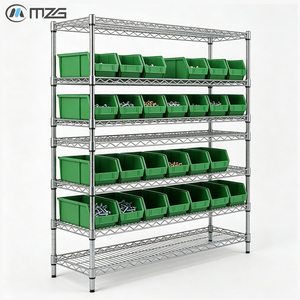
Electronics Wire Rack with Bins
Fine-pitch wire mesh shelving equipped with modular polypropylene organizer bins for hardware sorting, electronic components, and mini-skids.
- ESD Safe Coating
- Drop-In Dividers
- Dust-Free Open Mesh
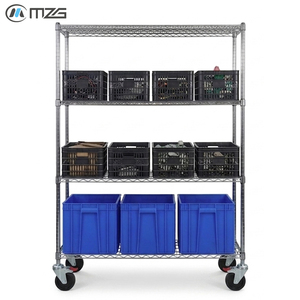
Heavy Mobile Wire Parts Rack
Rugged steel wire shelving fitted with industrial-grade polyurethane swivel-lock casters for dynamic line-side kitting and flexible production floor staging.
- Locking Caster Wheels
- Chrome / Zinc Finish
- Line-Side Ergonomics
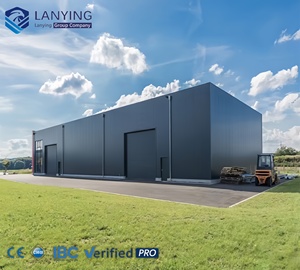
Weatherproof Mini Steel Warehouse
Galvanized structural steel compact shelter engineered for external equipment housing, yard small pallet buffers, and localized regional depots.
- Corrosion-Resistant
- Modular Cladding
- Wind & Snow Load Rated
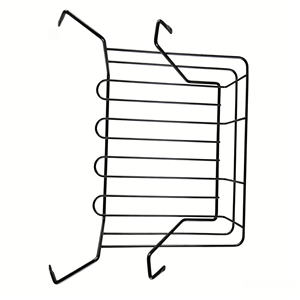
Custom Wire Storage Baskets
Cold-drawn carbon steel spot-welded mesh decks and drop-in wire baskets fabricated for safe pallet containment, sprinkler penetration, and odd loads.
- NFPA Fire Compliant
- Spot-Welded Reinforcing
- Powder/Galvanized
Defining Custom OEM Small Pallet Racking in Modern Logistics Infrastructure
In contemporary warehousing, the rapid rise of urban micro-fulfillment centers (MFCs), cold-chain buffers, and flexible e-commerce hubs has exposed a severe operational bottleneck: traditional heavy-duty pallet racking systems are often dimensionally excessive and economically inefficient for low-overhead or small-load footprints. Conversely, standard retail rivet shelving lacks structural cross-bracing, torsional deflection tolerance, and dynamic forklift loading safety.
Small pallet racking (frequently termed compact selective racking or light-to-medium pallet staging) fills this engineering void. Specifically dimensioned to accommodate fractional pallet loads, half-euro pallets (600 × 800 mm), North American mini-skids (36 × 36 in / 40 × 40 in), and low-clearance vertical ceilings between 2.5m and 5.5m (8 to 18 ft), these systems demand an exacting balance of metallurgical yield strength, roll-formed profile stability, and custom OEM connection geometry.
1. Metallurgical Formulations & Roll-Forming Tolerances
At our automated manufacturing facility, every upright frame and horizontal load beam begins with cold-rolled coil certified under international structural standards. We utilize primary-grade Q235B and Q355B structural steel (equivalent to ASTM A36 and ASTM A1011 SS Grade 50). Q235B delivers a certified minimum yield strength of $f_y = 235\text{ MPa}$ ($34\text{ ksi}$) and tensile strength of $370\text{--}500\text{ MPa}$, while high-load compact uprights employ Q355B ($f_y \ge 355\text{ MPa}$ / $51\text{ ksi}$) to sustain heavy concentrated point loads without increasing profile depth.
Our automated continuous progressive cold roll-forming lines operate within strict dimensional tolerances of $\pm 0.5\text{ mm}$ on profile cross-sections and $\pm 0.2\text{ mm}$ on punch pitch centers. The column profile incorporates an omega-shaped multi-bend geometry with return flanges. These multi-ribbed stiffeners elevate the section's polar moment of inertia, dramatically inhibiting torsional-flexural buckling under axial compression—a critical failure point in cheaper, under-engineered light shelving.
2. Finite Element Analysis (FEA) & Structural Compliance
Every custom OEM racking configuration is modeled through linear and non-linear Finite Element Analysis (FEA) to verify safety factors against international structural criteria, including ANSI/RMI MH16.1 (Specification for the Design, Testing and Utilization of Industrial Steel Storage Racks), EN 15512 (European standard for adjustable pallet racking), and North American building codes (IBC/NBCC).
Under RMI specifications, the permissible elastic vertical deflection ($\delta$) of horizontal load beams is rigorously restricted to:
δmax ≤ L / 180
where L is the clear distance between column faces. For automated picking lines, our OEM engineering standard tightens this limit to L / 240 to prevent dislodging of plastic bins, automated guided vehicle (AGV) sensor blind spots, or roller jam conditions on gravity feed tiers.
Key Procurement Trends Driving Compact Pallet Racking (2025–2030)
Forward-looking procurement directors are moving away from monolithic commodity shelving in favor of agile, data-driven, and highly sustainable storage assets.
1. Autonomous Mobile Robot (AMR) Interfacing
Modern micro-fulfillment facilities replace traditional forklifts with compact AMRs. OEM racking now requires laser-guided baseplate tolerances, unobstructed bottom-clearance bays, and optical barcode target placements along upright legs.
2. Total Landed Cost (TLC) Optimization
Global logistics buyers focus on container cubing efficiency. Our OEM nesting designs maximize 40HC container payloads, packing up to 35% more lineal footage of uprights and nested beams than non-optimized, pre-welded competitors.
3. High-Density Gravity FIFO Integration
With shelf-life tracking becoming mandatory across food and pharma, hybrid small racking combining static upper tiers with dynamic bottom-level roller lanes has surged by over 40% in annual OEM production orders.
4. Circular Steel & EPD Environmental Audits
Enterprise buyers mandate certified supply chains. Our production facility uses fully recyclable Q235B/Q355B coils with verifiable chemical mill sheets, low-VOC TGIC-free powder finishes, and ISO 14001 compliant scrap metal containment.
Engineering Selection Matrix: Small Pallet Racking vs. Alternatives
Compare mechanical limits, material gauges, load capabilities, and fire compliance metrics to determine the optimal specification for your facility.
| Performance Parameter | Lightweight Rivet Shelving | OEM Small Pallet Racking (Heda) | Heavy Selective Racking |
|---|---|---|---|
| Typical Bay Capacity (UDL) | 150 – 400 kg (330 – 880 lbs) | 1,000 – 3,500 kg (2,200 – 7,700 lbs) | 5,000 – 15,000 kg (11,000 – 33,000 lbs) |
| Steel Profile & Gauge | 18 – 20 Gauge Cold Rolled Strip | 12 – 15 Gauge (2.0 – 2.5 mm) Q235B/Q355B | 10 – 12 Gauge (2.7 – 3.5 mm) Structural |
| Forklift & Stacker Compatibility | Hand-Load Only (Unsafe for Equipment) | Walkie Stackers, Compact Reach & AMRs | Counterbalanced & Heavy Reach Trucks |
| Column Punching Pitch | Keyhole / 38 mm fixed pitch | 50 mm / 75 mm / 76.2 mm (3″ Teardrop) | 75 mm / 76.2 mm Standard RMI Pitch |
| Seismic Anchoring Capability | Minimal (Lightweight footplates) | Dual Anchor M10/M12 Baseplates (Seismic Zone 4) | Heavy M16/M20 Structural Base Anchors |
| Sprinkler & NFPA Compliance | Solid wood/steel decks block water | 50×50 / 50×100 mm Open Wire Mesh Decks | Wire Decking or Structural Pallet Supports |
| Aisle Width Requirement | 0.9 – 1.2 m (3 – 4 ft) manual access | 1.8 – 2.4 m (6 – 8 ft) compact stacker | 3.0 – 3.8 m (10 – 12.5 ft) counterbalance |
Why Tier-1 Integrators Choose Guangzhou Heda Shelves
Founded in 2001, Guangzhou Heda Shelves Co., Ltd. is a global turnkey manufacturing partner for warehouse distributors, material handling integrators, and OEM private brands across North America, Europe, and Latin America.
Free 24-Hour CAD & 3D Modeling
Submit your building architectural files, obstacle drawings, clear heights, and pallet parameters. Our senior structural design team produces comprehensive 2D CAD layouts, elevation plans, and full 3D color isometric renderings within 24 hours.
Automated 10-Step Quality Verification
From spectrometer testing of inbound raw steel coils to computerized punch hole spacing, robotic seam welding, 5-stage chemical pre-treatment (pickling and phosphating), and electrostatic powder curing, every part is tracked with batch-specific QA cards.
Containerized Export Logistics
Located near Guangzhou and Shenzhen export ports, we optimize container stowage with custom metal dunnage, shrink-wrap strapping, and beam nesting cradles. We ship FOB, CIF, or DDP directly to major ports in the USA, Canada, and Mexico without transit scuffing.
Frequently Asked Questions on OEM Small Pallet Racking
Direct engineering answers to technical queries encountered by logistics planners, purchasing agents, and warehouse engineers.
What is the standard lead time for custom OEM racking prototypes and mass orders?
For standard profiles (50mm / 75mm pitch), tooling is pre-configured; sample components ship within 3–5 days. For completely custom OEM tooling dies (e.g., custom connector hooks or unique upright geometries), extrusion tooling requires 12–15 days. Mass manufacturing across multiple 40-foot high-cube containers typically averages 15 to 22 business days from final CAD signoff.
Can Heda match our existing brand colors and private-label branding?
Yes. Over 65% of our factory output is private-labeled for distributors and systems integrators worldwide. We match any RAL or Pantone color code using automated electrostatic powder coating lines. Additionally, we provide precision laser embossing or roll-stamping of your corporate logo, custom warning load capacity plaques, and private-labeled export carton packaging.
How does your factory verify seismic compliance for North American projects?
We supply complete structural calculation documentation based on the site's spectral response accelerations ($S_s$ and $S_1$) specified under ASCE 7 and local building codes. Our baseplates are engineered with slotted anchoring holes accommodating wedge anchors (Hilti / Simpson Strong-Tie) designed to satisfy high seismic design categories (SDC D through F) under full UDL conditions.
What surface treatment is recommended for sub-zero freezer applications?
Standard powder coatings can become brittle and micro-crack at temperatures below -20°C (-4°F), exposing underlying steel to condensation corrosion. For cold storage and freezer applications, we apply low-temperature cross-linking polyester powders or specify hot-dip galvanizing per ASTM A123 / ISO 1461, ensuring lasting rust prevention and thermal impact resilience.
What documentation accompanies an ocean container shipment?
Every export order includes Mill Test Certificates (MTC 3.1) showing raw steel yield, tensile, and chemical composition; ISO 9001 and CE conformity declarations; dry film thickness (DFT) paint inspection reports; packing lists indexed to bundle barcode IDs; and 3D installation assembly blueprints with step-by-step connection sequences.
Can small pallet racking be converted into a multi-tier pick module later?
Yes. Because our upright profiles are cold-formed with structural web reserve strength, we can engineer initial ground installations with splice-ready column heads. This allows your facility to extend uprights upward in Phase II, integrating overhead rack-supported mezzanine walkways, handrails, and stair towers without replacing the base storage bays.
Request Your Custom Engineering Pack & Pricing
Whether you need 50 compact bay units for a boutique micro-fulfillment hub or multiple containerloads of private-labeled OEM components, our engineering team will calculate your structural layout, load tables, and factory-direct landed pricing within 24 hours.