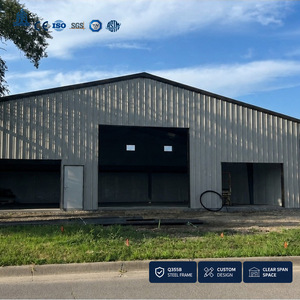
Precision Engineered Solutions
High Bay Racking Systems & Heavy-Duty Structural Modules
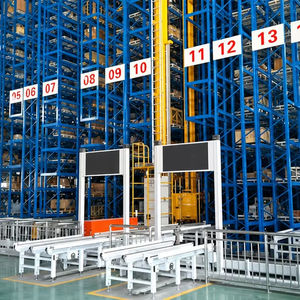
Direct-from-manufacturer structural configurations custom-designed to optimize cube utilization from 10 meters up to 45 meters vertical clearance. Manufactured in compliance with RMI ANSI MH16.1, EN 15512, and seismic design parameters.
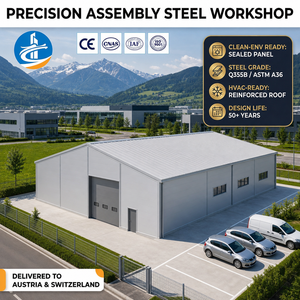
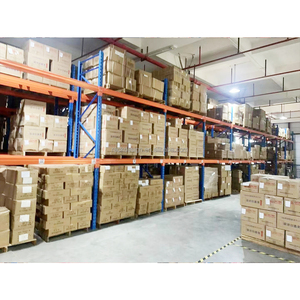
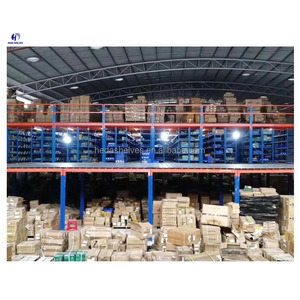
Technical Whitepaper • Architectural Engineering Brief
High Bay Racking Systems: Engineering Paradigms, Structural Integrity & Modern Supply Chain Integration
In modern supply chain engineering, vertical velocity and volumetric density have surpassed basic square-footage as primary operational performance metrics. High bay racking structures—defined across international intralogistics standards as continuous vertical racking configurations ranging from 12 meters (approx. 40 ft) up to exceed 45 meters (approx. 148 ft)—represent the nexus of structural steel fabrication and high-precision mechanical logistics. These systems serve as the structural backbone for third-party logistics (3PL) conglomerates, mega e-commerce fulfillment hubs, automated cold storage facilities, and heavy industrial distribution terminals.
As a verified OEM high bay racking manufacturer and tier-one exporter, Guangzhou Heda Shelves Co., Ltd. builds structural systems engineered to absorb dynamic kinetic loads exerted by automated stacker cranes (AS/RS cranes), very narrow aisle (VNA) man-up turrets, and high-frequency autonomous mobile robots (AMRs). Unlike conventional static pallet racks, high bay installations operate under rigorous deflection limitations specified by FEM 9.831 / FEM 10.2.02 and RMI (Rack Manufacturers Institute) ANSI MH16.1 standards. When structural racking towers reach upwards of 30 to 40 meters, millimetric deviations caused by floor slab settling, frame buckling, or dynamic loading can cause automated mechanical equipment to fault. Our high-bay designs balance ultra-tight roll-forming tolerances, certified Q235B/Q355B high-tensile hot-rolled and cold-formed coil steels, and advanced finite element modeling (FEM) to safeguard long-term structural survivability and seismic compliance.
| System Typology | Standard Clear Height | Typical Bay Capacity | Handling Machinery Interface | Seismic Compliance Profiles | Volumetric Efficiency |
|---|---|---|---|---|---|
| Clad-Rack AS/RS Building | 24m – 45m+ (Up to 150 ft) | Up to 45,000 kg / bay | Automated Stacker Cranes (SRM) | IBC / Eurocode 8 / AS 4084 Class C-F | 90% – 95% (Cube Max) |
| Free-Standing Automated High-Bay | 12m – 30m (40 – 100 ft) | Up to 30,000 kg / bay | AS/RS Crane or Top-Running AMR | RMI MH16.1 / FEMA 460 / UBC Zone 4 | 82% – 88% |
| Very Narrow Aisle (VNA) High Bay | 10m – 18m (33 – 60 ft) | Up to 22,000 kg / bay | Man-Up / Man-Down VNA Turrets | EN 15512 / ISO 9001 / OSHA 1910.176 | 75% – 82% |
| High-Bay Radio Shuttle System | 10m – 22m (33 – 72 ft) | Up to 28,000 kg / bay | Reach Trucks + 4-Way Radio Shuttles | RMI Seismic / ANSI / AS 4084 | 85% – 92% (Deep Lane) |
Market Foresight • Strategic Sourcing
Future Procurement Trends in High Bay Warehouse Infrastructure (2025–2035)
Global logistics directors and enterprise procurement executives are pivoting from conventional spot-buying toward strategic, technology-driven OEM relationships. Here are the five key industry transformations reshaping high bay procurement.

1. Shift to Rack-Clad Building Envelopes
Industrial civil construction costs continue to surge globally. Consequently, EPC contractors and enterprise 3PLs increasingly specify rack-supported "clad-rack" architecture. In this paradigm, the high bay racking structure itself carries not only the stored pallet inventory, but also the exterior insulated sandwich panels, wall purlins, roof trusses, and dynamic wind/snow roof loads. Sourcing rack-clad systems from an OEM with heavy structural engineering capabilities cuts civil steel consumption by up to 28%, significantly accelerating project commissioning schedules.

2. Digital Twin & BIM Pre-Commissioning
Procurement workflows now routinely mandate high-precision Building Information Modeling (BIM Level 2 and Level 3 LOD 400). Sourcing managers require millimeter-accurate 3D Revit models, floor slab load footprint mappings, and deflection simulations before steel slitting begins. Supplying export projects across North America and Europe requires factory-level capability to provide stamped structural analysis, dynamic seismic calculations, and 24-hour CAD layout turns to align with local Engineers of Record (EOR).

3. High-Strength, Thin-Gauge Cold-Forming
With international ocean freight volatility and carbon-border adjustment mechanisms (CBAM), enterprise buyers are moving away from overweight structural hot-rolled channels toward ultra-high-yield cold-formed profiles (e.g., Q355B, ASTM A572 Gr 50). By utilizing proprietary roll-forming roll patterns with 12 to 16 cold-bending deformation passes, modern high bay upright profiles achieve structural yield strengths above 355–420 MPa while minimizing dead load weight and maximizing container payload packing density.

4. Stringent Micro-Tolerance Enforcement
The rapid proliferation of Autonomous Mobile Robots (AMRs) and high-speed cranes traveling up to 5 m/s vertically and 4 m/s horizontally makes conventional rack manufacturing tolerances obsolete. Procurement specifications now mandate European FEM 9.831 tolerances: plumbness deviations must remain within 1:1000 of column height, and beam elevation deviations across a bay must not exceed 1.5 mm. Sourcing directly from automated punching and CNC roll-forming lines is now a fundamental requirement for AS/RS projects.
5. Decarbonized & Low-VOC Powder Finishes
Environmental, Social, and Governance (ESG) frameworks dictate that international warehouse facilities comply with rigorous emissions standards. Traditional solvent-based painting has been decommissioned across reputable export hubs. Procurement demands non-toxic, TGIC-free polyester powder finishes backed by automatic multi-stage pickling, phosphating, and electrostatic deposition curing lines. These coatings resist scratch damage during automated robotic pallet insertion while passing 500-hour neutral salt spray tests.
6. TCO Analysis vs. Initial Purchase Price
Leading procurement authorities evaluate total cost of ownership (TCO) over a 20-year structural lifecycle. Factors such as connection rigidity, bolted upright interchangeability, cold-chain corrosion resistance, and fast containerized shipping packaging dominate supplier selection. Guangzhou Heda Shelves Co., Ltd. packages every container using steel strapping, protective edge boards, and moisture desiccants, ensuring damage-free arrival across ports in North America, Europe, Australia, and the Middle East.
R&D Horizons • Next-Gen Intralogistics
Technological Innovations in High Bay Storage & AS/RS Engineering
Vertical warehousing is transforming from static structural steel into dynamically monitored, smart structural ecosystems integrated with warehouse management software (WMS) and warehouse execution systems (WES).
IoT Structural Health Monitoring
Advanced high bay facilities in seismic zones (such as California, Japan, and Western Latin America) are increasingly fitted with integrated strain gauge transducers and tri-axial MEMS accelerometers mounted directly to rack baseplates and lower structural uprights. These sensors continuously monitor frame stress, structural harmonics, and micro-deflections caused by dynamic crane stops or forklift impacts. If an upright exceeds designated strain thresholds, an instant alert triggers maintenance protocols before catastrophic column buckling can occur.
Extreme Temperature Cryogenic Steels
Cold chain logistics for biologics, frozen food, and cryogenic pharmaceuticals requires high bay structures to operate continuously at temperatures as low as -30°C to -40°C. Standard structural carbon steels suffer severe ductile-to-brittle transition temperature (DBTT) embrittlement under these conditions, risking sudden brittle fractures during seismic loading. Heda Shelves custom formulates cold-chain high bay uprights utilizing modified manganese-alloyed steels with enhanced Charpy V-notch impact toughness tested to -40°C.
Robotic 4-Way Shuttle Channels
High bay racking channels are moving beyond single-direction gravity flow or simple 2-way radio shuttles. Today's high-density bays integrate ultra-thin, low-profile 4-way robotic shuttles capable of longitudinal and transverse lane crossing across multiple levels via integrated vertical lifts. Racking beams must feature continuous laser-leveled guidance tracks, precision-punched positioning notches, and sub-millimeter level rail joins to ensure seamless, jam-free travel for high-speed autonomous shuttles.
Modularity for Dark Warehouses
Fully automated "lights-out" or "dark" warehouses demand racking architectures engineered without manual forklift corridors. This allows narrower flue spaces, minimized aisle widths (as low as 1.45 meters for mini-load systems and 1.65 meters for unit-load AS/RS), and integration of internal sprinkler piping directly through pre-punched structural beam and upright web apertures. This engineering approach eliminates sprinkler head strike hazards and guarantees optimal fire suppression coverage compliant with NFPA 13 and FM Global standards.
OEM / ODM Manufacturing Powerhouse
Guangzhou Heda Shelves Co., Ltd.: 25+ Years of Export Excellence
Headquartered in Guangzhou with international logistics capabilities, we have served as the trusted OEM & ODM production partner for global distributors, logistics integrators, and Fortune 500 distribution operations since 2001.

2001
Established • 25+ Years Manufacturing Heritage

323,000 sq ft
30,000 m² Modern Manufacturing Campus

30,000 tons
Monthly High-Strength Steel Processing Capacity

300+
Senior Engineers, Certified Welders & QC Specialists
Why Global Integrators Partner with HEDA Shelves
✓
Over 10,000 Completed Installations Worldwide
From mega automated distribution centers in North America to heavy industrial steel mezzanines and cold-chain facilities across 130+ countries.
✓
Free 24-Hour CAD & 3D BIM Engineering Service
Send building clear height, pallet dimensions, and forklift specifications to receive custom AutoCAD layouts, elevation profiles, and 3D renderings within 24 hours.
✓
Dual Imperial & Metric Calculations
All engineering drawings, structural shop drawings, and component load ratings are delivered in both lbs/ft/in and kg/mm, fully prepared for local Professional Engineer (PE) seismic review.
✓
10-Stage Precision Fabrication Workflow
Raw coil ultrasonic testing → Precision slitting → Automated high-tonnage punching → 16-pass cold roll-forming → Robotic welding → 7-tank pickling/phosphating → Electrostatic powder coating → Curing → Batch QA → Containerized strapping.
International Accreditations & Certificates
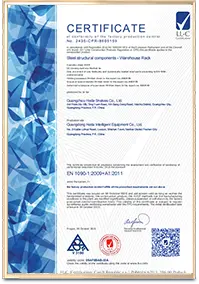
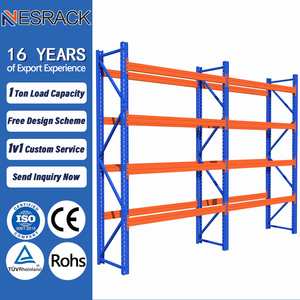
ISO 9001:2015 Quality System
No. 18624Q00169R0M
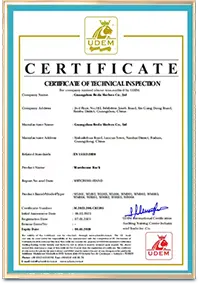
CE Factory Production Control
No. 2435-CPR-8605159
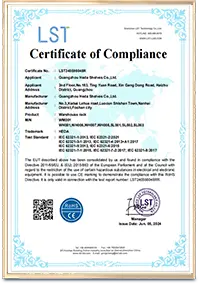
RoHS Eco-Compliance
Heavy Metals & Toxins Free
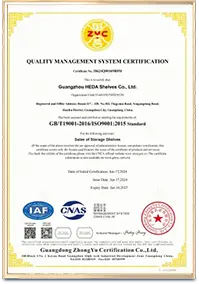
Material & Deflection Reports
Full-Scale Loading Verification
Procurement Intelligence
Frequently Asked Questions: Sourcing High Bay Racking Systems
Engineered answers to critical questions raised by procurement managers, structural engineers, and logistics directors when importing high bay warehouse systems.
What structural steel standards and grades are utilized in your high bay racking production?
Our uprights and heavy-load structural members are fabricated predominantly from prime continuous-cast coils of high-strength structural carbon steel (grades Q235B and Q355B in Chinese GB standards, which directly cross-reference to ASTM A36 / ASTM A572 Grade 50 in North America and EN 10025 S235JR / S355JR in Europe). For extreme vertical heights exceeding 24 meters and seismic zone D/E/F classifications, we utilize custom micro-alloyed steel formulations with minimum yield strengths exceeding 355 MPa (approx. 51,500 psi). Mill Test Certificates (MTCs) detailing tensile strength, chemical composition, elongation percentage, and Charpy impact toughness accompany every ocean freight batch.
How do you support structural permitting and Professional Engineer (PE) seismic stamping in North America and Europe?
We provide a complete structural submittal package tailored for your project. This includes structural finite element analysis (FEA), shop fabrication drawings, anchor bolt shear and pullout tension reaction schedules, baseplate bearing pressure calculations, and beam capacity plaques. Our documentation is formatted to adhere directly to RMI ANSI MH16.1 (Specification for the Design, Testing and Utilization of Industrial Steel Storage Racks), AISI S100 (North American Specification for Cold-Formed Steel Structural Members), and EN 15512. Your local Professional Engineer (PE) or Structural Engineer of Record (SEOR) can review, adopt, and wet-stamp these calculations without requiring time-consuming geometry conversions.
Can your high bay racking accommodate standard 48" x 40" GMA pallets, Euro pallets, and non-standard skids?
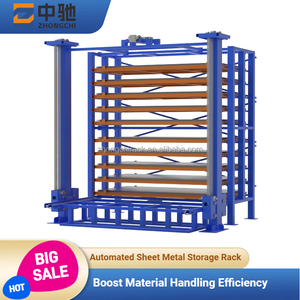
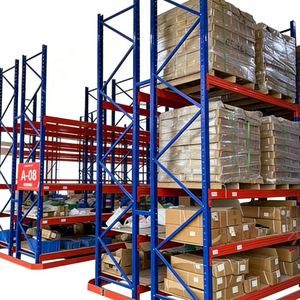
Yes. As an OEM manufacturer, all frame depths, beam clear spans, and wire mesh or structural bar decking dimensions are customized to your exact inventory profile. For standard North American 48" x 40" GMA pallets, we typically supply 42" or 44" deep upright frames paired with 96", 108", or 144" beam lengths. For European operations managing 800 mm x 1200 mm or 1000 mm x 1200 mm EUR pallets, frame depths of 1050 mm or 1100 mm are standard. We also engineer specialized high bay cradles for chemical drums, heavy metal coils, automotive stamping dies, and sheet metal cassettes with integrated positioning guides.
What deflection limitations and tolerances are maintained for AS/RS automated stacker crane interfacing?
For automated AS/RS high bay environments, we design under the strict tolerance guidelines of FEM 9.831 (Design principles of automated storage systems) and FEM 10.2.02. Maximum allowable horizontal frame sway under combined operating and crane dynamic loads is maintained within H/1000 to H/1500 (where H is total height). Beam vertical deflection under full rated pallet loading is constrained to L/200 (or L/300 for sensitive optical sensor cranes). Every upright column is punched on automated continuous lines with hole pitch tolerances within ±0.1 mm over a 10-meter span, ensuring exact vertical alignment for crane guidance top-rails and rack-mounted busbar power tracks.
How are components packed and secured to prevent transit damage during long-distance ocean shipping?
Shipping heavy structural steel across international waters requires engineered container packing protocols. Uprights are bundled with high-tensile steel banding, cushioned with protective corner guards, and separated by corrugated timber dunnage to eliminate metal-on-metal abrasion. Beams are nested with protective interleaving to preserve powder-coat integrity. All pallets and bundles are tagged with weatherproof UV-resistant barcodes that match project erection drawings. Each 20-foot GP, 40-foot GP, or 40-foot HQ container is packed to maximize volumetric cube and gross weight limits while maintaining balanced centers of gravity for safe container yard unloading.
What surface treatment guarantees rust prevention in high-humidity or cold storage environments?
Prior to finishing, every welded and roll-formed steel component undergoes an automatic 7-stage chemical pretreatment line consisting of hot alkaline degreasing, clean water rinsing, industrial acid pickling to eliminate scale and oxides, zinc phosphating to create an anti-corrosion barrier, and demineralized seal rinsing. Components then receive an automated electrostatic application of thermosetting polyester or epoxy powder, cured in an infrared convection oven at 180°C to 200°C for 20 minutes. Total dry film thickness (DFT) measures 60 to 90 microns (μm). For outdoor clad-rack frameworks or blast freezers with aggressive condensation cycles, we also offer hot-dip galvanization conforming to ASTM A123 / ISO 1461 with coating thickness up to 80–100 μm.
What information is required from our engineering team to generate a formal layout and firm quotation?
To provide a preliminary CAD design, 3D visualization, and itemized landed-cost quote within 24 hours, our engineering team requires:
(1) Warehouse architectural drawings indicating clear height below joists, column grids, building slab expansion joints, and overhead door locations;
(2) Pallet specifications including width, depth, overall height (including pallet load), and maximum gross load weight;
(3) Forklift or material handling equipment models, turning radius, and maximum reach height;
(4) Local environmental design loads (seismic zone, wind speed for clad-rack, floor slab thickness and concrete compressive strength f'c);
(5) SKU inventory count and velocity rotation strategy (FIFO versus LIFO).