Direct-from-factory structural steel solutions configured for extreme volumetric storage density, seismic stability, and custom unit-load specifications.
A rigorous engineering breakdown of structural roll-formed profiles, weld joint moment capacities, and Euler column buckling formulas utilized across custom OEM heavy-duty pallet racking systems.
We source prime, certified structural carbon steel coils complying with ASTM A1011 / A572 Grade 50 and Q355B/Q235B metallurgy. These substrates exhibit yield strengths exceeding 355 MPa (51,500 psi) and ultimate tensile ratings above 490 MPa, guaranteeing elastic resilience during seismic sway and dynamic forklift acceleration impacts.
Heavy-duty box beams are built using dual interlocking C-sections continuously robotic MIG-welded to forged multi-claw connector brackets. The mechanical hook engagement provides exceptional rotational stiffness, directly mitigating frame drift and preventing connector shearing under rated torsional load envelopes.
Seismic zoning requires strict dissipation of ground acceleration forces through ductile base assemblies. Our heavy-duty frames integrate enlarged laser-cut baseplates ranging from 8mm to 16mm in thickness, bored for dual chemical capsule or wedge anchors that distribute axial forces into the structural concrete slab.
| Racking Topology | Pallet Selectivity | Aisle Width Requirement | Standard Load / Level | Seismic Zone Readiness | Optimum Industry Use |
|---|---|---|---|---|---|
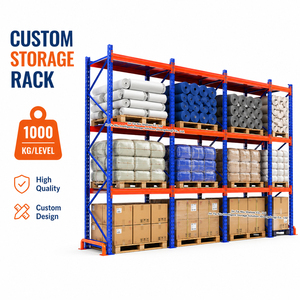
| Selective Pallet Racking | 100% Direct | 3.0m – 3.8m (Counterbalance / Reach) | 1,000 kg – 4,500 kg (2,200 – 9,900 lbs) | Seismic Zones 1 to 4 | FMCG, 3PL Warehousing, Retail Distribution |
| Very Narrow Aisle (VNA) | 100% Direct | 1.6m – 1.9m (Turret Truck / Wire Guided) | 1,000 kg – 3,000 kg (2,200 – 6,600 lbs) | High-Tolerance Superflat Floors | Pharmaceutical, High-Value Spares, E-Commerce |
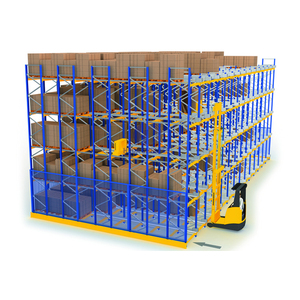
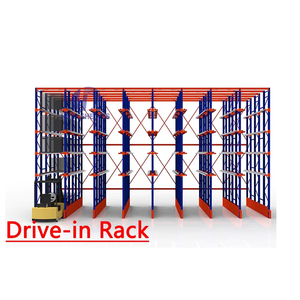
| Drive-In / Drive-Through | LIFO / FIFO Bulk | Single Access or Drive-Through Lanes | 1,000 kg – 2,000 kg / Position | Reinforced Top & Back Bracing | Cold Storage Freezers, Raw Material Staging |
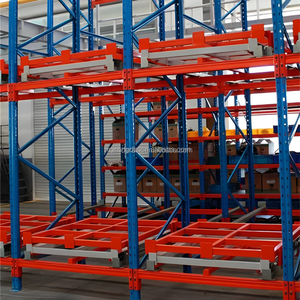
| Push-Back Cart Racking | LIFO (2–6 Deep) | Standard Reach Truck Corridors | 1,500 kg / Cart Tier | Incline Structural Stop Dampening | Beverage Distribution, High-Turnover Batches |
| Radio Shuttle Automation | Hybrid FIFO & LIFO | Minimized Forklift Transfer Aisles | 500 kg – 2,000 kg / Shuttle Run | Structural Rail Tie-Rod Clamping | Automated Cold Chain, Meat, Deep Storage Hubs |
| Automated High-Bay ASRS | 100% Computerized | Crane Mast Track Profiles (1.4m–1.6m) | 1,000 kg – 3,500 kg Unit Loads | Full Dynamic Moment Calculation | Mega-Distribution Centers, Smart Factories |
Strategic logistics executives and supply chain directors are fundamentally changing how heavy-duty warehouse racking is specified, costed, and landed.
Forward-thinking warehouse procurement has evolved past simple raw steel metric tonnage pricing. Buyers now evaluate TCO through the lens of long-term operational resilience, damage frequencies, and modular reconfigurability. High-tensile steel cold-roll formed with narrower thickness profiles achieves equivalent or higher capacity ratings than heavier, low-grade steel, dramatically reducing transatlantic container shipping weights, drayage expenses, and floor slab pressure.
By opting for premium thermoset polyester powder coats with minimum 70–90 micron thickness over multi-stage zinc phosphating, operators save hundreds of thousands of dollars in repainting, rust-remediation, and corrosion-driven upright beam replacements in humid or refrigerated distribution facilities.
Middlemen and catalog distributors often markup imported steel racking by 35% to 65% while introducing communication friction on custom seismic calculations and engineering revisions. Sourcing directly from an established OEM manufacturing campus allows North American engineering teams, integrators, and 3PL contractors to interface directly with the factory structural engineers who run the roll-forming lines.
Direct OEM collaboration facilitates customized column punching layouts (e.g., standard teardrop compatible, 50mm metric, or 76.2mm European pitch), customized beam length optimization to eliminate flue space dead zones, and dedicated container-stuffing software that maximizes 40ft High Cube container volumetric utilization up to 98%.
Global environmental mandates, LEED warehouse certifications, and Scope 3 emissions reporting now dictate capital asset procurement. Modern racking tenders increasingly mandate verifiable carbon foot-printing, utilizing high-recycled-content electric arc furnace (EAF) steel and closed-loop pretreatment lines that eliminate volatile organic compounds (VOCs) and hazardous chemical effluents.
Purchasers are prioritizing suppliers who provide comprehensive Life Cycle Assessments (LCAs) alongside CE construction declarations, guaranteeing that structural assets retain high residual salvage scrap value at the end of building lease tenancies without environmental degradation.
The number-one bottleneck in launching greenfield or brownfield distribution hubs across California, the Pacific Northwest, British Columbia, and earthquake-prone regions is building department permit approvals. Specifiers are shifting their procurement rules to mandate factory-supplied structural calculation packages that are 100% pre-formatted for seamless PE (Professional Engineer) stamping.
Procuring from manufacturers that furnish verifiable material chemistry, mechanical test coupons, and certified moment-rotation curves eliminates months of protracted municipal plan review delays, saving critical lease capital before site occupancy.
From autonomous robotic interfaces to cryogenic metallurgy, explore the structural milestones shaping next-generation industrial pallet storage systems.
Warehouse robotics require tighter manufacturing tolerances than manual forklift operations. Modern rack systems are cold-formed with millimeter-grade positional precision, providing unobstructed laser alignment corridors, reflective marker cutouts, and bottom-level cantilevered transfer stations where Autonomous Mobile Robots (AMRs) interface directly with high-bay buffer racks.
Deep-freeze pharmaceutical and frozen food operations operating at -25°C to -35°C cause traditional carbon steels to transition from ductile to brittle behavior, increasing catastrophic shearing hazards under forklift impact. Emerging metallurgy relies on nickel-alloyed micro-treated steel and thermoset low-cure coatings engineered to retain high Charpy V-notch impact toughness under sub-zero thermal shock.
The cutting-edge frontier of industrial racking features embedded low-power strain-gauge sensors and tri-axis accelerometers mounted to critical upright column bases. These sensors capture live strain fluctuations, warning facility directors of beam overloads, floor settling, or structural column micro-deflections instantly via cloud telemetry before catastrophic progressive rack collapse occurs.
Authoritative technical, commercial, and freight answers addressing compliance, manufacturing tolerances, pallet interface standards, and shipping protocols.
Our structural calculation procedures adhere strictly to the American Rack Manufacturers Institute (RMI) specification ANSI MH16.1 ("Design, Testing and Utilization of Industrial Steel Storage Racks") and European EN 15512 / FEM 10.2.02 codes. Component capacities are validated through physical stub-column testing, upright frame shear tests, and beam-to-column connector moment tests conducted on calibrated universal testing machines.
For North American projects requiring municipal building permits, we deliver comprehensive engineering packages including material mill certs, component sectional properties (cross-sectional area, moments of inertia Ix and Iy, torsional constants), and full load tables specified in imperial units (lbs, inches, feet). These documents are formatted specifically to allow your local Engineer of Record (EOR) to stamp permit calculation sets efficiently.
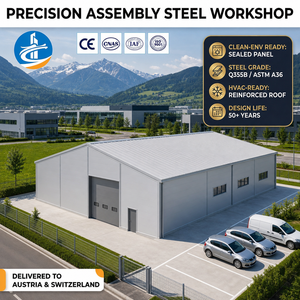
We strictly utilize certified hot-rolled and cold-rolled prime steel coils of Q235B (comparable to ASTM A36) and Q355B (comparable to ASTM A572 Grade 50 / European S355JR). Every coil is verified for yield strength, tensile limits, and elongation before entering the slitting and continuous roll-forming lines.
Surface finishing follows a 10-stage automated pretreatment sequence: chemical alkaline degreasing, twin water wash rinses, acid pickling to eliminate mill scale, immersion zinc-iron phosphating, and deionized water passivating. Components then pass through an automated electrostatic powder coating booth receiving architectural-grade thermoset polyester powder baked at 180°C–200°C. Total film thickness averages 75–100 microns, delivering high cross-hatch adhesion and over 500 hours of continuous salt-spray corrosion resistance (ASTM B117).
Yes. As an authentic OEM manufacturer with custom tooling and automated CNC punching lines, we manufacture fully compatible teardrop punching profiles (2-inch vertical hole pitch interchangeability), as well as 50mm, 75mm, and 76.2mm European and Australasian slot configurations. Whether you require add-on bays to expand an existing facility or need private-label contract manufacturing matching your proprietary upright punch footprint, our tooling team builds custom stamping dies in-house.
For standard North American Grocery Manufacturers Association (GMA) pallets (48-inch depth by 40-inch width), upright frames are engineered at a standard 42-inch depth. This provides the mandatory 3-inch overhang at the front and back load faces, ensuring pallets sit solidly across the structural step beams while accommodating wire mesh decking channels or cross-bar supports.
Beam spans are typically engineered at 96 inches (for 2-pallet positions with 3-inch side clearances) or 108 inches and 144 inches (for 3-pallet configurations with 4-inch column clearances). For automotive, aerospace, or heavy machinery packaging utilizing non-standard skids or steel bins, our engineering department provides custom CAD layouts with calculated flue spaces matching NFPA 13 sprinkler penetration standards.
Standard fabrication lead time for full container loads (FCL) ranges from 15 to 25 business days from final CAD sign-off and color approval. With a monthly production output of 30,000 tons of structural steel, multi-hundred-ton projects can be phased across consecutive container shipments without factory bottlenecks.
To eliminate shipping transit damage, upright columns are nested with corrugated isolation pads and banded with heavy-gauge PET straps onto heavy timber skids. Step beams are packed on specialized nesting pallets with steel protective dunnage corners and moisture-barrier shrink wrap. Fasteners, base plates, shims, and safety locks are crate-packed in labeled, moisture-sealed maritime crates with full itemized packing lists for immediate on-site inventory reconciliation.
All HEDA Shelves industrial racking systems carry a standard 5-year structural warranty against manufacturing defects, weld failures, and material micro-cracking under specified design load ratings. Extended 10-year warranty contracts are available for custom enterprise installations.
Our quality control program operates under ISO 9001:2015 certification (Registration No. 18624Q00169R0M) and European CE Marking (Certificate 2435-CPR-8605159). Quality inspections occur at each manufacturing milestone: automated ultrasonic coil thickness verification, weld penetration macro-etching checks, digital powder coating adhesion cross-cut tests, and random assembly load-deflection verifications. Complete QA inspection dossier reports are submitted with every export Bill of Lading.
Combining heavy manufacturing capacity, rigorous internal quality regimes, and 25 years of global engineering execution since our establishment in 2001.
Founded in 2001, Guangzhou Heda Shelves Co., Ltd. has delivered over 10,000 industrial racking installations globally without structural collapse, earning trusted supplier status among multinational 3PLs and logistics integrators.
Our expansive 30,000 m² (323,000 sq ft) production campus houses 18 automated roll-forming lines, automated laser slitting, robotic continuous welding cells, and high-speed powder coating facilities producing 30,000 tons monthly.
Independently audited and certified under ISO 9001:2015 Quality Management Systems and CE European Construction Products Regulation (CPR 2435-CPR-8605159), guaranteeing verifiable structural steel conformity.
Our 30+ dedicated structural engineers utilize advanced finite element analysis (FEA) and BIM software to return comprehensive CAD layouts, 3D spatial renders, and itemized structural quotations within 24 hours.
We provide full white-label manufacturing for regional racking dealers and warehouse equipment distributors across North America, including proprietary punch dies, custom branded cartons, and specialized color matching.
Located near major maritime hubs, we handle FOB, CIF, DDU, and DDP deliveries to key US and Canadian ports (LA/Long Beach, Houston, Savannah, New York/NJ, Vancouver) with precision container-stuffing software.