Factory Racking & Industrial Shelving Portfolio
Direct manufacturer supply spanning high-density pallet racks, boltless warehouse units, heavy wire mesh, and modular multi-tier platforms.
Procuring storage racking directly from established Chinese manufacturing centers provides global distribution centers, third-party logistics (3PL) providers, and industrial distributors with substantial structural load capacity per dollar invested. Every unit featured below is engineered to comply with international structural safety standards, including ANSI MH16.1 (RMI), FEM 10.2.02, and EN 15512, delivering verified beam deflection thresholds under $L/200$ to $L/300$ parameters.
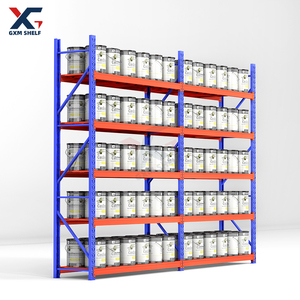 Heavy-Duty Racking
Factory Heavy Duty Metal Shelving Industrial Warehouse Storage Rack Shelf Steel Racking System For Stacking Racks & Shelves
Roll-formed Q235B box beams and upright omega-profiles with 50mm/75mm adjustable connector pitch, engineered for concentrated unit loads exceeding 3,000 kg (6,600 lbs) per pair of beams.
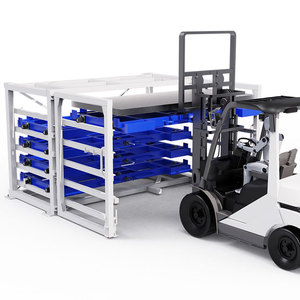 Specialized Sheet Rack
Sliding Shelf Rack Stacking Racks Shelves Sheet Metal Storage Rack Metal Sheet Rack Warehouse Rack Anti-Rust Foldable 6-Layer
Ergonomic drawer-slide cartridge system designed for crane and forklift retrieval of heavy steel sheets, non-ferrous plates, and expensive dies with integrated interlocking safety latches.
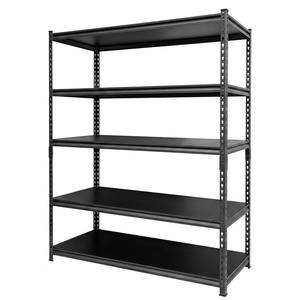 Commercial Display
Burst Silver Finish 5 Shelf Steel Display Storage Rack 200kg Capacity MDF Shelving Unit for Supermarket Goods Shelf
Reinforced hammer-tone burst silver epoxy coating combined with high-density moisture-resistant MDF decks, supporting 200 kg per shelf tier in cash-and-carry retail environments.
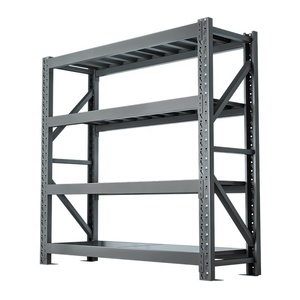 Multi-Purpose Steel
Warehouse Shelves Supermarket Rack Home Furniture Storage Shelves 4/5 Layer Metal Rack Garage Shelves
Precision cold-rolled slotted uprights with interlocking snap-fit corner tie plates, optimized for dense manual pick spaces, automotive dealership parts counters, and maintenance workshops.
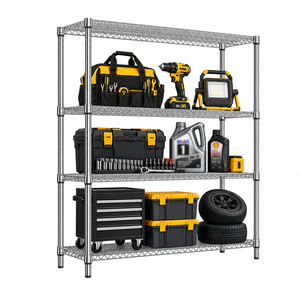 Chrome Wire Shelving
MZG Wholesale Boltless Chrome Garage Organizer Rack Modular 4-Tier Large Heavy Duty Steel Wire Shelving System
Commercial-grade electroplated nickel-chrome wire shelving with trussed wire perimeters, delivering maximum illumination penetration and NFPA sprinkler pass-through for sanitary dry storage.
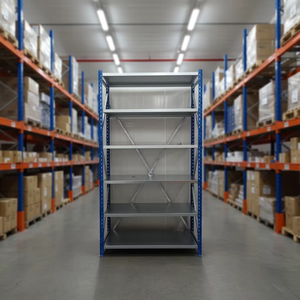 Modular Boltless
Adjustable 5-Layer Boltless/Bottleless Cold Rolled Steel Blue Main Sub Shelving Rack Storage System High Load Capacity Powder
Main-and-add-on modular configuration utilizing precision cold-formed steel frames, toolless butterfly-hole assembly, and multi-rib steel decking panels for high-density bin picking.
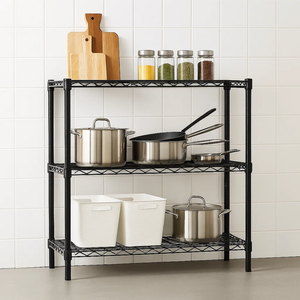 Mesh Utility Racks
Adjustable Heavy-Duty Metal Wire Mesh Shelving Storage System Modern Design Office Furniture Hospital School Workshop Hotel
Zinc-chromate powder-coated wire matrix shelves engineered for healthcare, hospitality, cleanroom, and archive applications where high air circulation and zero dust collection are mandated.
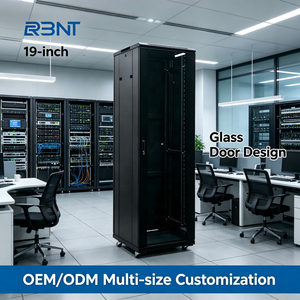 Data Center Racks
High Quality 19inch Server Rack 22u 27u 32u 37u 42u 47u Indoor Network Cabinet Black OEM/ODM
EIA-310-D compliant 19-inch server enclosures fabricated with SPCC cold-rolled steel, featuring vented high-flow mesh doors, dynamic vertical cable conduits, and integrated thermal air control.
Engineering Metallurgy & Structural Design Criteria in Racking Procurement
A rigorous examination of yield strength, cold-forming dynamics, deflection formulas, and seismic design parameters.
When enterprise procurement teams and third-party logistics engineering directors source pallet racking and industrial shelving systems from China, the evaluation must move beyond raw price per kilogram to structural integrity, metallurgy, and fabrication tolerance. Warehouse storage structures are load-bearing civil installations governed by strict deflection criteria and complex stress interactions under static, dynamic, and seismic forces. In direct factory manufacturing, the primary structural raw material is continuous hot-rolled or cold-rolled strip steel, predominantly graded as Q235B and Q355B (GB/T 700 and GB/T 1591 standards), which correlate directly with international grades such as ASTM A36, ASTM A572 Grade 50, and European S235JR / S355JR (EN 10025).
The performance of cold-formed steel uprights—typically rolled into multi-bend open omega ($\Omega$) profiles—relies heavily on work-hardening during the progressive roll-forming sequence. Each bend in the upright column increases the local yield strength of the steel through strain hardening, resulting in a significantly stiffer member capable of resisting torsional-flexural buckling under axial compressive loads. Our structural engineering department calculates load-bearing capacities in strict conformance with the Rack Manufacturers Institute (RMI) Specification for the Design, Testing and Utilization of Industrial Steel Storage Racks (ANSI MH16.1) and European code EN 15512:2020.
A central focus in rack engineering is beam deflection control. Under uniformly distributed loads ($UDL$), beam deflection ($\delta$) is bounded by the standard limitation: $$\delta_{max} \le \frac{L}{200} \quad \text{or} \quad \delta_{max} \le \frac{L}{300}$$ where $L$ represents the clear span of the horizontal step beam or box beam. Excessive deflection not only risks permanent plastic deformation of the connector lugs but can also compromise automatic forklift mast clearance, bind automated storage and retrieval system (AS/RS) shuttle units, and pinch wire mesh decks.
| Racking Architecture | Primary Material Grade | Nominal Yield Strength ($f_y$) | Standard Safety Factor | Optimum Pallet Density | Stock Rotation Strategy |
|---|---|---|---|---|---|
| Selective Pallet Racking | Q235B / Cold-Rolled SPCC | 235 MPa (~34.1 ksi) | 1.67 (RMI) / 1.40 (FEM) | Moderate (100% Selectivity) | FIFO (First-In, First-Out) |
| Drive-In / Drive-Through | Q355B High-Tensile Alloy | 355 MPa (~51.5 ksi) | 1.75 (Reinforced Rail) | Very High (75% Footprint Gain) | LIFO / FIFO Operational |
| Radio Shuttle Automation | Cold-Drawn Precision Q355B | 355 MPa (~51.5 ksi) | 1.80 (Dynamic Cycling) | Ultra-High (Max Cube Use) | Dual FIFO / LIFO Software-Driven |
| Pallet Flow (Gravity Roller) | Q235B + Extruded Alloy Rollers | 235 MPa (~34.1 ksi) | 1.67 (Speed Brake Governed) | High (Deep Lane Velocity) | Strict FIFO Date-Coded |
| Push-Back Nested Cart | Structural Channel + Q235B | 235–355 MPa Combined | 1.70 (Incline Rail Guide) | High (2 to 6 Pallets Deep) | LIFO Multi-SKU Retrieval |
| Rack-Supported Mezzanine | Q235B Box & I-Beam Girder | 235–355 MPa Composite | 2.00 (Occupancy Code Rating) | Vertical Doubling (60–250 psf) | Manual Cart / Each-Pick Access |
Enterprise Strengths: 25+ Years of Specialized Manufacturing Mastery
Inside our Guangzhou campus: Integrated metallurgy, certified powder coating, and rapid imperial engineering.
Founded in 2001, Guangzhou Heda Shelves Co., Ltd. has grown into an international manufacturing force, deploying high-capacity storage installations across 130+ nations. Operating out of an expansive 30,000 square meter (approx. 323,000 sq ft) industrial campus, our plant employs over 300 experienced technical fabricators, structural design engineers, and quality assurance inspectors. With an active monthly capacity exceeding 30,000 metric tons of finished racking steel, we have the industrial bandwidth to execute massive, multi-phased distribution center developments without component delivery delays.
Rapid CAD & 3D Modeling
Deliver your building floor plan, clear height, pallet dimensions, and forklift reach parameters. Our application engineering team generates detailed CAD layouts, load capacity tables, and 3D architectural renders within 24 hours.
Imperial & Metric Dual Engineering
For US, Canadian, and Mexican warehouses, our engineers issue all shop drawings, baseplate anchor spacing, flue clearances, and load plaques in feet, inches, and pounds, ready for local Professional Engineer (PE) seismic stamping.
Chemical Pretreatment & Coating
All cold-formed profiles undergo automated ultrasonic degreasing, acid pickling, zinc phosphating, and electrostatic epoxy-polyester powder coating (60–80 μm), passing 500-hour ASTM B117 salt-spray corrosion tests for cold-chain longevity.
Verified Turnkey Compliance
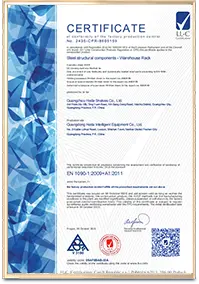
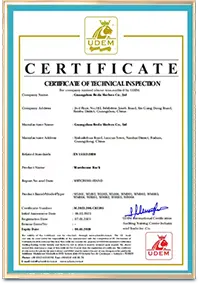
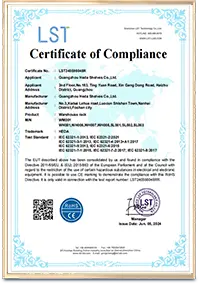
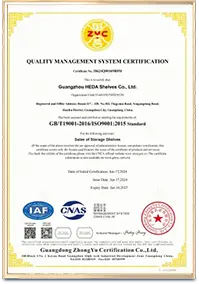
Certified under ISO 9001:2015 (Cert No. 18624Q00169R0M) and European CE Marking (No. 2435-CPR-8605159) for structural construction components, ensuring complete customs clearance documentation and structural reliability.
Rigorous 10-Step Quality Control Manufacturing Sequence
From prime steel coil sourcing to automated profiling and container-stuffed export packaging.
Eliminating dimensional deviation is fundamental to ensuring interlocking stability on site. Our manufacturing plant operates integrated CNC roll-forming lines with continuous optical alignment. Every beam connector lug, column tear-drop punch, and splice plate is formed to within tight ISO 2768-m tolerances, minimizing onsite erection friction and field welding.
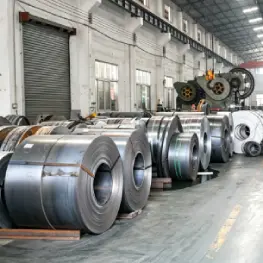
Spectrometric verification of Q235B/Q355B coils for yield, elongation, and carbon chemistry.
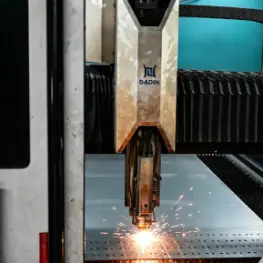
High-speed rotary shear slitting wide master coils into exact profile development strip widths.
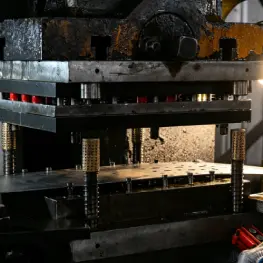
High-tonnage continuous hydraulic punching producing precise 50mm/75mm connector pitch patterns.
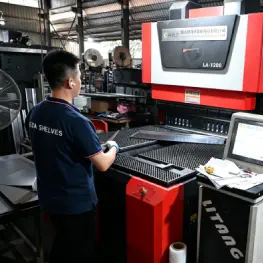
Progressive cold-roll deformation through 18–24 roller stands, optimizing cold-work hardening.
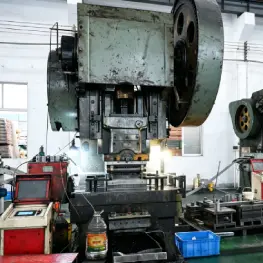
Continuous roll-forming of high-moment uprights and twin-interlocking seam welded box beams.
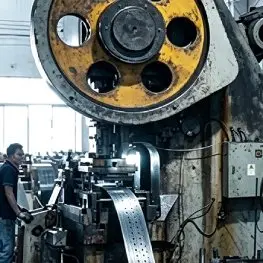
Mechanical edge-conditioning and laser cut deburring to eliminate micro-cracks and rough edges.
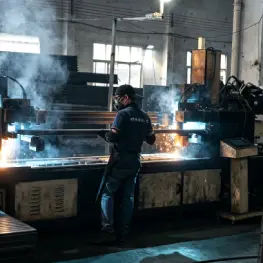
Automated CO₂/MIG robotic welding of 3-to-5 lug beam connectors and heavy structural baseplates.
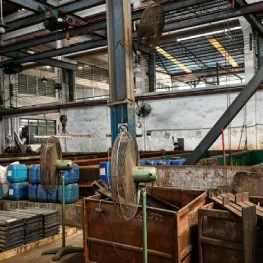
Hot alkaline wash, acid rust removal, and immersion zinc phosphating ensuring coating adhesion.
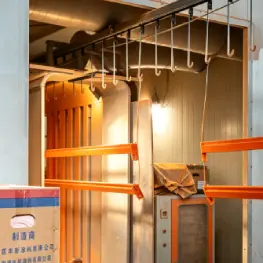
Automated powder spray deposition followed by 200°C convection curing to achieve 60–80 μm dry film.
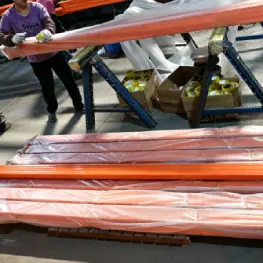
Cross-directional strapping, dunnage cushion packing, and barcode piece labeling for fast site assembly.
Accredited Certifications & Quality Traceability
Documented verification for vendor qualification, safety audits, and municipal building permitting.
Future Procurement & Technological Trends in Rack Engineering
Strategic macro factors influencing warehouse design, automation readiness, and global steel sourcing.
Global supply chain infrastructure is undergoing a massive transformation driven by rapid industrial e-commerce expansion, rising urban land prices, and automation retrofits. As distribution network directors assess storage assets, four strategic technological and procurement shifts are reshaping the racking industry through 2030:
1. AMR & AS/RS Hybrid Racking
Traditional static wide-aisle racks are rapidly giving way to dense automated storage structures. Systems must now incorporate sub-millimeter beam deflection allowances, floor guide rails, integrated busbar electrification, and rack-supported runways for Autonomous Mobile Robots (AMRs) and automated 4-way radio shuttles.
2. Landed TCO Optimization
Enterprise buyers are transitioning from simple FOB metric-ton pricing to comprehensive landed Total Cost of Ownership (TCO) models. Direct-from-factory partnerships that optimize 40ft HQ ocean container stuffing density (averaging 25–26 metric tons per container) deliver 28% to 42% cost savings versus domestic Western brands.
3. High-Strength Micro-Alloys
The transition toward high-yield micro-alloy steels (Q355B and specialized cold-formed boron-titanium treated alloys) allows manufacturers to decrease profile wall thickness while retaining ultimate moment capacity. This reduces overall deadweight by 12–18%, significantly cutting intercontinental ocean freight costs and carbon footprint.
4. Smart Structural Health Sensors
Modern mega-DCs increasingly demand integrated structural impact monitoring. Upright column protectors are being retrofitted with low-power wireless IoT accelerometers and strain gauges that detect and flag accidental reach-truck collisions before undetected micro-buckling can cause catastrophic progressive collapse.
Frequently Asked Questions: Global Industrial Sourcing & Compliance
Essential guidance on building permits, ocean shipping logistics, seismic factors, and custom fabrication.
Our engineering department designs to ANSI MH16.1 and local International Building Code (IBC) provisions using your site’s mapped spectral response accelerations ($S_s, S_1$). We provide structural design calculation packets, baseplate anchor pull-out calculations, and dimensional drawings prepared for immediate review, approval, and wet-stamping by your local jurisdictional Professional Engineer (PE).
Yes. Our standard selective rack configurations use 96-inch (2,438 mm) or 108-inch (2,743 mm) beam spans designed specifically to support two standard 48" x 40" Grocery Manufacturers Association (GMA) pallets with standard 3-inch side clearances. Standard upright depths of 42 inches (1,067 mm) provide the required 3-inch pallet front-and-rear overhang mandated by fire and material handling standards. Custom Euro (1200 x 800 mm) and Asian (1100 x 1100 mm) layouts are regularly fabricated.
Racking profiles undergo specialized nesting and bundling with heavy-gauge PET strapping, corrugated edge protectors, plastic stretch encapsulation, and timber dunnage blocks. To prevent moisture condensation (container sweat) and oxidation during 25–40 day ocean transit, high-absorption desiccant bags are distributed throughout every 40-foot HQ container. Uprights and beams are labeled with color-coded bundle tags matching site installation drawings.
Standard factory production lead time for orders between 2 and 10 full container loads (FCL) ranges from 18 to 25 calendar days following signed CAD approval. Ocean shipping transit takes 14–18 days to US West Coast ports (Los Angeles/Long Beach), 24–30 days to US East/Gulf Coast ports (Houston, Savannah, New York), and 22–28 days to Western European ports (Rotterdam, Hamburg, Valencia).
We operate fully automated electrostatic powder coating lines capable of matching any RAL or Pantone industrial color code (such as Safety Orange RAL 2004 for beams and Signal Blue RAL 5005 for upright frames). We apply high-durability epoxy-polyester architectural powders that resist chalking, chipping, and chemical detergent degradation, holding film thickness within a uniform 60 to 80 microns.
Every shipment includes an itemized Commercial Invoice, Packing List with piece weights, Clean on Board Ocean Bill of Lading, Certificate of Origin (Form A/RCEP where applicable), ISO 9001 and CE Mill Test Certificates (MTC) conforming to EN 10204 Type 3.1, and an assembly hardware manual complete with component exploded views and tightening torque tables.
Yes. For distribution facilities handling heavy dies, beverage kegs, lumber, or high-risk forklift impact environments, we manufacture structural racking utilizing hot-rolled C-channels and structural I-beams. Structural racks feature thick bolted beam connections and reinforced structural baseplates capable of enduring severe impact without loss of vertical load-bearing capacity.
We provide a comprehensive 5-year structural warranty on all industrial pallet racking, drive-in systems, cantilever racks, and mezzanine structures installed in accordance with our engineering drawings and operated within specified load limits. We also stock standard replacement upright components and beam connectors for immediate dispatch to support ongoing operational maintenance.