Factory-Direct Heavy Duty Racking Systems & Storage Assets
Precision-manufactured from high-tensile Q235B and Q355B cold-rolled steel. Each system is dynamically modeled in 3D CAD/FEA and custom-tailored to North American GMA pallets, European CEN standards, and specialized high-bay warehouse footprints.
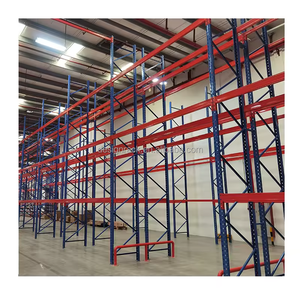
Heavy Duty Shelving Storage Easy Assemble Material Racking Unit Industrial Pallet Rack Solution
- Load Rating: 1,000–3,000 kg / level
- Upright Pitch: 50 mm / 75 mm adjustable
- Connector: 3/4-claw rivet locking pin
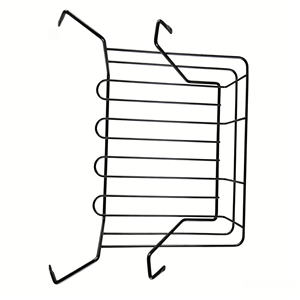
Custom Wire Form Shelf Carbon Steel Cold-drawn Wire Rack Spot Welded Storage Mesh
- Material: Cold-drawn wire Q195/Q235
- NFPA 13: 70%+ water penetration
- Capacity: 500–1,500 kg UDL
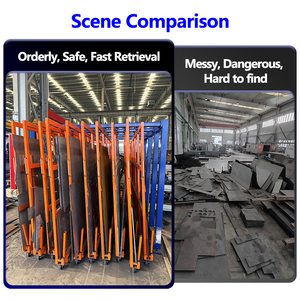
Constant Heavy Duty Powder Coated Multi-Level Adjustable Vertical Storage Racks Stackable
- Installation: Zero-bolt modular stack
- Tier Height: 3 to 5 levels nestable
- Finish: Outdoor thermoset epoxy
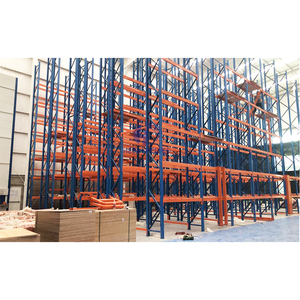
Industrial Adjustable Beam Shelving Heavy Duty Steel Selective Pallet Rack 2000-4000Kg
- Frame Load: Up to 24,000 kg total
- Beam Span: 2,300–3,900 mm custom
- Standards: ANSI MH16.1 & ISO 9001
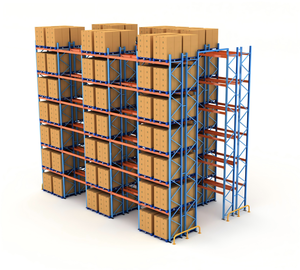
Factory Selling Industrial Heavy-Duty Steel Warehouse Pallet Storage Multi-Layer Racking
- Configuration: Single/Double deep runs
- Forklift Aisle: 2.8 m to 3.5 m reach truck
- Deflection: Exceeds 1/200 standard
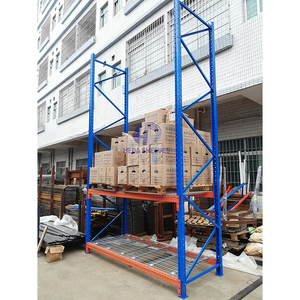
High Bay Heavy Duty Selective Pallet Racking System for Tall Warehouses & Logistics Hubs
- Max Height: Up to 18–30 meters
- Aisle Width: 1.6–1.8 m (VNA Wire Rail)
- Utilization: +45% volumetric cube
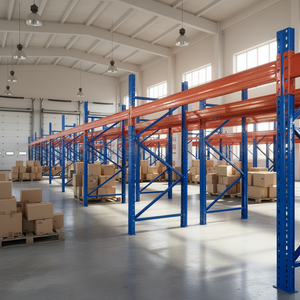
Warehouse Heavy Rack Pallet Rack Store Shelf Multi-Tier Factory Logistics Racking System
- Flexibility: Pallet base + hand-pick tiers
- Decking: Steel flanged / wire / solid
- Corrosion: ASTM B117 500-hr salt spray

AS/RS Automated Storage and Retrieval System High Bay Heavy Duty Pallet Racking Solution
- Integration: Stacker crane guide rails
- Tolerances: Tight FEM 9.831 limits
- Speed: Up to 240 m/min travel
Engineering Standards, Steel Metallurgy, and Global Supply Chain Economics
In modern industrial logistics, selecting a warehouse heavy-duty pallet racking system is no longer merely a commodity purchasing task. It has transformed into a high-stakes structural engineering decision that directly impacts facility safety, continuous throughput velocity, seismic resilience, and multi-decade CAPEX returns. Global distribution hubs, multi-client 3PL campuses, cold storage freezers, and automotive distribution networks face unprecedented industrial land inflation. As clear heights ascend from historical 24-foot averages to contemporary 36-to-45-foot ceilings, the load-bearing requirements placed upon racking columns, baseplates, and beam-to-column connections have risen exponentially.
Top Chinese racking manufacturers—epitomized by enterprise pioneers such as Guangzhou Heda Shelves Co., Ltd. (operating continuously since 2001)—have systematically reshaped global material handling procurement. By integrating localized upstream raw material access with high-capacity continuous cold roll-forming lines, automated CNC progressive punching, robotic welding cells, and eco-friendly electrostatic thermosetting powder coat lines, tier-one Chinese factories now supply international EPC contractors and warehouse owners with systems that match or surpass European (EN 15512, FEM 10.2.02) and American (ANSI/RMI MH16.1) benchmarks at a 25% to 40% reduction in total capital expenditure.
Structural Metallurgy Note (Information Gain Insight): A critical differentiator between commercial-grade utility shelving and certified industrial heavy-duty racking lies in the continuous yield strength ($F_y$) of the raw structural coils. Tier-1 Chinese exporters strictly employ Baosteel or Ansteel certified Q235B ($F_y \ge 235 \text{ MPa}$, ultimate tensile $370\text{–}500 \text{ MPa}$) and Q355B ($F_y \ge 355 \text{ MPa}$, ultimate tensile $470\text{–}630 \text{ MPa}$) structural carbon steels. For cold-chain environments reaching -30°C (-22°F), fine-grained steel chemistries with guaranteed Charpy V-notch impact energy values prevent catastrophic low-temperature brittle cleavage fracture.
This technical whitepaper provides logistics directors, structural engineers of record (EOR), operations consultants, and procurement managers with a comprehensive, data-backed foundation for qualifying, evaluating, and purchasing heavy-duty racking systems from premier Chinese factories and exporters.
Structural Comparison: Heavy Duty Racking Topology vs. Operational Efficiency
Selecting the optimal racking topology demands balancing selectivity, volumetric cube utilization, forklift travel cycles, and load turnover speed. The matrix below benchmarks key engineering parameters across primary industrial racking configurations produced by Chinese manufacturers:
| Racking Topology | Pallet Selectivity | Floor Utilization | Deflection Limits | Aisle Width Reqd. | Inventory Principle | Best Industrial Fit |
|---|---|---|---|---|---|---|
| Selective Pallet Racking | 100% Direct Access | 35% – 40% | L/200 Under Max UDL | 3.0m – 3.8m Standard | FIFO / Random SKU | General 3PLs, E-Commerce, Retail FMCG |
| Double-Deep Pallet Rack | 50% Direct Access | 50% – 58% | L/200 Standard | 3.1m – 3.5m Reach | LIFO (Modified) | Dry Groceries, Fast-Moving Electronics |
| Drive-In / Drive-Through | Low (Lane Selective) | 65% – 75% | Cantilever Rail Limit | Dedicated Drive Lane | LIFO (Drive-In) / FIFO | Cold Storage Freezers, Batch Chemical Drums |
| Radio Shuttle Automation | High Lane Density | 75% – 85% | L/400 High Precision | Forklift Transfer Aisle | FIFO & LIFO Flexible | Food Processing Freezers, Beverage Distribution |
| Gravity Pallet Flow | Face Selective | 65% – 75% | Brake Roller Control | Dedicated In/Out Aisles | Strict FIFO Enforced | Perishables, Pharmaceutical Cold Chain |
| Heavy Duty Cantilever | 100% Unobstructed | Variable by Arm | L/180 Tip Deflection | 3.5m – 4.5m Sideload | Direct Access | Lumber, Steel Tubes, Extrusions, Sheet Drywall |
| AS/RS High-Bay Racking | 100% Automated | 85% – 92% | L/750 – L/1000 Tight | 1.5m – 1.8m Stacker Crane | Digital Automated | Mega Distribution Hubs, 24/7 Production Plants |
Guangzhou Heda Shelves Co., Ltd.: Manufacturing Engineering Excellence
With an established production footprint dating back to 2001, Guangzhou Heda Shelves Co., Ltd. has served as an authoritative backbone for global warehouse infrastructure. Our expansive 30,000 square-meter (approx. 323,000 sq. ft.) facility in Guangzhou, China, deploys high-speed precision manufacturing systems that solve the structural, logistical, and commercial pain points commonly faced by international importers.
Free 3D & CAD Engineering in 24 Hrs
Our dedicated team of civil and logistics engineers produces fully dimensioned plan views, structural elevations, flue space layouts, and imperial-unit 3D models within 24 hours of receiving site drawings.
Independently Certified Compliance
Fully certified under ISO 9001:2015 Quality Management (Cert No. 18624Q00169R0M), CE Marking (No. 2435-CPR-8605159), and non-toxic RoHS coatings, satisfying North American and European regulatory gatekeepers.
Containerized Nesting & Ocean Protection
We maximize 40-foot HQ container fill rates up to 98% through modular nesting, edge-wrap steel bundling, desiccants, and anti-scuff foaming, eliminating transit vibration damage across transpacific voyages.
Our in-house 10-step fabrication chain controls raw coil precision slitting, high-tonnage automated column punching, continuous multi-roller cold profiling, robotic connector welding, five-stage pickling and phosphating, and electrostatic powder coating. This end-to-end integration produces components with minimal residual stress and dimensional deviations under ±0.5 mm, ensuring seamless on-site bolt-together assembly without field re-drilling.
Future Procurement Trends in Heavy-Duty Racking (2026–2035)
Global logistics operations are navigating dynamic shifts driven by labor scarcity, land constraints, and supply chain volatility. Purchasing directors must anticipate macro changes when issuing Requests for Proposals (RFPs) for storage infrastructure over the next decade:
1. Automation-Ready Hybrid Structuring
Warehouses are no longer designed solely for human-operated counterbalanced forklifts. Modern buyers demand hybrid upright profiles ready for retrofitting with autonomous mobile robots (AMRs), automated guided vehicles (AGVs), or high-speed radio shuttles without structural tearing or full replacement.
2. Green Steel & Embodied Carbon Tracking
Tier-one global brands now mandate Environmental Product Declarations (EPDs). Chinese mills and tier-1 racking exporters are transitioning to electric arc furnace (EAF) recycled scrap steel and solvent-free, non-VOC powder coatings to dramatically lower Scope 3 supply chain carbon accounting.
3. Total Landed Cost (TLC) Modeling
Sophisticated procurement teams are abandoning simple "per-bay FOB quotation" comparisons. Sourcing evaluations now employ Total Landed Cost (TLC) matrices incorporating container volumetric stuffing densities, duty mitigations, tariff classification codes (HTS 7308.90), and localized EOR stamp readiness.
Furthermore, the acceleration of e-grocery fulfillment has driven massive investment into multi-tier rack-supported pick modules and structural mezzanines. By utilizing vertical clear height to construct three-to-four-story picking floors above conventional selective lower tiers, operators double or triple pick-face availability while bypassing the municipal tax reassessments associated with expanding warehouse physical footprints.
Product Development Trends: Structural Metallurgy, Micro-Alloying & Smart Racks
The structural design of heavy-duty warehouse racking is experiencing continuous mechanical evolution. Racking is no longer considered static iron; modern systems incorporate advanced cold-formed engineering principles to maximize weight-to-strength ratios:
Micro-Alloy High-Strength Steels
Transitioning from standard low-carbon coils to micro-alloyed structural formulations containing vanadium, titanium, and niobium yields higher ultimate tensile strength. This reduces steel profile wall thickness while retaining strict moment of inertia requirements, decreasing dead weight loads on foundation slabs.
Smart Impact Telemetry & IoT Strain Gauges
Integration of low-power IoT structural health sensors embedded within critical upright column footings. These devices continuously record impact shocks from forklift masts and transmit structural displacement data directly to cloud-based Warehouse Management Systems (WMS).
Dual-Lock Interlocking Beam Connectors
Advanced beam end-connectors featuring cold-stamped 4-to-5-claw wrap designs with automatic spring-loaded visual safety pins. This configuration resists vertical dislodgement forces exceeding 5,000 lbs under accidental forklift upward snagging, complying with OSHA and RMI safety criteria.
Additionally, high-bay automated warehouses reaching up to 40 meters (130 feet) utilize "rack-supported building" (clad-rack) engineering. In these configurations, the heavy-duty racking skeleton supports not only the palletized payloads, but also the external wall paneling, roof trusses, insulation envelopes, and wind/snow environmental loads, eliminating the need for independent pre-engineered structural steel buildings.
Frequently Asked Questions: Sourcing Heavy-Duty Racking from China
Detailed technical answers addressing compliance, engineering verifications, seismic permitting, and international freight logistics for commercial procurement teams.
How do Chinese factories ensure compliance with US RMI (ANSI MH16.1) and European EN 15512 standards?
Top exporters engineer their components specifically around international cold-formed steel specifications (such as the American AISI S100 and European Eurocode 3 Part 1-3). Manufacturers perform mechanical testing on upright-and-beam assemblies, including stub-column compression tests, beam end-connector rotational stiffness (looseness) testing, and shear tests.
HEDA Shelves provides raw mill test certificates (MTRs) confirming chemical composition and elongation, along with complete structural calculation packages compatible with review by your local registered Professional Engineer (PE) or structural Engineer of Record (EOR).
Can load capacity charts and engineering drawings be issued in Imperial units (lbs, ft, inches)?
Yes. Tier-one Chinese exporters maintain engineering teams proficient in both metric and imperial measurement standards. All layout drawings, structural elevations, beam load tables (expressed in pounds per pair), and upright column capacity charts (at specified vertical beam spacing) are issued in imperial units to streamline municipal permitting, fire marshal reviews, and local installation workflows.
How are seismic baseplates and slab anchor bolts calculated for high seismic risk zones?
For installations in designated seismic areas (such as US West Coast Seismic Design Categories D, E, and F, or earthquake-prone Pacific Rim regions), baseplates are custom-engineered with increased thickness (typically 8 mm to 16 mm structural plate) and expanded footprint dimensions.
Chinese engineering teams analyze localized spectral acceleration values ($S_s, S_1$), soil site classes, and building risk categories to specify the required quantity, diameter, and embedment depth of high-strength mechanical wedge or chemical adhesive anchors.
What anti-corrosion pretreatment and powder coating finishes are utilized for harsh environments?
Industrial racking steel undergoes multi-stage surface preparation, including chemical degreasing, acid rust-stripping pickling, and micro-crystalline zinc phosphating. This forms an anti-corrosion conversion layer prior to powder application.
Components then pass through automatic electrostatic spray booths applying thermosetting epoxy-polyester hybrid powder coats (cured at 180°C to 200°C), achieving dry film thicknesses of 60 to 90 microns. For outdoor lumber yards or chemical storage, hot-dip galvanizing (HDG) per ASTM A123 or ISO 1461 guarantees decades of atmospheric protection.
What is the standard manufacturing lead time and ocean container shipping optimization?
Standard fabrication lead times range between 15 and 25 calendar days for volumes spanning 1 to 10 standard 40-foot High Cube (HQ) containers. Because racking steel is heavy and dense, shipping efficiency depends on maximizing weight limits without exceeding ocean carrier constraints (typically 26 to 28 metric tons per container).
Beams, upright frames, and wire decking are nested and bundled with reinforced steel strapping, timber battens, and protective edge angles to allow rapid offloading using standard forklifts at the destination warehouse.
How does the factory support warehouse permitting and third-party PE structural stamping?
Factories supply structural engineers with component section properties (cross-sectional area, moments of inertia $I_x, I_y$, section moduli $Z_x, Z_y$, torsional constants, and raw yield strengths). These technical packages provide the structural inputs needed for your domestic structural engineer to run finite element models and execute local building department PE stamps for city permits.
Engineering Checklist for Issuing a Warehouse Racking RFP
To eliminate scope ambiguity and secure precise, apples-to-apples structural quotations from tier-one Chinese racking exporters, procurement managers should compile the following data points before requesting engineering tenders:
| Critical Specification Category | Required Input Data & Engineering Parameters | Structural Impact on System Design |
|---|---|---|
| 1. Slab & Building Envelope | Concrete slab compressive strength (e.g., 3,000–4,000 PSI), slab thickness (6"–10"), reinforcement mesh type, clear height to lowest sprinkler head or obstruction. | Determines baseplate anchor expansion loads, maximum allowable single-leg upright point loads, and total permissible upright frame heights. |
| 2. Pallet Unit Load Profiles | Pallet dimensions (W × D × H including cargo overhang), maximum gross pallet weight, pallet material (wood GMA, plastic, steel), bottom board direction. | Governs horizontal beam clear span lengths, beam profile heights (step vs. box), frame depth calculation (e.g., 42" deep frame for 48" deep pallet), and pallet support configurations. |
| 3. Material Handling Equipment (MHE) | Forklift make/model, mast collapsed height, maximum lift height, right-angle stacking aisle requirement, outrigger base leg dimensions. | Establishes operational clear aisle widths, bottom beam elevation requirements, rack entry protector spacing, and top-tier loading clearances. |
| 4. Seismic & Environmental Codes | Site geographical coordinates, local building code edition (IBC 2021/2024, NFPA 13, Eurocode), soil site class, indoor temperature ranges (-30°C cold chain vs. ambient). | Directs horizontal/diagonal upright bracing patterns, anchor bolt grade and embedment, steel alloy impact toughness selection, and transverse/longitudinal flue space design. |