Industrial Flow Storage Whitepaper & Procurement Hub

China Top Flow Through Racking Factories & Exporter

Direct manufacturing excellence from Guangzhou since 2001. Supplying high-throughput gravity flow, carton live storage, and structural dynamic racking engineered for North American and European logistics standards.

Direct-From-Factory Portfolio

Engineered Dynamic Flow Racking & High-Density Storage Solutions

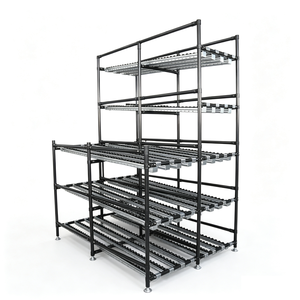
Manufactured using certified structural Q235B cold-rolled steel, custom roller track pitches, and heavy-duty brake controllers to maintain flawless FIFO inventory rotation.

2001.
Established Year
25+ Years Industrial Racking Leadership
10,000+
Global Projects Delivered
Installed Across North America, Europe & SEA
30,000t
Monthly Steel Output
High-Throughput Continuous Roll-Forming Lines
323,000sq ft
Manufacturing Campus
Guangzhou Facilities Certified ISO9001 & CE
Technical Whitepaper

Engineering Principles of Flow-Through Racking Systems

A rigorous examination of physics, mechanics, and lean inventory rotation powering modern first-in, first-out (FIFO) logistics operations.

Gravitational Kinematics & Pitch Precision

Flow through racking relies on controlled gravity slope mechanics. For standard carton flow, an engineered pitch between 2.5% and 4.0% guarantees uninterrupted glide without velocity runaways. For heavy pallet flow systems carrying GMA 48"x40" loads up to 1,500 kg, slope is rigorously calculated between 1.5% and 2.0%. Dynamic speed controllers and eddy-current brake rollers dissipate kinetic momentum to eliminate impact shock at the discharge face.

Strict FIFO Traceability & SKU Density

Unlike selective racking which demands 50% dedicated aisle footprints, or Drive-In racking that forces Last-In, First-Out (LIFO) indexing, flow through storage cleanly segregates replenishment aisles from retrieval zones. This eliminates forklift traffic congestion, protects operators in pick aisles, and delivers 100% strict First-In, First-Out expiration control essential for pharmaceutical, chemical, and perishables distribution.

Structural Metallurgy & Beam Deflection

Every dynamic upright frame and step-beam is cold-roll formed from certified high-tensile Q235B structural steel. In compliance with RMI (Rack Manufacturers Institute) and EN 15512 specifications, load beam deflection is constrained below L/180 (or L/240 under automated picking guidelines). Automated 10-step pickling, phosphating, and electrostatic epoxy coating ensure resistance to warehouse humidity and cooler room moisture.
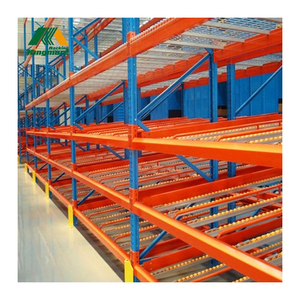
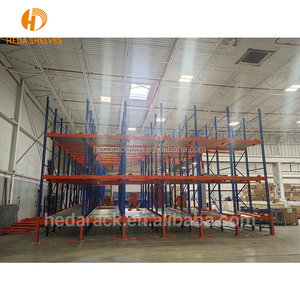
Storage Racking System Pallet Density Index Inventory Rotation Footprint Space Utilization Labor Efficiency Gain Optimal Industry Application
Pallet Flow (Gravity) Extreme (Up to 25 Pallets Deep) Strict FIFO 85% - 90% +45% Rapid Throughput Cold Storage, Food & Beverage, FMCG
Carton Flow (Roller Beds) High (Multi-Track Split Case) Strict FIFO 75% - 85% +60% Pick Speed E-commerce Fulfilment, Auto Spares, Pharma
Drive-In Storage Very High (8-10 Deep) LIFO 70% - 80% -15% (Aisle Congestion) Single-SKU Bulk, Seasonal Overflow
Push-Back Racking Moderate (2-6 Deep Carts) LIFO 70% - 75% +20% Over Selective Wholesale Distribution, Staging Buffers
Standard Selective Low (Single Deep) Any (Manual Manage) 40% - 50% Baseline Reference High SKU Proliferation, Low Turnover
Strategic Market Insights

Future Procurement Trends in Flow-Through Intralogistics

Global warehouse operators and distribution networks are adapting their racking procurement strategies to keep pace with rapid warehouse automation.

Integration with AMR & Autonomous Picking

By 2027, over 40% of tier-one distribution hubs will deploy Autonomous Mobile Robots (AMRs) directly interfacing with carton flow discharge tiers. Future flow racking procurement demands high-precision roller track alignments, magnetic lane guidance channels, and zero-deflection stop plates engineered specifically to facilitate robotic suction and gripper arms without manual intervention.

Smart IoT Sensors & Pick-to-Light Synergy

Static flow racking is rapidly evolving into dynamic IoT nodes. Modern carton flow systems are increasingly ordered with pre-punched wiring ducts, optical sensor brackets, and digital displays. Real-time depletion alerts send instant replenishment triggers to upstream automated storage systems (ASRS), cutting pick-face stockouts down to near zero in high-velocity fulfillment environments.

Cold Chain Optimization & Green Warehousing

With freezer real estate costing up to four times more per cubic foot than dry ambient storage, flow racking procurement is pivoting rapidly toward zero-power gravity storage. Replacing energy-draining powered conveyors with maintenance-free gravity roller lanes slashes operational kilowatt consumption while ensuring ultra-dense product cubes in temperature zones down to -30°C.

Enterprise Reliability

Why Enterprise Buyers Partner with HEDA Shelves

Combining 25+ years of heavy manufacturing mastery with turnkey export engineering, transparent pricing, and comprehensive project support.

Free 24-Hour CAD & 3D Calculations

Our licensed structural engineers generate fully dimensioned CAD floor layouts, clearance elevations, and 3D visual renderings within 24 hours. Load calculations can be issued directly in imperial units (lbs, in, ft) or metric equivalents, pre-engineered for your local professional engineer (PE) seismic and permit reviews.

Verified ISO 9001 & CE Quality

Every production batch complies with European standard CE (2435-CPR-8605159) and ISO 9001:2015 quality frameworks. From raw coil micrometer inspections to ultrasonic weld verifications and cross-hatch powder adhesion testing, our QC ensures fail-safe integrity in heavy-duty distribution environments.

Container-Optimized Ocean Packaging

Exporting direct to major ports across North America (Los Angeles, Houston, Savannah, New York, Vancouver) and Europe. Upright bundles and roller tracks are strapped with heavy protective dunnage and waterproof wrapping, maximizing container cube density and eliminating maritime transit damage.

Procurement Clarity

Frequently Asked Questions on Flow Racking Procurement

Essential engineering, logistics, and compliance details to streamline your supplier qualification and project design.

How do you calculate the correct incline angle for carton and pallet flow racks?
Slope calculation depends directly on package weight, base rigidity, and roller diameter. For standard cardboard boxes, we generally engineer a slope gradient between 2.5% and 3.5%. Plastic totes with reinforced rigid flat bottoms move on a gentler 2.0% to 2.5% incline. For pallet flow racks carrying wooden GMA pallets, slope is tuned to 1.5% - 2.0%. We conduct custom empirical slip tests in our factory testing bay using sample packaging provided by clients to guarantee predictable flow speeds.
What load certifications and steel documentation are provided for permitting?
We provide comprehensive mill test certificates (MTC) verifying the chemical and physical properties of certified Q235B steel coil. Every project file includes structural shop drawings, beam load tables, weld certifications, and third-party ISO 9001 / CE compliance certificates. These technical packets are structured specifically to support review and stamping by your local engineer of record (PE) for municipal building permits and seismic compliance.
Can flow through racks accommodate both wooden pallets and plastic totes?
Yes. We engineer versatile dual-purpose and multi-lane systems. For light to medium cartons and totes, we supply heavy-duty placon tracks or multi-wheel polypropylene roller beds with drop-in sheet metal lane dividers that reconfigure in seconds without tools. For pallet loads, continuous full-width steel rollers or heavy three-rail wheel tracks are customized to interface with traditional two-way, four-way, and perimeter-base pallets.
What is the typical production lead time and export delivery cycle?
Following written engineering approval of CAD shop drawings, manufacturing for standard 20ft or 40ft high-cube container orders requires approximately 15 to 25 business days. Ocean transit to US West Coast ports (Los Angeles/Long Beach) typically spans 14 to 18 days; East Coast ports (Savannah/New York) span 28 to 35 days. CIF, FOB, and DDP project arrangements are readily supported with end-to-end export documentation.
How do brake rollers function on heavy pallet flow lines?
On deep-lane pallet flow beds (3 to 20+ pallets deep), centrifugal speed controller rollers are placed at intervals of roughly one pallet length. These rollers remain disengaged at low speeds. When an advancing pallet exceeds nominal glide velocity (typically above 0.3 m/s), internal centrifugal weights engage internal brake pads against the roller drum, restricting pallet velocity to a controlled, safe crawl regardless of pallet weight variance.
Can flow levels be retrofitted into existing selective pallet rack uprights?
Yes. Our carton flow tracks and bed assemblies can be manufactured with universal step-beam hanger brackets and teardrop-compatible adapter clips. This allows operators to easily retrofit high-density dynamic carton flow pick-faces into existing selective racks, immediately freeing up lower floor levels for rapid manual piece-picking without altering existing upright structural infrastructure.

Accelerate Your Throughput with Factory-Direct Flow Systems

Connect directly with our senior application engineers to obtain an optimized CAD layout, detailed structural load calculations, and a competitive landed factory quote within 24 hours.