High-Performance Pallet Racking & Industrial Systems
Manufactured on high-speed CNC punching and roll-forming complexes. Optimized for seamless FIFO/LIFO turnover, high-density warehousing, dynamic roll storage, and deep seismic resilience.
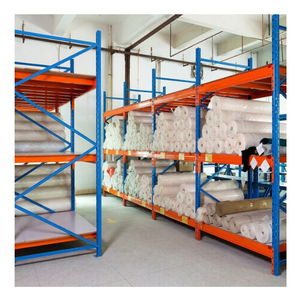
DJ Industrial Heavy Duty Steel Adjustable Warehouse Racking System For Fabric Roll Textile Material Storage
Engineered saddle supports and cradle beams prevent roll flattening, optimizing fabric and carpet roll handling with dedicated fork clearances.
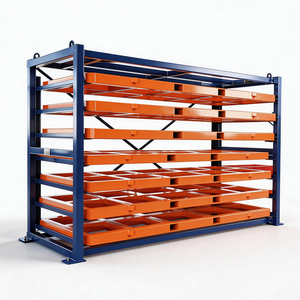
CE Certified Industrial Warehouse Steel Shelving System Heavy Duty Storage Racks Metal Racking Durable Cargo Shelves
Standard industrial shelving incorporating boxed-step beams and solid steel or wire deck panels. Certified under CE EN 15512 specifications.
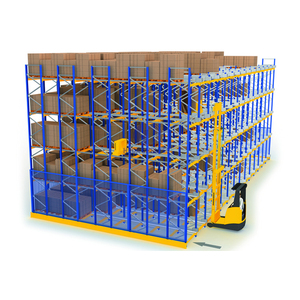
Durable Shuttle Heavy Duty Rack System Asrs 4-Way Shuttle Racking Automated Radio Shuttle Racking System for FIFO & LIFO
High-density radio cart and 4-way shuttle rack. Dramatically eliminates aisle space, delivering automated pallet movement inside deep channels.
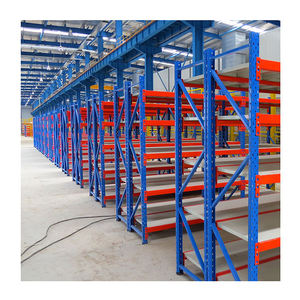
Adjustable Factory 5 Layers Lightweight Pallet Racking Warehouse Shelves Shelves Rack Light-Duty Rack Storage Rack
Fast assembly boltless system configured with 5 height-adjustable tiers. Excellent for small cartons, picking bins, and light-duty stockrooms.
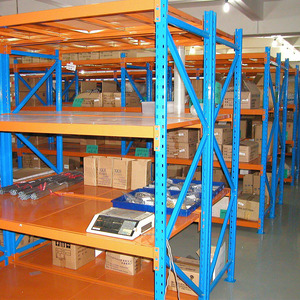
Wall Mounted Adjustable Shelving
Floor-clear perimeter wall cantilever and track shelving for industrial maintenance shops, tool rooms, and archive facility optimization.
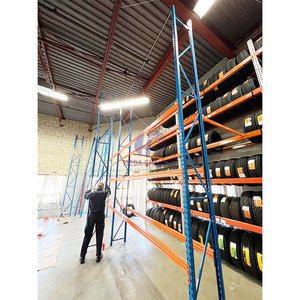
Heavy Duty Racking System Warehouse Storage Tire Pallet Rack Tire Rack for Garage Pallet Shelves
Specialized angled beam configurations prevent tire deformation while providing dense storage for PCR, TBR, and OTR automotive stock.
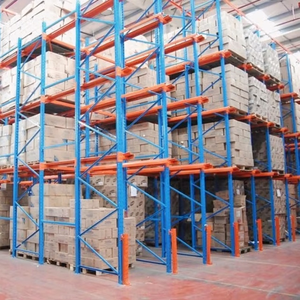
Drive Through Racking System Durable Steel Pallet Storage Racks for FIFO Logistics Management in Large Distribution Centers
Continuous drive-through lanes with separate load/pick access. Engineered for cold store hubs, FMCG distributors, and mass SKU batches.
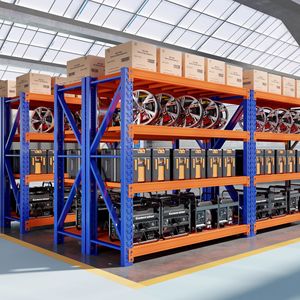
Boltless Adjustable Industrial Heavy Duty Steel Racking System 5 CE Certified Corrosion Protection Warehouse Shelving Storage
High-grade pre-treated phosphated finish with 70-90 micron electrostatic epoxy coating resisting chemical fumes, salt mist, and heavy humidity.
Why Blue (RAL 5015) Pallet Racking Dominates Global Industry
Industrial racking is not simply warehouse furniture; it is an unyielding structural framework bearing thousands of tons of dynamic kinetic and static weight. Discover why precision signal blue uprights and safety orange beams represent the pinnacle of facility safety and structural longevity.
RAL 5015 / RAL 5005 Chromatic Ergonomics
Signal Blue frames create a high-contrast backdrop that reduces optical fatigue for MHE operators. Coupled with RAL 2004 Pure Orange load beams, it provides instant peripheral recognition of aisle edges, horizontal beam levels, and upright column faces, cutting lift-truck collision occurrences by up to 28% in high-velocity 3PL distribution centers.
Q235B vs. Q355B Metallurgical Integrity
We source prime, mill-certified hot-rolled coil (HRC) strictly slit from certified primary steelmakers. For seismic zones or heavy-tier configurations (>4,000 kg/tier), cold-formed Q355B low-alloy micro-alloyed structural steel delivers an enhanced yield strength (fy ≥ 355 MPa), assuring elastic deflection well inside the stringent L/200 engineering threshold under maximum capacity.
10-Step Thermoset Powder Finishing
Our automated finishing lines integrate high-pressure alkaline cleaning, hot water rinsing, micro-crystalline zinc phosphating, and deionized washes. Electrostatic guns apply heavy-build TGIC-free polyester powder cure baked at 200°C (392°F), achieving 500-hour ASTM B117 salt spray endurance and 2H pencil hardness resistance against impact flakes.
| Structural Parameter | Selective Racking (Standard) | Drive-In / Drive-Through System | Automated 4-Way Shuttle Racking | Structural Mezzanine Systems |
|---|---|---|---|---|
| Steel Grade Standard | Q235B (ASTM A36 Equiv.) | Q235B / Q355B High-Tensile | Q355B (ASTM A572 Grade 50) | Q235B / Q355B Structural I-Beam |
| Upright Profiles (mm) | 80×60, 90×70, 100×70, 120×95 | 90×70, 100×70, 120×95 | 90×70, 100×70, 120×95 High-Moment | Square Tube / H-Section 150-300mm |
| Beam Deflection Factor | L/200 (ANSI MH16.1) | L/250 Cantilever Rail Rigidity | L/300 Precision Leveling | L/300 - L/400 Human Ergonomics |
| Standard Finish Specification | Electrostatic Powder (70-90μm) | Electrostatic Powder / Hot-Dip Galv. | Precision CNC Rail Zinc Plated + Powder | Heavy-Duty Anti-Slip Epoxy Enamel |
| Seismic Engineering Readiness | IBC Seismic Categories A-D | Custom Stiffened Bracing Portal | Full Dynamic FEM 3D Modal Analysis | Moment-Resisting Base Anchor Plates |
| Standard GMA Pallet Size | 48" × 40" (1200×1000mm) | 48" × 40" & Euro 1200×800mm | Universal Programmable Shuttle Base | Bulk Skid & Heavy Tote Picking |
End-to-End Precision Manufacturing Protocol
From prime coil slitting to automated robot welding and export container dunnage, our 300+ engineering and production crew enforce multi-point statistical quality control at every stage.
Raw Steel Coil Slitting
Mill test certificates (MTC) verified on hot-rolled coil. Slit into exact profile widths with micrometer gauge checking.
High-Speed CNC Punching
Continuous automatic punching lines punch 50mm, 75mm, or 76.2mm (3-inch teardrop) pitches at tight ±0.1mm tolerances.
Multi-Roll Cold Forming
18 to 24-station rolling mills progressively shape complex 12-fold upright profiles without thermal stress or micro-cracks.
Twin-C Box Beam Clamping
Twin interlocking C-sections rolled and automated seam-welded to create ultra-rigid boxed load beams resisting lateral rotation.
Robotic Connector Welds
Panasonic robotic arc welding cells weld 3, 4, or 5-claw beam connectors with deep penetration and zero weld-slag retention.
Surface Blast & Degreasing
Chemical immersion baths strip oil, industrial lubricants, and oxidation scale down to bare white metal before coating.
Phosphating Pretreatment
Nanotechnology zinc-phosphate immersion builds a dense microscopic conversion film ensuring chemical bonding of polymer resins.
Electrostatic Blue Coating
Automated reciprocator spray booths deposit high-molecular RAL 5015 Blue and RAL 2004 Orange powder uniformly.
Curing Tunnel Baking
Gas-fired overhead curing ovens bake profiles at a continuous 200°C for 25 minutes, crosslinking epoxy-polyester chains.
Container-Max Packaging
Corrugated wraps, steel dunnage, protective foam chocks, and strapping prevent transit abrasion during multi-week ocean shipments.
Future Procurement Trends in Industrial Storage Systems
Supply chain leaders are re-architecting fulfillment centers to counter soaring square-footage leasing rates and labor shortages. The next 5-year cycle hinges on four core structural developments.
1. Manual to Semi-Automated Hybrid Upgrades
Firms are demanding forward-compatible selective racking. By standardizing beam step profiles and upright perforations, warehouses can seamlessly transition selective racking lanes into radio-shuttle or AMR (Autonomous Mobile Robot) picking tunnels without razing the core structural upright grid.
2. Cold Chain High-Cube Volumetric Optimization
With freezer energy consumption costs escalating by over 18% globally, deep-lane drive-in, push-back, and 4-way shuttle systems are replacing standard wide-aisle configurations. High-cube blue steel cold-store racks allow sub-zero facilities to shrink unutilized air space by up to 60%, delivering radical kWh savings per pallet stored.
3. Decarbonized Steel Sourcing & Low-VOC Powder
Tier-1 multinational procurers are mandating audited ESG footprints. Factory-direct sourcing now weighs EPD (Environmental Product Declaration) filings, zero-VOC solvent-free powder chemistries, and electric-arc-furnace (EAF) lower-emission steel coil inputs that slash Scope 3 supply chain carbon contributions.
4. Rapid Container-Cube Freight Modularization
Ocean container shipping economics require precise beam and frame component sizing. Engineers now pre-calculate component nested packaging in 40ft High Cube containers during the initial CAD stage, eliminating air pockets, cutting dunnage waste, and driving freight landed-costs down by up to $14 per pallet position.
How Global Buyers Audit Chinese Racking Manufacturers
A B2B technical checklist for supply chain directors to ensure structural performance, certification authenticity, and field safety before issuing an initial Letter of Credit or deposit.
Verify Steel Mill Test Certificates (MTC)
Never accept vague broker assertions. Always request batch-specific Mill Test Certificates displaying actual chemical heat numbers, Carbon equivalents (C%), Manganese content, and yield strengths. Sub-standard structural steel often exhibits sulfur and phosphorus impurities, leading to brittle weld joints.
Examine Upright Frame Bracing Geometry
Inspect horizontal and diagonal panel bracing welded or bolted to upright profiles. Ensure heavy gauge tubular or channel profiles are used rather than thin stamped strip steel. The intersection node points must align with the centroid axis of the upright column to prevent torsional twisting under eccentric loading.
Confirm Safety Pin Retention Standards
Every beam-to-column connector claw must incorporate a spring-loaded or snap-in safety locking pin engineered to withstand a minimum 1,000 lbs (4.4 kN) upward dislodgement shear force, preventing accidental beam ejection from errant forklift masts as required by RMI ANSI MH16.1.
Evaluate Coating Pretreatment Protocols
Inspect the factory's pretreatment line. If an OEM applies powder coating directly over raw, unwashed mill oil without multi-stage degreasing and phosphating, the finish will blister and peel within 12-24 months of exposure to warehouse humidity, compromising the underlying steel integrity.
Frequently Asked Questions on Importing & Specifying Blue Pallet Racking
Direct technical guidance covering structural codes, container consolidation, seismic engineering, lead times, and customization protocols.
What are the key technical differences between teardrop racking and European-style uprights?
Teardrop racking utilizes a 2-inch center-to-center inverted teardrop punching pattern, which is the predominant industry standard in North America (USA, Canada, Mexico). It allows rapid tool-less beam insertion and universal compatibility across most major North American racking brands. European-style systems (predominantly 50mm or 75mm pitch) utilize rectangular, diamond, or trapezoidal slots and multi-claw wrap-around connector brackets. European connections often provide superior moment-frame stiffness under seismic design requirements governed by EN 15512. Guangzhou HEDA Shelves Co., Ltd. operates high-precision tooling for both universal teardrop (ANSI MH16.1) and metric CE-compliant systems (EN 15512), configuring components precisely to local engineering requirements.
How do you calculate permissible beam deflection under full working load?
Under ANSI MH16.1 specifications, maximum vertical elastic deflection of a horizontal beam level under uniformly distributed load (UDL) must not exceed L/200, where L represents the clear span distance between upright columns. For example, on a standard 96-inch (2438 mm) selective pallet beam, maximum allowable deflection under load is 0.48 inches (12.19 mm). In European and Australian frameworks (EN 15512 and AS 4084), deflection limits can be dialed to L/200 or L/250 depending on whether automated shuttle devices or manual lift trucks are utilized. Our design office provides certified engineering calculation sheets illustrating Section Modulus (Z), Moment of Inertia (Ix), and safety factors (typically 1.65 to 1.95) for every beam size specified.
Can HEDA Shelves issue stamped structural drawings for building permits in the USA and Canada?
Yes. For turnkey projects in the United States, Canada, and Australia, we provide complete engineering structural packages including component sectional properties, connection spring stiffness data, 3D CAD/BIM floor plans, and elevation load charts. These packages are formatted specifically to enable our network of licensed local Professional Engineers (PE) or your chosen Engineer of Record (EOR) to verify seismic loads (IBC / ASCE 7 seismic spectral acceleration values Ss, S1) and apply local engineering stamps required by local municipal building authorities for warehouse occupancy permits.
What anti-corrosive powder coating standards do your blue uprights meet?
All HEDA Shelves upright columns, beams, and horizontal ties undergo an automated continuous surface finishing process. We utilize a multi-zone pre-treatment including hot degreasing, clean water rinse, and micro-crystalline zinc-phosphating conversion bath to eliminate all rolling lubricants and oxidation. Following pretreatment, an electrostatic powder coating of pure thermoset epoxy-polyester powder is cured at 200°C for 25 minutes. This creates a uniform 70 to 90-micron dry film thickness (DFT). Finished coatings meet ASTM B117 salt spray testing in excess of 500 continuous hours without creepage, ASTM D3359 cross-hatch adhesion classification 5B, and 2H pencil hardness resistance against scratching.
How is container space maximized when shipping pallet racking via ocean freight?
Shipping pallet racking requires careful packaging engineering to maximize weight limits before container cubic volume is exhausted. Standard 40-foot High Cube (40HC) containers have a typical internal payload allowance of approximately 26,500 to 28,000 kg (subject to shipping line and regional port road-weight limits). We ship upright frames as pre-punched knocked-down (KD) upright posts and diagonal/horizontal bracing channels bundled in high-density strapped packs, or as assembled frames nested head-to-toe with custom foam separators. Step beams are bundled in uniform wood-chocked packs with protective plastic edge protectors. By optimizing nesting geometry, a single 40HC container can hold between 1,200 and 2,000 pallet positions of standard selective racking.
What concrete floor slab thickness and strength is required for anchoring?
Most heavy-duty industrial pallet racking systems require a reinforced concrete floor slab with a minimum thickness of 6 to 8 inches (150 to 200 mm) and a minimum compressive strength of 3,000 to 4,000 PSI (20 to 30 MPa). Base plates for our upright columns are precision-punched from 4mm, 6mm, or 8mm structural steel plate and secured using heavy-duty wedge mechanical expansion anchors (standard M12 × 100mm to M16 × 125mm) or chemical adhesive capsule studs. For seismic or tall-bay installations (height-to-depth ratio > 6:1), we engineer oversized baseplates to distribute point loads and resist uplifting overturning moments.
What is the standard production lead time and FOB/CIF delivery schedule?
With an integrated 30,000 m² factory campus and 30,000 metric ton monthly throughput, standard selective pallet racking orders (1 to 5 containers) are fabricated, powder-coated, and packed within 15 to 20 business days following CAD drawing sign-off. High-volume project orders (10+ containers) or customized automated shuttle rails typically complete in 25 to 30 business days. Ocean transit to major North American ports (Long Beach, Houston, Savannah, New York/NJ, Vancouver) takes between 14 and 30 days. We provide comprehensive export documentation, including Mill Test Certificates, Bill of Lading, Packing Lists, Commercial Invoices, and Certificate of Origin (Form E or COO).
Can you customize powder coat finishes to custom corporate colors (RAL)?
While RAL 5015 Signal Blue (frames) and RAL 2004 Pure Orange (beams) represent our standard inventory colorway, our computer-controlled powder booths match any international RAL Classic or Pantone code. Common custom industrial configurations include RAL 5005 (Dark Blue), RAL 7035 (Light Gray), RAL 7016 (Anthracite Gray), RAL 6005 (Moss Green), and RAL 1023 (Traffic Yellow). For exterior or caustic wash-down facilities, we also provide hot-dip galvanized (HDG) treatments exceeding 85 microns thickness under ISO 1461 standards.