Engineering-Grade Dynamic & Static Racking Lines
Manufactured using cold-formed structural steel, automated punching lines, and durable electrostatic powder coating to ensure seamless logistics workflows.
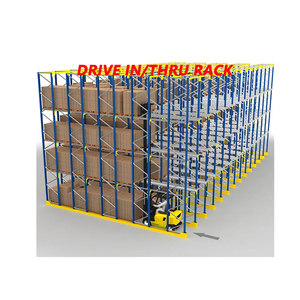
High Density Drive-In Pallet Rack Storage System
Designed to eliminate operating aisles, this drive-in system maximizes cube utilization up to 80% for uniform SKUs, cold store freezers, and volume production.
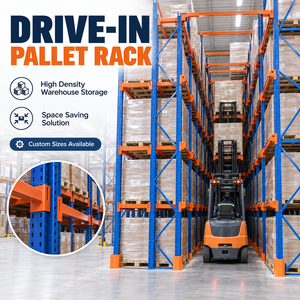
Heavy Duty Drive-in Pallet Racking System
Built with rigid structural rails and reinforced column uprights, providing superior impact resistance and secure high-bay storage for multi-tier applications.
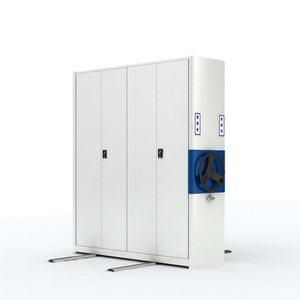
High Density Manual Mobile Filing Shelving System
Consolidates archives and small component storage onto synchronized floor tracks, reducing required aisle space by 50% through mechanical hand-crank or geared mobility.
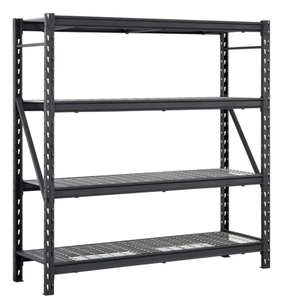
3 Layers Boltless Steel Industrial Garage Shelving
Engineered for quick tool-free setup, providing durable, adjustable tier heights for maintenance shops, parts replenishment depots, and workshop hand-loaded operations.
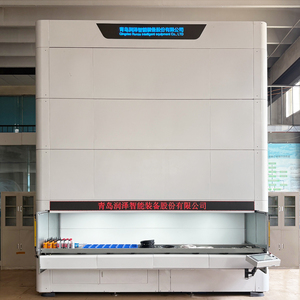
Automatic Vertical Lift Module AS/RS Warehouse System
Intelligent computer-controlled enclosed vertical carousel unit delivering precise SKU presentation, automated picking throughput, and real-time inventory synchronization.
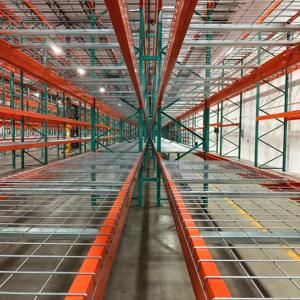
Heavy Duty Teardrop Pallet Racking for Cold Storage
Interchangeable teardrop connection design treated with specialized low-temperature powder coatings to withstand sub-zero embrittlement in food cold-chain environments.
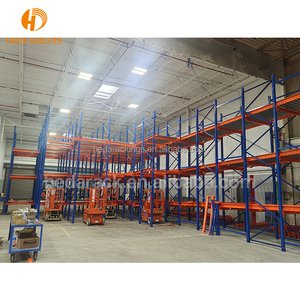
FIFO High Efficient Storage Gravity Pallet Flow Racks
Continuous dynamic flow bed utilizing heavy-duty steel rollers, centrifugal speed dampers, and pallet separators to drive high-turnover first-in-first-out pallet movement.

Minimalist Wall-Mounted Floating Wood Shelves
Precision-engineered hardwood shelving with concealed mounting brackets, offering robust load stability for modern interior displays, retail stores, and commercial suites.
Engineering Architecture: How CE Certified Flow Racks Elevate Logistics Throughput
A technical examination into gravity dynamics, speed regulation, and steel fabrication metallurgy for global distribution fulfillment centers.
In modern high-velocity supply chain hubs, conventional static selective racking introduces unnecessary forklift travel times, elevated carbon footprints, and severe bottlenecks at loading docks. As a premier CE Certified Flow Racks warehouse manufacturer and direct factory, our engineering framework solves these operational deadlocks through passive gravitational kinetic movement. Pallet Flow (also designated as Gravity Live Racking) operates along an inclined roller trackbed—typically engineered at a calibrated gradient between 2.8% to 3.5%—allowing pallets loaded at the charging rear elevation to slide self-propelled to the forward discharging face under continuous gravitational pull.
This dynamic architecture bifurcates warehouse traffic cleanly: loading replenishment drivers operate exclusively along the feed aisle, while picking and dispatch vehicles manage the extraction aisle. In fast-moving consumer goods (FMCG), pharmaceuticals, and dairy distribution, strict First-In, First-Out (FIFO) stock turnover is an absolute operational necessity to eliminate expiration shrinkage. Gravity flow racks inherently enforce 100% stock rotation discipline without relying exclusively on warehouse management software algorithms to restrict picker decisions.
| Storage Mechanism | Space Cube Utilization | Inventory Rotation | Forklift Aisle Dependency | Handling Safety Index |
|---|---|---|---|---|
| Gravity Pallet Flow Racking | 85% - 90% (Maximum) | Strict FIFO (100% Controlled) | Separated Charge & Pick Aisles | High (No Truck Entry Into Lanes) |
| Drive-In Pallet Racking | 70% - 80% | LIFO (Last-In, First-Out) | Shared Forklift Access Channels | Moderate (High Rack Impact Risk) |
| Standard Selective Racking | 40% - 50% | Free Access / Any | Requires Dedicated Aisle Every 2 Rows | High Aisle Congestion Profile |
| Push Back Racking (Nested Carts) | 70% - 75% | Strict LIFO | Single Front Loading/Unloading Aisle | Medium (Spring/Gravity Pushback Force) |
Crucial to system integrity is European CE standard EN 15512 / EN 15620 and EN 15629 structural compliance. Each structural bay is modeled using finite element calculations to compensate for torsional moments, dynamic impact loads, and seismic acceleration factors. Unlike low-specification roller beds that deform under repeated dynamic impact, our certified factory integrates hardened galvanised rollers mounted on self-lubricating, precision dust-sealed ball bearings. Integrated brake rollers (centrifugal dampers) maintain constant descending speeds regardless of whether a pallet weighs 300 kg or 1,500 kg, preventing runaway collisions at the extraction stop plate.
Future Procurement Trends for Warehouse Flow Racking (2026–2030)
Where intralogistics capital investments are heading over the next five-year cycle.
Convergence of AMR & Gravity Live Racks
Procurement specifications are pivoting toward hybrid automation. Autonomous Mobile Robots (AMRs) and automated counterbalanced forklifts are increasingly tasked with feeding and retrieving pallets from gravity tracks, demanding millimetric roller alignment and zero-deflection end-stop fabrications.
Total Cost of Ownership (TCO) Prioritization
Global procurement teams are shifting away from evaluating initial steel weight alone toward comprehensive life-cycle costs. Flow racks that incorporate pre-galvanized track finishes, modular roller cartridge drop-ins, and high-tensile upright steel drastically reduce long-term line maintenance downtime.
Verification of Validated CE & Regional Stamping
With tightening workplace safety regulations across the EU, North America, and Australia, enterprise procurement mandatorily demands mill certificates, EN 10204 3.1 inspection protocols, and verifiable CE compliance documentation to expedite regional municipal permitting and occupational safety clearances.
Evolutionary Advancements in Flow Rack Manufacturing Technology
How metallurgical improvements and smart sensor telemetry are transforming gravity systems.
The manufacturing paradigms of industrial gravity flow systems have progressed beyond simple punched channels and generic conveyor wheels. At our modern production facility, engineering focus is centered on four core technological advancements:
Intelligent Centrifugal Speed Dampening
Next-generation brake rollers feature self-adjusting internal planetary gears that apply proportional magnetic and mechanical braking. Light pallets roll unimpeded, while dense steel containers trigger progressive deceleration to eliminate sudden shocks.
Dynamic Pallet Separator Mechanisms
To eliminate back-pressure when a forklift picks the lead pallet, automatic mechanical separators isolate the front load from subsequent pallets in the lane. Once the first pallet is lifted clear, the separator safely releases the queue forward.
Automated Pick-Face Sensor Telemetry
Integration of optical time-of-flight (ToF) sensors and RFID track nodes provides real-time visibility into lane occupancy, signaling replenishment triggers immediately when pick faces clear and feeding live telemetry into warehouse ERP systems.
Why Tier-1 Warehouses Partner With Our Factory
End-to-end manufacturing control, certified European standards, and structural engineering expertise.
Accredited CE & ISO Conformance
Certified under CE Construction Products Regulation (No. 2435-CPR-8605159) and ISO 9001:2015. Every upright, beam, and connector meets validated international safety thresholds.
Complimentary CAD & 3D Engineering
Our in-house structural engineers deliver complete CAD layouts, elevation studies, and 3D warehouse simulations in both Imperial (feet/inches/lbs) and Metric standards within 24 hours.
Massive 30,000 Ton Monthly Output
Spanning 30,000 square meters of manufacturing floor space with continuous roll forming, automated punching, and automated electrostatic powder coating lines for rapid project delivery.
Container-Optimized Ocean Packaging
Components are precision-bundled and labeled to maximize container cube utilization for direct transport to major North American, European, and Asia-Pacific freight gateways.
Frequently Asked Questions: Flow Racks Procurement
Essential engineering and logistics questions answered by our structural design engineers.
What is the standard track incline for gravity flow systems?
The standard incline ranges between 2.8% and 3.5% (roughly 35 to 45 mm of fall per linear meter of track). The precise pitch is engineered based on bottom runner conditions (wood, plastic, or slave boards), overall pallet deflection, and load weight variation across lanes.
How do brake rollers control pallet descent speed?
Brake rollers operate on an internal centrifugal clutch mechanism. As a pallet passes over, the roller accelerates until the centrifugal counterweights engage brake shoes against the internal drum wall. This caps pallet travel velocity at approximately 0.25 to 0.3 meters per second.
Can flow racks accommodate non-standard pallets or weak skids?
Yes. When handling non-standard 48x40 inch GMA pallets, Euro pallets, skids with missing bottom boards, or plastic runners with variable flex, we engineer full-width continuous cylindrical rollers or add triple-track configurations with customized center spacing to prevent pallet sagging.
What CE documentation is provided with our factory shipments?
Shipments arrive accompanied by complete Declaration of Conformity documents under EN 1090 / EN 15512 standards, raw steel mill test certificates (EN 10204 3.1), stamped calculation blueprints, safe working load (SWL) bay capacity plaques, and comprehensive assembly manuals.
How does gravity flow compare to push back racking in cost and performance?
While push back racking requires only a single access aisle and operates on LIFO via nesting steel carts up to 6 pallets deep, Pallet Flow handles lanes 20+ pallets deep on true FIFO rotation. Pallet flow offers higher throughput capacity, lower fork truck handling cycles, and zero cart jamming risk.
Are flow racks suitable for sub-zero cold storage warehouses?
Yes. We engineer cold-chain specific flow systems equipped with low-temperature synthetic lubricants inside bearings, specialized cold-elastic polycarbonate wheels or zinc-plated steel rollers, and ductile alloy steel frames certified to prevent low-temperature brittle fractures down to -30°C.
Transform Your Warehouse Density with Factory-Direct Engineering
Send our senior engineering team your warehouse architectural layout, clear ceiling heights, and pallet specifications. Receive a certified CAD design, loading calculation summary, and transparent quotation within 24 hours.