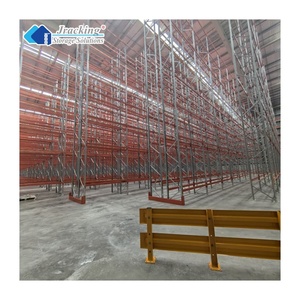
 Heavy Duty System
Factory-Direct Heavy-Duty Racking Portfolio
Precision-Engineered Storage Hardware for Austrian Warehouses
Explore our certified industrial storage hardware manufactured to high structural tolerances. Designed to integrate seamlessly with both standard counterbalanced forklifts and specialized narrow-aisle reach trucks.
Heavy Duty System
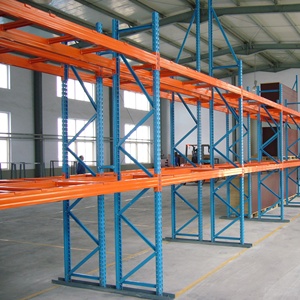 Custom Capacity
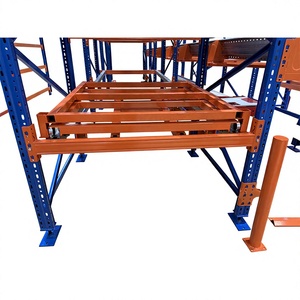 Push Back Racking
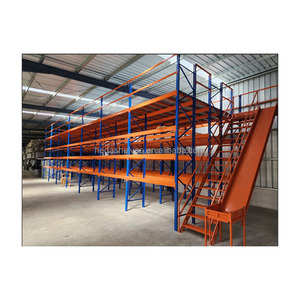 Mezzanine Platform
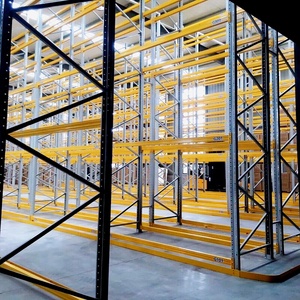 Narrow Aisle (VNA)
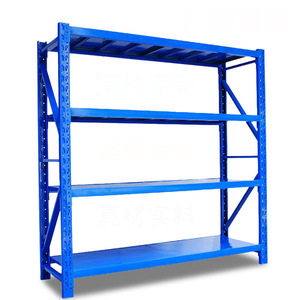 Corrosion-Proof
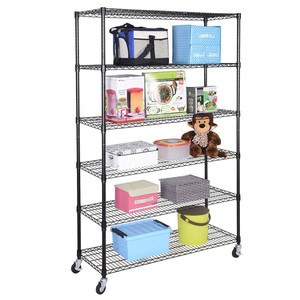 Wire Mesh Shelving
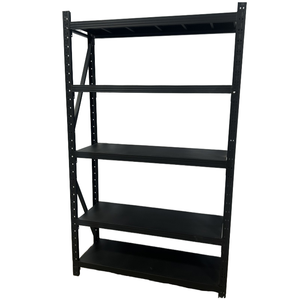 Boltless Modular
30,000t
Monthly Cold-Formed Steel Capacity
10,000+
Global Warehousing Projects Executed
30,000m²
Automated Manufacturing Campus
25+ Yrs
Precision Racking Engineering Since 2001
Push Back Rack Engineering: Cart-on-Rail Kinematics for High-Throughput Facilities
Push back rack systems (also categorized as dynamic push rack storage) represent the apex of Last-In, First-Out (LIFO) material handling. Unlike drive-in racking that requires lift truck operators to enter dangerous structural bays, push rack systems utilize a series of nested, telescoping steel carts riding upon inclined structural steel rails with an inclination angle engineered between 1.5% and 3.0%.
Telescoping Nested Cart Geometry
Our engineered push back carts utilize ultra-low-profile nesting, preserving critical clear vertical height in warehouses with standard 6m to 12m clear heights.
- Accommodates 2, 3, 4, 5, and 6-deep pallet lane configurations.
- Heavy-duty, sealed ball-bearing steel wheels lubricated for extreme temperature variations (-30°C to +40°C).
- Color-coded front cart indicators for instantaneous visual load confirmation.
Gravity & Impact Load Mitigation
Pallet momentum within inclined channels demands fail-safe structural deceleration to protect high-cost industrial goods and operators at the pick face.
- Integrated kinetic end-stops and cart push-back dampening bumpers.
- Engineered anti-lift clips preventing accidental cart derailment during aggressive forklift retraction.
- Boxed-profile upright reinforcement at bay entrances to absorb operational impact.
EPAL & Industrial Pallet Adaptability
Austrian and broader Central European freight circulation is dominated by standard EPAL 1 (800 x 1200 mm) and industrial EPAL 2 / 3 (1000 x 1200 mm) specifications.
- Universal bottom runner orientation: longitudinal or transversal cart placement.
- Full perimeter safety wire decks engineered for defective or non-standard wooden skid protection.
- Rated unit capacities from 500 kg up to 1,500 kg per pallet cart position.
Engineering Compliance for Austria: EN 15512, ÖNORM, and Alpine Seismic Safety
Procuring industrial racking within the Republic of Austria requires strict adherence to both Harmonized European Standards (CEN) and rigorous Austrian National Annexes (ÖNORM). As certified manufacturers and international exporters, Guangzhou Heda Shelves delivers turn-key technical dossiers verified against statutory European cold-formed steel mandates.
| Regulatory Standard | Technical Scope & Legal Mandate | Engineering Implementation by HEDA Shelves | Austrian Audit Relevance |
|---|---|---|---|
| EN 15512:2020 | Steel static storage systems – Adjustable pallet racking systems – Principles for structural design. | Limit-state design methodology utilizing finite element modeling (FEM) for beam-column connector non-linear moment behavior. | Mandatory Statik Prüfbuch |
| EN 15620 / EN 15635 | Tolerances, deformations, clearances, and operational maintenance inspections of storage equipment. | Strict beam deflection limits set to < L/200 under maximal working load limit; documented safety signages and load plaques. | AUVA Occupational Safety |
| ÖNORM EN 1998-1 / Eurocode 8 | Design of structures for earthquake resistance, including local Austrian National Seismic Application Documents. | Custom engineered baseplates, double-anchor M12/M16 chemical bolts, and ductile vertical bracing calibrated for the Vienna Basin and Mur-Mürz fault lines. | Regional Seismic Zones 1–4 |
| EN 1090-1 / CE Marking | Execution of steel structures and aluminum structures – Technical requirements for structural steel components. | Factory Production Control (FPC) system certified under CPR 305/2011; fully traceable mill certificates (3.1 EN 10204) for all Q235B / Q355B coils. | EU Import Customs Cleared |
Structural Engineering Note for Austrian Project Approvals (Baubehörde)
In Austria, commercial logistics installations exceeding standard height thresholds often necessitate formal construction filings with local municipal authorities (Baupolizeiliche Bewilligung). HEDA Shelves coordinates directly with your designated Civil Structural Engineer (Ziviltechniker) by providing complete 2D DWG installation drawings, load tables, reaction force calculations at baseplates, and weld seam documentation to expedite project permitting without costly site-level redesigns.
Comparative Engineering Analysis: Push Back vs. Alternative High-Density Systems
Selecting the correct high-density storage framework directly impacts building footprint utilization, operational forklift travel times, and total cost of ownership. The following matrix illustrates structural trade-offs for logistics planners in the Austrian market.
| System Architecture | Density Ratio (%) | Inventory Access | Forklift Damage Exposure | Mechanical Complexity | Best Suited Operational Profile |
|---|---|---|---|---|---|
| Push Back Racking (HEDA Cart) | 70% – 75% | LIFO (Lane Specific) | Extremely Low (Masts stay outside lanes) | Low (Gravity + Nested Bearings) | Medium SKU turnover, cold storage, fast 2–6 pallet replenishment lanes. |
| Selective Pallet Racking | 40% – 45% | 100% Direct (Any Pallet) | Moderate (High traffic in aisles) | Zero (Static Beams) | High SKU proliferation, pick-and-pack fulfillment, rapid e-commerce sorting. |
| Drive-In Racking | 75% – 85% | Strict LIFO (Deep Channel) | High (Truck enters rack structure) | Zero (Static Support Cantilevers) | Homogeneous bulk goods, seasonal holding, minimal SKU diversity. |
| Pallet Flow (Gravity Roller) | 80% – 85% | True FIFO (Gravity Bed) | Very Low (Separate load/pick faces) | Moderate (Rollers & Speed Controllers) | Perishable food, date-coded dairy/meat, fast-moving consumer goods (FMCG). |
| Radio Shuttle Automation | 85% – 90% | FIFO or LIFO (Automated) | Minimal (Robotic shuttle cart) | High (Batteries, PLC, Sensors) | Ultra-deep lanes (>10 pallets deep), high throughput deep-freeze centers. |
Targeted Deployment Across Austria’s Industrial Corridors
Austria’s strategic location at the crossroads of Western and Central-Eastern Europe (CEE) makes warehousing real estate an exceptionally high-value asset. Land acquisition costs along key highway corridors (Westautobahn A1, Südautobahn A2) necessitate maximum vertical volume utilization.
Vienna / Lower Austria (A1/A4)
Hub Vienna-Bratislava (FMCG & E-Commerce)
3PL distribution centers serving the cross-border metropolitan region require dynamic 2- to 4-deep push back systems for intermediate buffer storage, eliminating long forklift travel runs.
Upper Austria (Linz / Wels A1/A8)
Industrial Core & Heavy Manufacturing
Heavy machinery and steel fabrication support warehouses deploy custom 1,200kg-capacity push back lanes to stage subassemblies near production lines without consuming valuable shop floor area.
Styria (Graz / Kalsdorf A2/A9)
Automotive & Mobility Supply Chains
Tier-1 automotive suppliers within the Steyr/Magna ecosystem utilize cart-on-rail racks to stage high-volume containerized stamped parts with absolute LIFO batch integrity.
Tyrol & Salzburg (A10/A12)
Alpine Cold Chain & Beverage Distribution
Refrigerated dairy, meat, and beverage plants nestled in Alpine valley corridors face extreme footprint limitations; 4-deep push back systems cut refrigerated volume costs by up to 35%.
Global Manufacturing Infrastructure
Guangzhou Heda Shelves Co., Ltd. – Engineered Reliability Since 2001
Founded in 2001, Guangzhou Heda Shelves Co., Ltd. has developed into a premiere manufacturer and international exporter of high-precision heavy-duty pallet racking systems, structural steel mezzanine platforms, and dynamic push back storage apparatus. Operating from a sprawling 30,000 m² (approx. 323,000 sq ft) advanced manufacturing center with over 300 experienced technicians, robotic welding units, and automated cold-roll lines, we export over 30,000 tons of racking steel monthly.
For our European and Austrian commercial partners, we bridge the gap between factory-direct cost efficiencies and strict Western engineering accountability. We manage structural finite-element verification, mill-certified steel sourcing, multi-stage anti-corrosion pre-treatments, automated electrostatic powder coating, and international container packaging engineered for break-free European transport.
ISO 9001:2015 Cert. No. 18624Q00169R0M
CE Marking 2435-CPR-8605159
RoHS Environmental Compliance
Rapid CAD & 3D Statik Drafting (24h)
Our structural engineering team produces preliminary layout plans, 3D render schematics, and load distribution profiles within 24 hours of site parameter submission.
Container-Optimized Ocean & Rail Logistics
Direct multimodal shipping via Mediterranean ports (Koper/Trieste) or Northern gateways (Hamburg/Rotterdam) directly railed to Austrian terminals in Enns, Linz, and Vienna.
OEM / Private Labeling for Austrian Racking Integrators
Complete white-label engineering support for local warehouse outfitters, including custom punch hole profiles, custom RAL powder finishes, and stamped component drawings.
Clear Answers to Critical Procurement Inquiries
Frequently Asked Questions by Austrian Warehouse Operators
Review our detailed technical, customs, and installation answers curated specifically for logistics managers, facility engineers, and procurement directors operating in Austria.
How does HEDA Shelves handle seismic load calculations required in specific Austrian provinces?
Austrian seismic zones are categorized from Zone 0 (negligible) to Zone 4 (elevated risk, particularly in the Mur-Mürz Valley, the Inntal, and the Vienna Basin) according to ÖNORM EN 1998-1. When designing push rack and pallet rack systems for these regions, our structural engineers calculate the spectral ground acceleration (ag) and soil behavior coefficients. We then increase the cross-sectional gauge of upright profiles, incorporate reinforced diagonal portal bracing, enlarge column baseplates, and specify high-tensile European Technical Assessment (ETA) approved mechanical or resin anchors to guarantee structural equilibrium during seismic excitation.
Can the push back cart system reliably handle standard Austrian EPAL 1 (800 x 1200 mm) pallets loaded in both orientations?
Yes. European logistics operations frequently alternate between deep handling (800mm face forward) and wide handling (1200mm face forward). Our nested push back carts are configured with custom transverse load spreaders and bottom skid capture rails. This prevents bottom deckboard deflection or skid slippage between cart frames, ensuring that standard EPAL 1, EPAL 2 (1000 x 1200 mm), and Chep skids track straight through the incline without binding or premature cart stoppage.
What is the typical shipping lead time and customs clearance pathway to Austrian inland destinations?
Production typically spans 15 to 25 days depending on project tonnage. Ocean freight is dispatched either via Southern European ports (Port of Koper, Slovenia or Trieste, Italy) which offers an exceptionally short sea transit of 22–26 days, followed by overnight rail freight to Austrian container terminals in Graz, Villach, or Vienna. Alternatively, Northern gateways (Hamburg/Rotterdam) are utilized. We provide complete EU TARIC customs classification dossiers (Harmonized Code: 7308.90), Certificate of Origin, and CE conformity declarations to enable frictionless DDP or CIF clearance through Austrian customs authorities (Zollamt Österreich).
How does Push Back Racking perform inside Austrian deep-freeze and cold storage distribution centers?
Cold storage warehouses operating down to -25°C or -30°C in food-production regions (such as Marchfeld or Upper Austria) represent our primary push rack application. Because push back systems do not require battery-powered shuttles or delicate optical electronics in sub-zero zones, failure rates are substantially lower than automated solutions. We specify low-temperature mechanical bearing grease, anti-condensation hot-dip galvanized cart rails, and cold-ductile structural steels that prevent low-temperature brittle fracture.
What documentation is provided to satisfy local Austrian labor and safety inspectors (Arbeitsinspektorat)?
Every commissioned system is supplied with a comprehensive Technical Project Dossier (Statische Dokumentation). This includes structural calculation protocols conforming to EN 15512, steel material grade 3.1 certificates, certified loading limit plaques in the German language (Belastungswarnschilder) adhering to EN 15635, anchor torque logs, and step-by-step erection protocols for on-site certified installation crews.