Factory Direct Engineering • Export Specialist

Big Industrial Racking Factory & Exporter in the United States Market

Heavy-duty structural storage architectures, RMI ANSI MH16.1 compliance, seismic-engineered calculations, and high-density warehouse solutions delivered directly to North American distribution centers.

Enterprise Product Portfolio

High-Performance Industrial Storage Systems for US Warehousing

Engineered for standard GMA 48" × 40" pallets, sheet fabrication inventory, and high-density logistics consolidation. Manufactured with high-yield cold-formed steel and architectural powder coatings.

2001est
Founded Year

Over 25 years of specialized racking manufacturing for industrial buyers globally.

323,000sq ft
Factory Campus

30,000 m² production site with automated CNC roll-forming and robotic welding.

30,000tons
Monthly Output

Massive steel processing volume guaranteeing punctual supply chain execution.

10,000+
Global Projects

Verified warehouse installations across the USA, Canada, Mexico, and Latin America.

Manufacturing Precision

Why Direct Mill Exporters Outperform Regional Intermediaries

Procuring industrial racking from an established direct-to-enterprise mill gives North American warehouse operators, developers, and logistics integrators structural autonomy, price stabilization, and rigorous engineering compliance.

ISO 9001 & CE Quality Validation

Every structural profile conforms to ISO 9001:2015 Quality Management standards and CE construction products certification (2435-CPR-8605159). Tensile, yield, and ultrasonic weld testing ensure components endure maximum rated static and seismic shear loads.

Full PE-Ready Imperial Engineering

We eliminate friction for US city permits. All CAD layouts, elevations, beam deflection tables, and baseplate anchorage shear details are delivered in feet and inches (lbs/beam, psf floor ratings), pre-formatted for rapid stamping by state-licensed Professional Engineers (PE).

Optimized Containerized Sea Freight

Utilizing high-density nesting and protective sub-bundling, our shipping engineers maximize 40ft High Cube container utilization up to 98% space efficiency. Components arrive damage-free at key coastal ports including Los Angeles, Houston, Savannah, and New York/NJ.

Geographic Application Profiles

Engineered for Prime United States Logistics Corridors

From coastal import gateways to central multi-modal distribution centers, different geographic zones present distinct operational hurdles, seismic accelerations, and throughput dynamics.

Southern California / Inland Empire

Primary Driver: High-velocity import de-consolidation and strict Seismic Design Category D/E/F compliance. Solution: Heavy-gauge structural box columns, reinforced welded baseplates with multiple wedge anchors, and double-deep selective pallet racks designed to meet ASCE 7 and California Title 24 seismic safety standards without racking twist or joint fatigue.

Dallas-Fort Worth & Texas Crossroads

Primary Driver: Mega-fulfillment regional centers requiring rapid cubic expansion and high SKU selectivity. Solution: Tall vertical uprights reaching 36 to 40 feet clear heights, integrated with wire mesh decking to support mixed GMA pallet weights. Step-beam lock pins ensure dynamic stability during rapid reach truck retrieval cycles in high-throughput 3PL facilities.

Midwest & Northeast Cold Chains

Primary Driver: Sub-zero freezer cost mitigation across Chicago, Pennsylvania, and New Jersey refrigerated warehouses. Solution: Multi-tier Drive-In and Push-Back racking systems engineered with cold-resistant epoxy finishes and low-temperature ductile steels. Eliminates costly operating aisles and slashes refrigeration thermal loads per stored cubic foot.

Seismic Note for Engineering Teams: In high-risk seismic zones (West Coast, New Madrid fault lines), standard friction coefficients cannot be assumed. Our engineering team calculates specific Spectral Acceleration values ($S_s$ and $S_1$) based on USGS soil classes, configuring upright column profiles, frame horizontal/diagonal bracing, and concrete anchor embedment depths to ensure seismic compliance under the International Building Code (IBC).
Engineering Selection Matrix

Technical Benchmark of Storage Architectures

Selecting the optimal racking system requires balancing SKU density, inventory rotation methodology (FIFO vs. LIFO), floor footprint cost, and material handling vehicle capability.

Racking Topology Access Method Cube Efficiency Standard Pallet Load Applicable US Standards Target Industry Sector
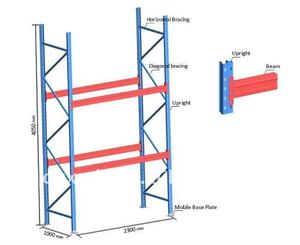
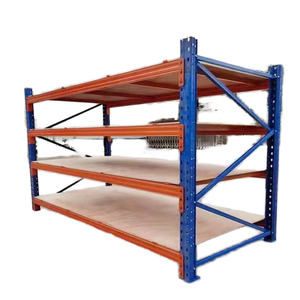
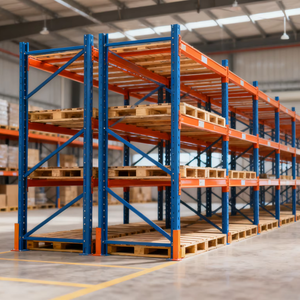
Selective Pallet Racking 100% Direct Selectivity 40% – 50% 2,000 – 5,500 lbs / beam RMI MH16.1 / IBC E-commerce, Retail DCs, 3PL Warehousing
Push-Back Racking (2–6 Deep) LIFO (Nested Carts) 65% – 75% 2,500 – 3,500 lbs / pallet ANSI MH16.1 / OSHA Food & Beverage, Grocery Wholesale
Drive-In / Drive-Through LIFO / FIFO Lanes 75% – 85% 2,200 – 3,000 lbs / position ASCE 7 Seismic Cold Storage, Agricultural Bulk, Seasonal SKU
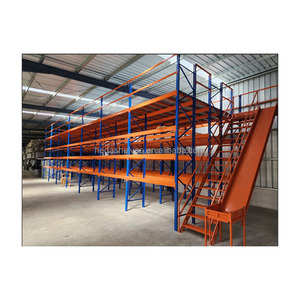
Rack-Supported Mezzanines Multi-Level Walkways 150% – 200% Gain 60 – 200 lbs / sq ft IBC 2024 / OSHA 1910 Apparel Sorting, Auto Parts, Spare Fulfillment
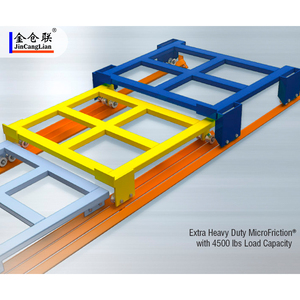
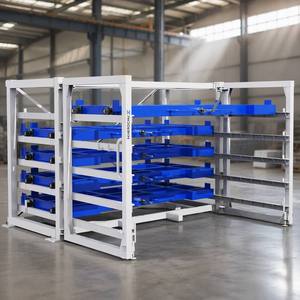
Industrial Roll-Out Drawer Racks 100% Overhead Crane Access 70% Compact Footprint 4,400 – 11,000 lbs / tier ASTM A500 / AISC Metal Fabrication, Tool & Die Workshops
Industry Macro Trends

Structural Trends Shaping the United States Storage Landscape

The modern US logistics ecosystem is encountering shifts in land acquisition pricing, labor costs, and fire mitigation codes that directly impact rack design specifications.

Vertical Cube Densification Over Sprawl

With industrial land costs in prime distribution clusters exceeding historic highs, warehouse operators are moving away from wide aisle configurations. Logistics architects prioritize 32' to 40' clear heights paired with Narrow Aisle (NA) and Very Narrow Aisle (VNA) racking systems to maximize cubic volume rather than horizontal footprint.

NFPA 13 Flue Space Strict Enforcement

Local municipal fire marshals enforce transverse and longitudinal flue spaces (typically 3" and 6" clear openings) to allow early fire suppression heat detection and water penetration. Our factory-engineered beam spacers, pallet stops, and flared waterfall wire mesh decking guarantee compliant ventilation flues without risking operator dislodgement.

AMR & Automation Integration Readiness

As Autonomous Mobile Robots (AMRs) and automated shuttle carriers proliferate in US fulfillment, racking requires tighter manufacturing tolerances. Our robotic punching lines maintain a ±0.5mm upright hole pitch tolerance, ensuring seamless docking alignment for shuttle carriers and automated guided vehicle sensors.

Procurement & Engineering FAQ

Common Questions from US Warehouse & Facility Managers

Critical insights regarding building codes, seismic engineering, customs clearing, and equipment compatibility when importing high-tonnage industrial racking.

How do you assist with US municipal building permits and PE stamping?

We supply a complete engineering package: component physical properties, steel grade tensile certifications, slab load calculations, and dimensional CAD elevation drawings. These documents are prepared to imperial standards, allowing your local licensed Professional Engineer (PE) to perform state-specific seismic reviews and provide sealed drawings for municipal building department approvals.

Are your systems engineered specifically for standard GMA 48" × 40" pallets?

Yes. Our standard US beam lengths (typically 96", 108", or 144") and frame depths (42" or 48") are calculated to provide standard 3" to 4" operational clearances between pallets and upright columns when handling 48" × 40" Grocery Manufacturers Association (GMA) standard pallets, including proper overhang support.

How are ocean container shipments handled to prevent in-transit rust or deformation?

All components undergo a 10-stage preparation process including acid pickling, phosphating, and electrostatic epoxy-polyester powder coating cured at 200°C. For ocean transit, uprights and beams are bundled with steel strapping, corner edge protectors, and waterproof vapor-barrier wraps, with custom wooden dunnage to prevent shifting during transit to US ports.

What is the typical production and shipping lead time for a multi-container order?

Standard fabrication lead times range from 3 to 4 weeks depending on order tonnage. Ocean transit from our export ports to US West Coast ports (LA/Long Beach) is approximately 14 to 18 days, and to US Gulf/East Coast ports (Houston, Savannah, NY/NJ) is approximately 28 to 35 days. CIF and DDP options are available based on your installation timetable.

Plan Your Warehouse Racking Infrastructure with Factory Engineers

Send us your warehouse CAD floor plan, target clear ceiling height, pallet specifications, and forklift models. Our engineering department will return a comprehensive 2D CAD layout, 3D spatial rendering, and itemized landed quotation within 24 hours.

Send an Inquiry