High-Throughput Smart Racking & Automated Storage Solutions
Precision-fabricated roll-formed and structural steel configurations optimized for smart pallet shuttles, high-speed automated vertical retrieval units, and continuous conveyor integration. Fully certified for global logistics deployments.
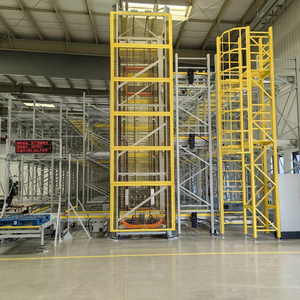
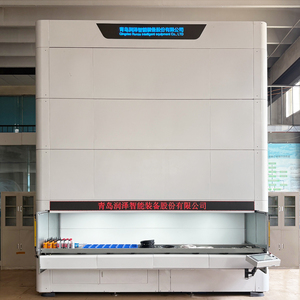
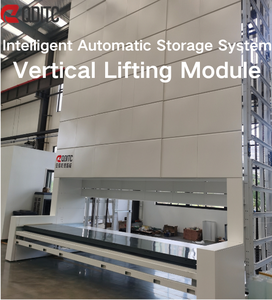
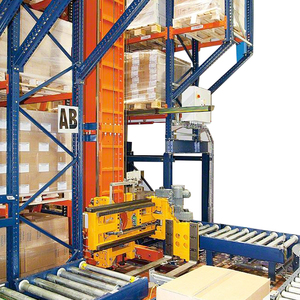
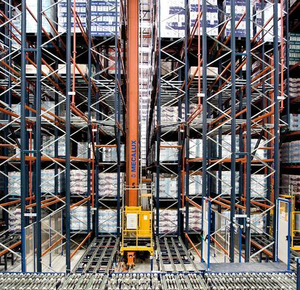
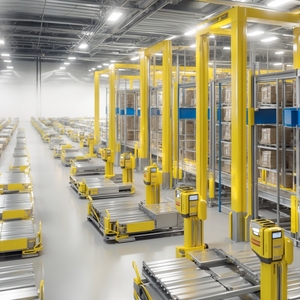 Radio Automation
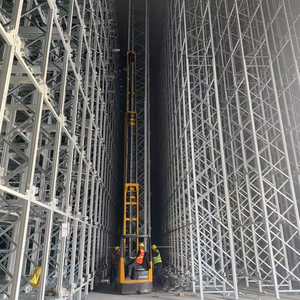 Distribution Hub
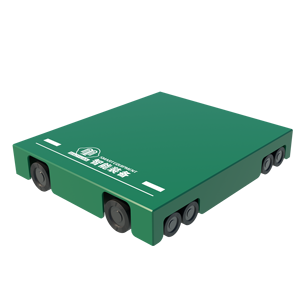
The Structural Physics of Smart Racking: Deflection, Rigidity & Automation Interfaces
Automated storage systems demand structural tolerances that conventional static pallet racks cannot provide. As crane speeds exceed 4 m/s and four-way autonomous shuttles navigate millimeter-precision rail networks, the engineering behind steel grade selection, cold-roll profiles, and frame deflection limits determines operational uptime.
High-Bay Deflection Control (FEM 9.831 Standards)
Standard selective racking tolerates vertical beam deflections up to L/180. In contrast, automated crane high-bay setups demand severe structural rigidity of L/300 or L/400 to prevent automated extraction arms from binding during high-speed pallet retrieval cycles.
- Q355B micro-alloyed structural high-tensile steel
- Continuous seam welding on heavy closed-box beams
- Zero-backlash 4-claw & 5-claw interlocking beam end-connectors
Sub-Millimeter Running Track Alignment
For 4-way shuttles and radio carrier carts, rail joint deviation must not exceed 0.5 mm horizontally or vertically. Specialized automated CNC cold-roll tooling profiles guarantee perfect running planes along entire 100-meter deep-lane channels.
- Galvanized guidance channels with laser-calibrated leveling
- Anti-slip serrated safety running surface options
- Integrated end-of-lane optical sensors and mechanical buffers
Seismic Dissipation & Dynamic Mass Resilience
Automated warehouses concentrate massive dynamic loads at elevations exceeding 24 to 35 meters. Our systems incorporate finite element analysis (FEA) compliant with RMI MH16.1 (USA), NBCC (Canada), and Eurocode 3 for high-seismic zones.
- Over-engineered baseplates with multi-point chemical anchoring
- Vertical K-bracing and horizontal portal truss stabilization
- Certified live-load and harmonic resonance damping
| Storage Architecture | Volumetric Space Utilization | Throughput Rate (Pallets / Hr / Aisle) | Automation Compatibility | Structural Deflection Limit | Typical Payback (ROI) |
|---|---|---|---|---|---|
| Selective Pallet Racking | 40% – 50% (Standard) | 25 – 35 (Manual Forklift) | Low / AMR Only | L / 180 – L / 200 | Immediate / Low CapEx |
| Radio Pallet Shuttle System | 75% – 85% (High Density) | 40 – 60 (Semi-Automated) | Medium / Semi-Auto | L / 250 | 14 – 20 Months |
| Four-Way Shuttle Matrix | 85% – 92% (Ultra High) | 80 – 150+ (Multi-Cart Scalable) | Full Lights-Out ASRS | L / 300 (Tight Tolerance) | 22 – 30 Months |
| High-Bay Stacker Crane ASRS | 80% – 90% (Vertical Cube >30m) | 60 – 110 (Continuous Dual-Cycle) | Autonomous Crane Interfaced | L / 400 (Millimeter Rigid) | 24 – 36 Months |
| Vertical Lift Module (VLM) | 90% (Floor Footprint Compression) | 120 – 300 (Totes / Small Parts) | Goods-to-Person Integrated | Internal Mechanical Guides | 12 – 18 Months |
Future Procurement Trends: Where Smart Warehousing Is Heading by 2030
Procurement leaders are navigating soaring industrial land lease rates, escalating labor costs, and compressed fulfillment cycles. Sourcing smart racking has evolved from buying commoditized structural steel to investing in lifecycle-optimized robotic infrastructure.
1. Shift from Floor-Space to High-Cube Exploitation
With urban industrial rents climbing globally, new warehouse design is moving rapidly upward. Green-field facilities routinely specify racking heights from 18m to over 35m. Rack-clad buildings—where the smart racking structure itself supports the facility exterior walls and roof purlins—are yielding 20% to 30% savings on overall civil construction budgets.
2. Cold-Chain Thermal Efficiency & Volume Compaction
Refrigerated storage energy costs demand maximum pallet count per cubic meter. Smart 4-way shuttle systems and deep-lane radio racks compress refrigerated footprints by up to 60%, drastically cutting the refrigeration air volume. Racking steels designed specifically for low-temperature ductile toughness (sub-zero Q355D/E alloys) prevent cold-short embrittlement.
3. Autonomous Mobile Robot (AMR) Interoperability
The era of disconnected storage is over. Forward-thinking buyers insist on dual-purpose ground profiles where Autonomous Guided Vehicles (AGVs) and AMRs dock directly into bottom rack pickup-and-deposit (P&D) stations. Laser-guided safety channels and floor-embedded inductive loop channels are designed during initial manufacturing.
4. Structural Health Monitoring & IoT Uprights
Next-generation smart racking incorporates fiber-optic or piezoelectric strain gauges at critical corner uprights and floor anchors. These sensors transmit real-time deflection alerts, forklift impact data, and overload warnings directly to facility maintenance dashboards via IoT telemetry, eliminating human error in rack integrity audits.
5. Modular Scalability: Phased CapEx Deployments
Enterprises avoid monolithic multi-million-dollar upfront automation bets. The trend favors modular "shuttle-ready" rack structures. Warehouse managers install precision-punched, shuttle-grade racking rails in Phase 1, operating with traditional reach trucks, and add autonomous shuttles and vertical lifts incrementally as parcel volume surges.
6. Near-Zero Environmental Footprint & Circular Steel
Corporate ESG benchmarks now dictate equipment sourcing. Cold-formed high-strength steels allow up to 15% lower steel weight while carrying equivalent pallet loads. Non-toxic, zero-VOC electrostatic powder coatings and closed-loop phosphating baths are becoming mandatory vendor qualification criteria across North America and Europe.
Why Top Global Brands Partner with HEDA Shelves
Founded in 2001, Guangzhou Heda Shelves Co., Ltd. is a recognized pioneer in heavy-duty and smart warehouse storage systems. Operating from a world-class manufacturing campus with over 300 skilled engineers and technicians, we combine engineering rigor with high-volume industrial output.
25+ Years Industrial Mastery
Over a quarter century of focused engineering in roll-formed uprights, beam connectors, and automated interfaces across 10,000+ completed installations worldwide.
30,000 Tons Monthly Output
Our 323,000 sq ft (30,000 m²) plant operates continuous automated roll-forming, CNC slitting, robotic welding, and twin powder-coating lines to satisfy rapid delivery schedules.
Free CAD & 3D Design in 24h
Send your building dimensions, clear height, and pallet specs. Our dedicated structural engineering team provides complete 2D/3D layouts and capacity tables within 24 hours.
Global Certified Quality
Strict QA/QC workflows verified under ISO 9001:2015, CE Marking (No. 2435-CPR-8605159), and RoHS compliance. Full mill material test certificates (MTC) supplied with every shipment.
10-Step Quality-Engineered Production Process
Every upright frame, box beam, and guide rail follows a certified manufacturing regimen from hot-rolled coil to finished export packaging.
Certified Steel Coils
Verified Q235B/Q355B strip with ultrasonic flaw detection.
Precision Slitting
High-precision width slitting to exact mill-run profile specs.
Automated Punching
Multi-axis CNC punching lines maintaining accurate pitch.
Continuous Cold Roll
Multi-station cold rolling creating rigid structural profiles.
Robotic Joint Welding
Shielded automatic arc welding of connectors and baseplates.
Pickling & Phosphating
Acid de-rusting and chemical film deposition for adhesion.
Electrostatic Coating
Uniform polyester powder baking at 180°C – 200°C for hardness.
Batch QC & Loading
Thickness gauges, deflection tests, and ocean export wrapping.
Frequently Asked Questions: Smart Warehouse Racking Procurement
Real engineering answers to technical, operational, and budgetary inquiries encountered when specifying, purchasing, and importing commercial-grade automated warehouse racking systems.
What are the exact dimensional and deflection tolerances required for 4-way shuttle and ASRS racking compared to traditional racking?
Conventional selective pallet racks are typically engineered to deflection limits of L/180 or L/200 of the clear span, which accommodates human forklift operators capable of making slight visual and manual corrections. In contrast, ASRS and 4-way autonomous shuttle systems demand extreme rigidity, restricting vertical deflection to L/300, L/400, or even tighter tolerances per FEM 9.831 and FEM 10.2.02 codes.
Horizontal guide rail alignment must stay within ±0.5 mm to ±1.0 mm across continuous 100-meter runs. If structural deflection exceeds this threshold, the autonomous shuttle’s optical sensors trigger emergency stop routines due to simulated obstacle alerts, or the vehicle’s drive wheels suffer premature mechanical binding. HEDA Shelves uses high-yield structural box beams, automated punching lines, and laser verification jigs to ensure these rigorous automation tolerances are met.
Can HEDA Shelves customize load tables and calculations in both Imperial and Metric units for US, Canadian, and European permit approvals?
Yes. We regularly supply comprehensive engineering calculation documentation in Imperial units (pounds, inches, feet) for customers in the United States and Canada, as well as Metric units (kilograms, millimeters, meters) for European, Latin American, and Asian jurisdictions.
Our engineering package includes:
- Detailed 2D CAD architectural plans and section elevation profiles.
- 3D isometric BIM models for clash detection with HVAC, sprinkler, and conveyor lines.
- Finite Element Analysis (FEA) reports indicating stress distribution, baseplate loading, and anchor bolt shear values.
- Calculations prepared to directly assist local licensed Engineers of Record (PE / SE in the USA or P.Eng in Canada) with municipal building permit approvals.
How does the total cost of ownership (TCO) of a smart 4-way pallet shuttle system compare with high-density Drive-In racking?
While static Drive-In racking presents a lower initial capital expenditure (CapEx), it typically carries a substantially higher operational cost (OpEx) and heightened risk profile. In Drive-In racking, forklifts physically drive inside the racking bays, leading to routine upright impact damage, frequent rack maintenance expenses, and slow pallet cycle times (typically 20–25 pallets per hour per truck).
A Smart 4-Way or Radio Shuttle Racking System increases storage density by up to 20% over Drive-In because aisles can be completely converted into storage lanes without vertical clearance penalties. Shuttle cycle times reach 45–70 pallets per hour, forklifts remain in the main transfer aisle (eliminating 95% of rack collision incidents), and labor costs are drastically cut. In typical commercial facilities operating two shifts, the CapEx differential is recovered through labor savings and zero pallet damage within 14 to 22 months.
What concrete floor slab specifications and flatness ratings are required to install tall smart racking systems?
Floor slab design is a critical success factor for smart automated warehouses. For high-bay ASRS installations exceeding 15 meters in height, the concrete slab must generally meet ACI 117 F-min 75 to F-min 100 defined-traffic flatness criteria, or DIN 18202 / TR34 (DM2 or Category 1) specifications.
Additionally, dynamic point loads under smart racking columns can easily reach 100 to 250 kN (22,000 to 56,000 lbs) per upright baseplate. The concrete slab should possess a compressive strength of at least 30 to 35 MPa (4,500 psi), with slab depth ranging from 200 mm to 350 mm depending on sub-base soil stability and seismic zone amplification factors. HEDA Shelves engineers provide exact column load reactions so your civil structural engineer can verify slab punching shear capacity.
How does HEDA Shelves handle ocean export logistics, packaging, and shipping damage prevention for smart components?
Smart racking involves precision-machined running rails, sensitive electronic busbars, and finished powder-coated steel that cannot be exposed to sea-air corrosion or transit scratching. Our dedicated export packaging protocols include:
- Upright Frames & Beams: Strapped in heavy-duty structural steel Dunnage skids with corrugated interleaving, corner protective boards, and high-density poly stretch wrap.
- Precision Shuttle Rails: Packed in dedicated wooden crates or heavy-gauge steel cages to maintain laser straightness during container handling.
- Electrical & Optical Units: Moisture-barrier sealed with industrial silica gel desiccants to prevent condensation damage during transit across temperature zones.
- Container Loading Plans: Optimized 3D load software maps out 20GP, 40GP, 40HQ, and 45HQ containers to maximize tonnage without exceeding axle weight limits at destination ports (such as LA/Long Beach, New York/NJ, Rotterdam, or Vancouver).
What is the standard manufacturing lead time for custom ASRS or smart shuttle racking projects?
Standard selective racking orders can be fabricated in 15 to 20 business days. For engineered smart warehouse systems, including custom-tooled 4-way shuttle tracks, high-bay ASRS frames, and automated vertical lift housings, typical factory production time ranges from 25 to 35 business days following final CAD and approval of shop drawings.
With an industrial output capacity of 30,000 tons of racking steel per month, our facility easily accommodates mega-scale distribution center fit-outs spanning tens of thousands of pallet positions without scheduling bottlenecks.
Plan Your Smart Automated Storage System with HEDA Engineers
Accelerate your warehouse transition with verified architectural blueprints, capacity analysis, and direct-from-factory pricing. Our engineering team returns comprehensive 3D layout proposals within 24 hours.