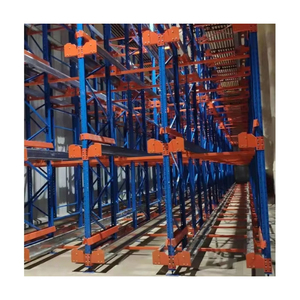
 Shuttle Dynamic
High Efficiency Auto Rack Shuttles Warehouse Racking Stacking Racks Pallet Shuttle System
- Load Capacity: Up to 1,500 kg / pallet
- Automated Radio-Controlled Carriage
- FIFO / LIFO Dual Functionality
Explore our export-certified heavy-duty drive-in and automated shuttle pallet racking systems. Custom-engineered with Q235B and Q355B cold-rolled structural steel, structural rail supports, and precision guide tracks for rigorous daily material handling operations.
Shuttle Dynamic
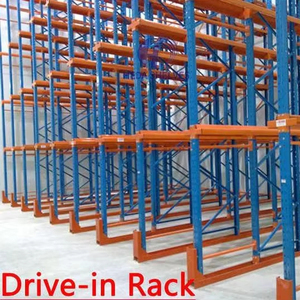 5-Tier High Cube
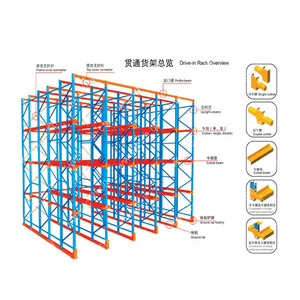 Anti-Corrosion
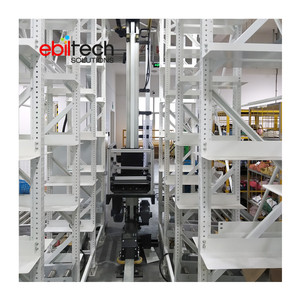 Automated ASRS
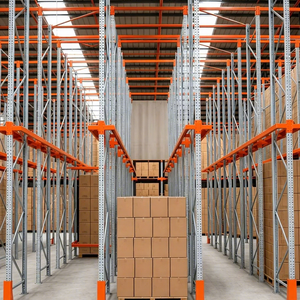 Bulk Storage
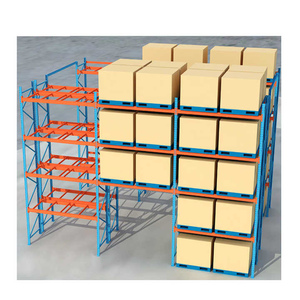 2000kg Payload
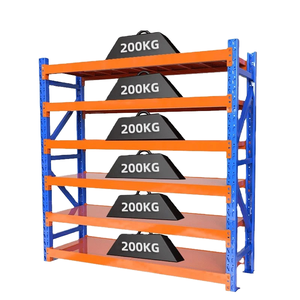 Modular Adjustable
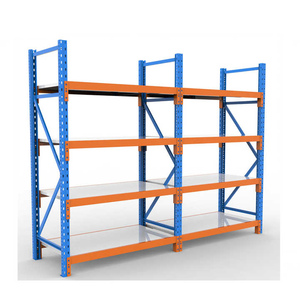 Roller-Guided
Drive-in and drive-through pallet racking systems represent the ultimate structural compression of warehouse floor plans by eliminating conventional forklift access aisles. Unlike selective pallet racking—where horizontal beams continuously bind frames in both planes—drive-in racks rely on cantilevered support arms and longitudinal top-tie portal beams to maintain lateral equilibrium.
Because forklifts enter directly into the storage lanes, intermediate horizontal cross-beams cannot be installed within the drive-in bays. Lateral stability is instead governed by structural roof-level horizontal bracing systems, top portal tie beams, and heavy-gauge back diagonal cross-braces (in single-entry drive-in layouts). Our engineering team executes finite element analysis (FEA) to confirm that secondary bending moments are thoroughly dispersed across the upright frame columns.
We source prime, high-tensile structural coil steel (standard Q235B and high-yield Q355B with minimum yield strengths exceeding 355 MPa). Upright columns feature complex multi-flange omega profiles roll-formed through 24-station automated cold-forming lines. The increased number of return bends imparts supreme torsional resistance and suppresses local Euler buckling under intensive vertical loads exceeding 20 metric tons per bay.
Inside drive-in bays, forklift clearance tolerances typically drop to 75–100 mm on either side of the pallet load. To mitigate the risk of upright column collisions, our high-density systems are fitted with 10 mm heavy-plate wrap-around upright protectors, bull-nose aisle entry shields, and hot-rolled structural C-channel or angle-iron floor guidance tracks bolted into concrete slabs with mechanical wedge anchors.
Evaluate space density, rotational velocity, operational safety, and capital expenditure across major pallet racking architectures to identify your optimal warehouse layout.
| Racking Architecture | Space Density Ratio | Rotation Principle | Forklift Inside Rack? | SKU Diversity | Direct Capital Cost |
|---|---|---|---|---|---|
| Heavy-Duty Drive-In Rack | Up to 80% | LIFO (Last-In, First-Out) | Yes (Aisle-free entry) | Low SKU / High Batch | Economical & Robust |
| Drive-Through Rack | Up to 75% | FIFO (First-In, First-Out) | Yes (Two-way entry) | Low SKU / High Turnover | Moderate Investment |
| Radio Pallet Shuttle | Up to 85% | FIFO or LIFO | No (Automated Cart) | Medium SKU Depth | High Automation ROI |
| Push Back Racking (Carts) | Up to 65% | LIFO (Gravity Push) | No (Front face only) | Moderate (2–6 deep) | Moderate-to-High |
| Standard Selective Rack | 35% – 45% | 100% Immediate Access | No (Wide Forklift Aisles) | Unlimited SKU Variety | Base Baseline |
As logistics real estate prices skyrocket and energy consumption becomes a critical KPI in cold storage operations, strategic procurement teams are transitioning from static, volume-hungry selective racks to high-yield engineered storage configurations.
In temperature-controlled facilities operating between -18°C and -30°C, refrigeration power represents up to 60% of total facility operational expenditures. Because cooling empty air space in wide forklift aisles is fiscally unsustainable, global food processors and cold-storage 3PLs are standardizing on multi-lane drive-in and automated shuttle installations. Condensing cubic volume reduces the refrigeration compressor load per pallet position by 35% to 50%.
A notable shift in global specifications is the demand for forward-compatible infrastructure. Warehouse operators purchase mechanical drive-in racking engineered with pre-punched rails capable of retrofitting battery-powered automated radio pallet shuttles in the future. This hybrid approach enables enterprises to commission cost-effective drive-in lanes today and seamlessly upgrade to automated lane runners as throughput volume warrants, without structural tearing or operational shutdown.
By leveraging advanced micro-alloyed structural steels treated with vanadium, niobium, and titanium additives, modern roll-forming technology produces columns that are 15% lighter while demonstrating a 25% increase in yield strength. This engineering breakthrough curbs overall container freight shipping costs to North American and European discharge ports while bolstering compliance with strict seismic building codes (such as California OSHPD and IBC high seismic zones).
Every beam, column profile, bracket, and guide rail manufactured at HEDA passes through our documented ten-stage production sequence to guarantee sub-millimeter dimensional tolerances and durable powder coating adhesion.
Prime carbon steel coils are ultrasonically inspected for surface flaws, gauge consistency, and chemical composition before slitting.
Automated slitting heads shear wide master coils into narrow strip dimensions tailored to specific roll-forming section geometry.
High-tonnage mechanical presses punch teardrop or diamond slot patterns with continuous pitch accuracy within ±0.1 mm.
A 24-station roll-forming train shapes the slit steel strip gradually, avoiding localized micro-cracking and residual stress.
Robotic welding cells execute deep-penetration CO2 shielded arc welds joining heavy connection brackets to boxed beam profiles.
Immersed in multi-stage chemical baths to completely strip rolling scale, oil, and rust, depositing a crystalline rust-inhibitive phosphate layer.
High-voltage electrostatic spray guns coat all steel components with thermosetting epoxy-polyester powder (60–80 μm dry film thickness).
Components travel through a 200°C convection baking tunnel, melting the powder into a uniform, chip-resistant, highly durable shell.
Quality engineers run cross-hatch adhesion tests, impact resistance checks, and random batch destruction tests to confirm load ratings.
Beams and uprights are bundled with dense dunnage, protective edge protectors, and vapor-barrier shrink wrap to ensure rust-free arrival at destination ports worldwide.
Clear, engineering-backed answers addressing the most common technical, operational, and commercial questions raised by international logistics project planners.
Drive-in racking eliminates inter-rack working aisles, converting up to 75% to 80% of total warehouse floor footprint into active pallet storage space. However, because pallets are accessed sequentially inside deep lanes, the system enforces a Last-In, First-Out (LIFO) inventory model. It is ideally suited for operations with low SKU variety and high pallet counts per SKU (such as fast-moving consumer goods, raw ingredients, beverage bottling, and seasonal cold storage), rather than high-mix, single-carton pick environments.
In standard drive-in configurations, the clear lane dimension between the inner vertical edges of the load rails is typically configured to provide a 75 mm to 100 mm margin on either side of the pallet. Forklift overall chassis width must be at least 150 mm narrower than the internal drive lane width. To protect structural uprights from operational mast sway, we strongly specify floor-mounted angle guide rails or inverted structural channels along the full lane depth.
Yes. Our engineering department develops full structural calculation packages, load tables, and detailed CAD layouts compliant with international building codes. For installations in the United States and Canada, calculations are prepared against RMI ANSI MH16.1 provisions, factoring in site-specific Spectral Acceleration coefficients (Ss, S1), seismic design categories, soil classifications, and building floor slab thickness for direct submittal to your local structural engineer of record (EOR).
For sub-zero freezers down to -30°C, temperature fluctuations create condensation during defrost cycles, accelerating oxidation on standard paint. We provide high-adhesion electrostatic polyester coatings cured over multi-stage zinc phosphating, or full hot-dip galvanization per ASTM A123. Hot-dip galvanized uprights and load rails provide comprehensive zinc metallurgical protection, ensuring rust-free performance and maintaining steel ductile integrity in moist, freezing environments.
To produce an optimized CAD proposal within 24 hours, our engineering staff requires: (1) Architectural floor plan showing columns, building obstructions, clear height under trusses, and floor slab specifications; (2) Pallet dimensions (W x D x H) including goods overhang and gross weight; (3) Forklift model, overall mast lift height, collapsed mast height, and turning radius; and (4) Throughput parameters (daily pallet movement volume and FIFO vs. LIFO requirements).
All upright columns and portal beams are strapped into rigid bundles on timber runners designed to be offloaded using forklifts at receiving container bays. Cantilever brackets, guide rail splices, hardware, and anchor assemblies are crated in corrugated industrial timber boxes. All steel-on-steel contact points are padded with high-density corrugated board and foam wraps to prevent coating abrasion throughout ocean transit.
Partner directly with Guangzhou Heda Shelves Co., Ltd.—your trusted, ISO 9001 and CE certified drive-in racking factory. Send your facility drawings for a complimentary 3D layout, structural load calculation, and itemized factory-direct export quotation within 24 hours.