Industrial Heavy Duty Steel Pallet Rack Warehouse Shelving System
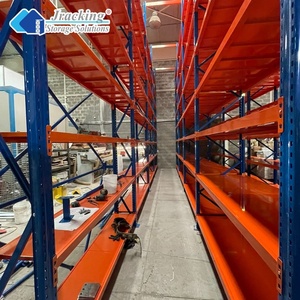
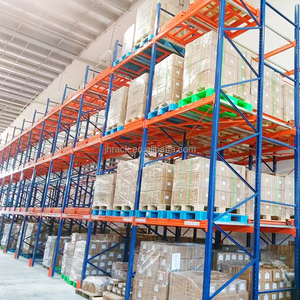
High-bay selective structural solution supporting single and double-deep pallet layouts with CNC-punched omega upright profiles.
- 1,000–5,000 kg/Level
- Q235B/Q355B Steel
- 50/75mm Pitch
Direct mill-formed industrial racking configured for international load standards (ANSI MH16.1, EN 15512, AS 4084). Select a qualified system below to review load tables, FEA profiles, and technical specifications.
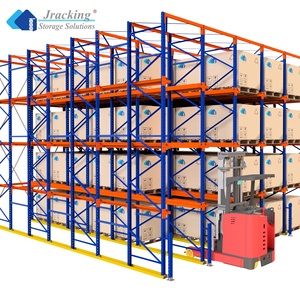
High-bay selective structural solution supporting single and double-deep pallet layouts with CNC-punched omega upright profiles.
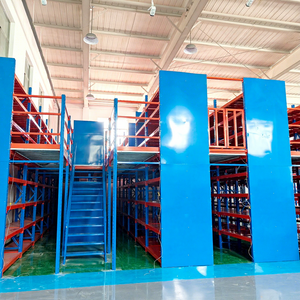
Multi-tier structural steel mezzanine platform maximizing vertical cubic space for high-density carton picking and operations.
Engineered to DIN EN 15512 specifications with precision interlocking beam-end connectors for high-turnover logistics hubs.
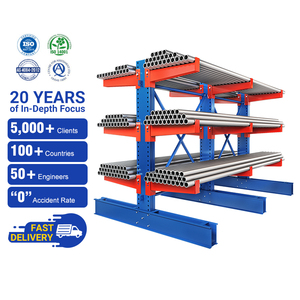
Unobstructed frontal design configured for timber, aluminum extrusion, structural steel pipe, and oversized building supply storage.
Telescopic rolling cart system providing 2-to-6 pallet deep gravity push-back operation, increasing floor capacity by up to 75%.
Sub-millimeter tolerance automated storage structure engineered for robotic shuttle extraction, crane interfaces, and e-commerce tote fulfillment.
100% selectivity configuration finished with industrial electrostatic thermosetting epoxy coating for extreme chemical & abrasion resistance.
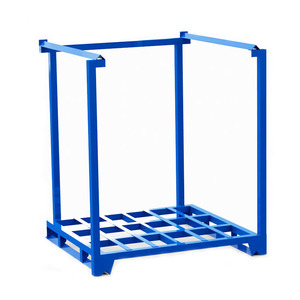
Heavy-duty movable and nestable storage racking eliminating permanent aisle overheads for seasonal, 3PL, and bulk agricultural warehouses.
In modern high-bay logistics facilities, the structural integrity of industrial warehouse racking is strictly governed by the underlying metallurgical chemistry and cold-formed profile geometry. For global procurement directors, distinguishing between domestic Chinese structural steel grades and their Western equivalents is fundamental to mitigating catastrophic frame buckling, excessive deflection, and seismic shear collapse.
The vast majority of top-tier Chinese racking fabricators utilize either Q235B or Q355B structural carbon steels. Under Chinese standard GB/T 700 and GB/T 1591, these steels are fine-grain killed steels optimized for continuous roll-forming without micro-cracking at cold bend radii:
| Steel Grade (China) | International Equivalent | Min. Yield Strength ($R_e$, MPa) | Tensile Strength ($R_m$, MPa) | Elongation ($A$, %) | Primary Intralogistics Application |
|---|---|---|---|---|---|
| Q235B | ASTM A36 / EN S235JR | ≥ 235 | 370 – 500 | ≥ 26 | Box beams, shelf panels, wire decking, base plates, row spacers |
| Q355B | ASTM A572 Gr 50 / EN S355JR | ≥ 355 | 470 – 630 | ≥ 22 | Heavy-duty upright columns, cantilever towers, ASRS high-bay frames |
| SPCC / DC01 | ASTM A1008 Cold Rolled | ≥ 130 – 210 | ≥ 270 | ≥ 38 | High-precision mini-load brackets, small parts bin dividers, tote rails |
When selecting a China warehouse racking supplier, verifying the mill test certificates (MTC) to EN 10204 3.1 standards ensures the raw coil meets precise carbon equivalents ($CEV \le 0.38$). Higher yield strengths like Q355B allow manufacturers to reduce cross-sectional steel gauge while preserving identical structural load factors, which significantly lowers shipping container gross weight and overall procurement expenditure per pallet position.
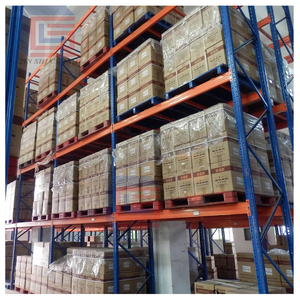
Operating across North American, European, and Asia-Pacific regulatory regimes requires Chinese racking manufacturers to adapt finite element models (FEA) and testing criteria to the regional building codes of each installation site.
Governed by the Rack Manufacturers Institute. Enforces strict torsional buckling limits, cold-formed effective width calculations (AISI S100), and seismic acceleration design (IBC Category A through F). Upright perforations require calibrated stub-column physical testing.
The European Standard specifies limit-state design principles with explicit partial safety factors ($\gamma_M = 1.4$). It mandates real-world testing of beam-end connectors for rotational spring stiffness ($c_k$) and upright baseplate floor-anchorage moment capacity.
The newly revised Australian standard mandates rigorous seismic drift modeling and second-order P-Delta analysis. Tier-1 Chinese suppliers targeting Australasia must validate factory batch samples using NATA-accredited test rigs for shear and compression capacity.
In selective and double-deep racking, horizontal beam deflection under full static rated load must strictly conform to $L/200$ (where $L$ is clear beam span length) under RMI provisions, or $L/200$ with European limit-state thresholds ($5\text{ mm}$ safety factor limit). Beam-end connectors typically feature a 3, 4, or 5-hook cold-punched lug pattern configured with automatic mechanical locking pins. These pins resist upward seismic or accidental forklift dislodgement forces exceeding $5.0\text{ kN}$.
The global intralogistics supply chain is undergoing profound structural modernization. Procurement teams sourcing from Chinese manufacturers must account for four major engineering and macroeconomic shifts over the next five-year cycle.
Traditional manual drive-in systems are rapidly giving way to 4-way radio shuttle and mother-child shuttle automation. Racking frames are now manufactured as mechanical guidance tracks, demanding dimensional tolerances below $\pm 1.0\text{ mm}$ over 30-meter continuous runs to prevent robotic carriage jams.
With the European Carbon Border Adjustment Mechanism (CBAM) and US corporate Scope 3 emission targets, leading Chinese racking factories are transitioning to electric arc furnace (EAF) low-carbon steel coils and adopting solar-powered electrostatic powder coating lines with zero heavy metals.
Cold-storage logistics facilities (operating at $-25^\circ\text{C}$ to $-35^\circ\text{C}$) induce severe embrittlement in conventional carbon steels. Forward-looking procurement mandates low-temperature impact-tested steel grades (Charpy V-notch tested at $-20^\circ\text{C}$) and micro-textured powder formulas that eliminate surface ice buildup.
A rigorous architectural breakdown to align warehouse layout parameters, SKU velocity, and capital expenditure constraints against proven racking typologies.
| Racking Topology | Pallet Selectivity | Floor Space Utilization | Inventory Rotation | Forklift Compatibility | Typical Cost per Pallet (USD) |
|---|---|---|---|---|---|
| Standard Selective | 100% Direct | 35% – 45% | FIFO / LIFO | Standard Counterbalance, Reach | $45 – $75 |
| Double-Deep Pallet | 50% Direct | 50% – 60% | LIFO | Deep-Reach Pantograph Forklift | $55 – $85 |
| Drive-In / Drive-Through | Single Lane Access | 65% – 75% | LIFO (Drive-In) / FIFO | Narrow Counterbalance / Reach | $70 – $110 |
| Push-Back Carts | Pick-Face Only | 65% – 75% | LIFO | Standard Counterbalance, Reach | $110 – $180 |
| Gravity Pallet Flow | Pick-Face Dedicated | 75% – 85% | Strict FIFO | Any Standard Lift Truck | $160 – $260 |
| Radio Shuttle Automation | Lane Dynamic | 80% – 90% | FIFO or LIFO Selectable | Forklift Interface + Auto Shuttle | $180 – $320 |
| Rack-Supported Mezzanine | Floor Level Dependent | 100% – 200% Added | Manual Carton / Pallet Mix | Pallet Jacks, VRC Lifts, Hand Trucks | $90 – $160 / m² |
Operating a modernized 30,000 m² (approx. 323,000 sq ft) production campus in Guangzhou, HEDA Shelves is an internationally certified OEM/ODM industrial racking and mezzanine manufacturer. Supplying global distribution hubs across the USA, Canada, Europe, and Australia, we bridge structural engineering precision with unmatched manufacturing capacity.
Upload your warehouse floor plans and clear heights. Our certified racking engineers will provide a complete structural layout, capacity bill of materials, and landed container cost estimate within 24 hours.
Inquire NowDirect technical answers addressing structural calculation, tariff classifications, container stuffing, and on-site engineering approvals.
Top Chinese manufacturers supply complete finite element modeling (FEA) data packages, material mill test certificates (MTC), and component section property tables (moment of inertia $I_x, I_y$, radius of gyration $r_x, r_y$, and torsional constants). These packages are directly formatted to ANSI MH16.1 and local building code standards (such as IBC 2024 or CBC in California). Your local professional engineer of record (PE) can immediately audit and stamp these structural calculations for city permit applications without having to recalculate from scratch.
Industrial steel warehouse racking is uniformly classified under HS Code 7308.90.00 (Structures and parts of structures, of iron or steel). Cargo is bundled using heavy-duty steel strapping, corrugated protective channels, and water-repellent VCI stretch wrap. Uprights and box beams are nested using precision dunnage blocks to optimize the gross weight limit of 40-foot High Cube (40HQ) ocean containers (typically up to 26–28 metric tons depending on port axle weight regulations).
Direct powder application onto untreated steel leads to rapid flaking, under-film corrosion, and failure within 24 to 36 months, especially in humid or temperature-fluctuating environments. HEDA utilizes a rigorous 10-step pre-treatment sequence: alkaline hot degreasing, acid pickling to eliminate scale, multiple water rinses, surface activation, and zinc phosphating. This produces a micro-crystalline conversion layer that chemically binds the electrostatic epoxy-polyester powder coat, delivering over 500 hours of standard salt spray resistance (ASTM B117) and pencil hardness ≥ 2H.
Yes. Chinese automated punching dies are fully configured to manufacture North American standard 2-inch teardrop profiles, European 50mm/75mm hook patterns, and Australian 76.2mm hole centers. Custom tooling can be produced to match legacy warehouse configurations, allowing seamless expansion of existing facilities without requiring complete structural teardowns.
Standard fabrication timelines for enterprise orders (2 to 10 full container loads) average 15 to 22 business days following structural shop-drawing sign-off. Ocean transit adds approximately 14–18 days to US West Coast ports (Los Angeles/Long Beach), 25–30 days to East Coast ports (Savannah/New York), and 22–26 days to major European ports (Rotterdam/Hamburg). Comprehensive bilingual installation manuals, 3D exploded views, and labeled bundle marks are supplied with every container.