2~5 Carts Heavy
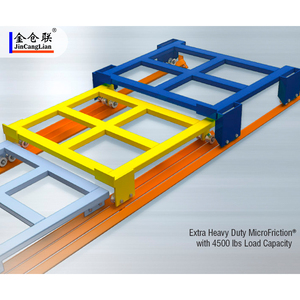
Modern distribution centers, 3PL facilities, and cold chain freezers face an urgent macro-economic imperative: skyrocketing cost per square foot coupled with intense pressure for rapid throughput. As a premier original design manufacturer (ODM) based in China with over two decades of production heritage, our push back pallet racking systems reconcile two historically conflicting warehouse objectives—extreme density and selective SKU accessibility. Operating on an inclined rail configuration with nested telescopic steel carts, these systems automatically advance loads to the aisle face via controlled gravity, completely eliminating the structural hazards and cycle bottlenecks associated with conventional drive-in systems.
Manufactured strictly according to ISO 9001:2015, CE Marking (EN 15512), and North American RMI (Rack Manufacturers Institute) standards. Explore our proven heavy-duty industrial configurations:
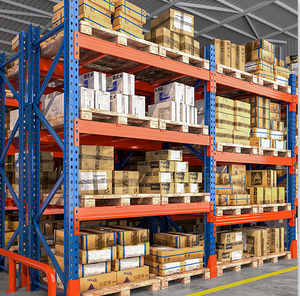
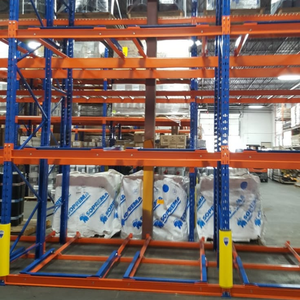
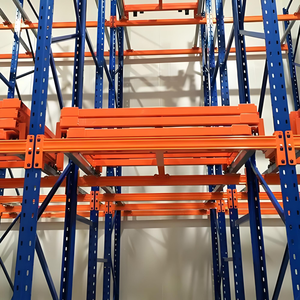
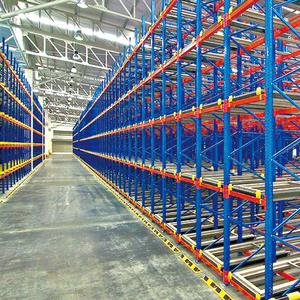
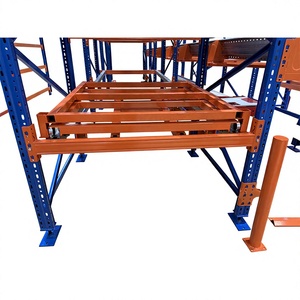
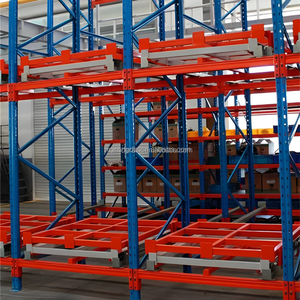
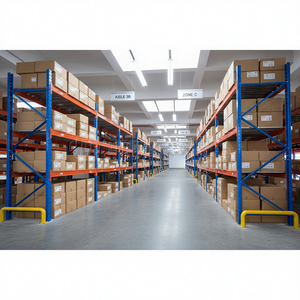
Unlike standard static pallet racks, push back systems operate as dynamic mechanical assemblies. Understanding the underlying kinetic design ensures zero hang-ups, structural balance, and long-term operating safety under peak loading cycles.
The rails are calibrated at an exact slope—typically between 1.5% and 3.0% depending on pallet weights and environment. This geometric gradient balances smooth gravitational return with controlled momentum, preventing pallet drift or unassisted velocity spikes at the aisle face.
Our nesting cart design stacks low-profile carriages over heavy structural guide rails. Cart 1 nests inside Cart 2, which nests inside Cart 3. This cascading geometry saves critical vertical clearance (headroom) and minimizes the vertical clearance requirement per beam tier, preserving up to 2 extra beam levels per bay.
Every cart rides on large-diameter, heavy-duty machined steel wheels fitted with permanently lubricated, sealed ball bearings. Anti-lift clips and dual-flange wheel tracking prevent cart derailment even under uneven pallet placement or sudden forklift braking.
Warehouse infrastructure procurement is undergoing a paradigm shift driven by smart sensing, cold supply chain expansion, and automated materials handling integration.
Procurement teams are prioritizing push back systems engineered with tighter dimensional tolerances to interface seamlessly with Autonomous Guided Forklifts (AGVs). Smart camera alignment tags, optical lane targets, and reinforced front stops accommodate automated pallet placement without operator intervention, transforming mechanical LIFO systems into automated high-density buffers.
With global cold chain and frozen food storage costs quadrupling, push back systems have become the preferred alternative to drive-in racks. Next-generation systems feature specialized low-viscosity synthetic bearing lubricants rated to -40°C, cryogenic-resistant structural steel formulations, and thermal galvanized coatings that eliminate freeze-thaw corrosion.
Enterprise procurement has shifted from initial purchase price (CapEx) to total cost of ownership (TCO). Buyers increasingly demand FEA (Finite Element Analysis) stress modeling certified against local seismic zones (IBC, Eurocode 3, AS4084), hot-rolled structural steel channel front columns, and easily replaceable cart modularity to withstand forklift impacts over decades.
Delivering turn-key manufacturing excellence, factory direct transparency, and certified compliance across North America, Europe, Australia, and worldwide logistics hubs.
Over 10,000+ completed installations across 130+ countries. Our proprietary cold-forming and roll-tooling lines ensure repeatable dimensional accuracy.
Send your warehouse floor plans and clear heights. Our certified racking engineers provide fully stamped structural CAD and 3D models within 24 hours.
From raw certified coil slitting to automated 10-step pickling, phosphating, and electrostatic powder baking, our Q/C testing adheres to rigorous ASTM & EN standards.
Custom steel packaging, color-coded bundle labeling, and pre-nested cart assemblies minimize ocean transit volume and reduce on-site installation labor by 35%.
Essential engineering and commercial answers to streamline your vendor evaluation and procurement process.
While drive-in racking achieves similar pallet density, it forces forklift operators to drive physically inside the steel rack bay, drastically increasing cycle times and risking structural column damage. Push back racking operates entirely from the aisle face—the truck never enters the rack. Operators gain up to 60% faster loading/unloading speeds while each lane can hold a distinct SKU.
Standard engineering configurations accommodate 2, 3, 4, 5, and 6 pallets deep per lane. While 2 to 4 pallets deep are the most popular configurations for standard counterbalanced forklifts, 5 and 6 pallet deep lanes are commonly fabricated for high-capacity reach trucks. Deep lanes utilize our reinforced multi-stage telescoping carriage chassis with specialized low-friction wheel compounds.
Yes. In standard push back systems, every pallet (except the final one in the lane, which sits directly on the structural guide rails or the last cart) rests securely across the full steel perimeter of a dedicated nested cart. This eliminates the catastrophic "drop through" risk common in selective or drive-in racks where broken bottom boards or defective runners can cause pallets to dislodge.
We supply complete engineering dossiers: mill test certificates for Q235B and Q355B steel coil chemistry and yield strength, weld inspection reports, CE Declaration of Performance (DoP), ISO 9001:2015 tracking, and CAD shop drawings dimensioned in imperial (inches/lbs) or metric units with structural engineer calculation sheets ready for local city permitting.
Consult with our senior warehouse systems designers today. Receive an optimized CAD layout, complete structural calculation report, and a transparent FOB/CIF factory direct quotation within 24 hours.