High-Efficiency Warehouse Racking & Material Handling Equipment
Engineered to international FEM and RMI standards. Browse our factory-direct industrial storage line ready for container export to the USA, Canada, Europe, and global supply hubs.
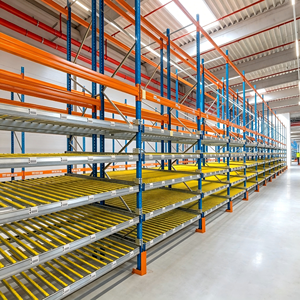
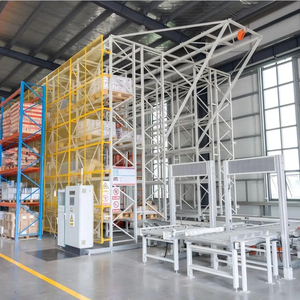
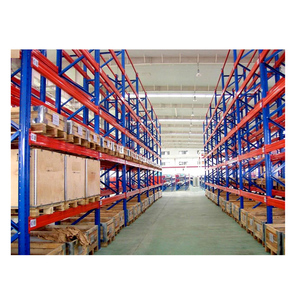
Very Narrow Aisle (VNA) Engineering Economics & Volumetric ROI
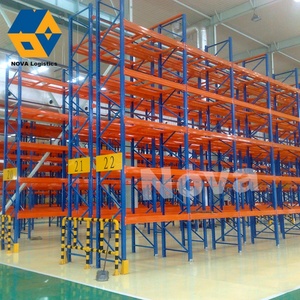
In modern industrial real estate, rising land acquisition costs and escalating facility lease rates have shifted focus from square footage to cubic volumetric utilization. VNA racking represents the peak convergence of mechanical selectivity and spatial compaction.
Shrinks typical 3.5m aisles down to 1.6m–1.8m.
Multiplies pallet positions across identical footprints.
Immediate access without honeycombing or re-slotting.
Fully exploits modern logistics clear ceiling heights.
Technical Definition: What Separates VNA from Standard Selective Systems?
Unlike standard wide-aisle selective racking (which demands 3.2m to 3.8m working clearance for standard counterbalanced lift trucks), a Very Narrow Aisle (VNA) system restricts aisle widths to strictly 1,500mm – 1,850mm. Specialized material handling equipment—predominantly Man-Up or Man-Down turret trucks (trilateral stackers) or articulated reach trucks—operates inside these narrow channels, guided either by mechanical floor-mounted profile rails or inductive under-floor radio frequency (RF) wire guidance systems.
This architectural transformation yields extreme spatial efficiency without sacrificing the 100% selectivity required by fast-moving distribution centers (3PLs), cold-chain freezers, pharmaceutical distribution networks, and auto-parts manufacturing hubs.
Engineering Benchmark: Conventional vs. VNA vs. Automated Storage
| System Architecture | Operating Aisle Width | Maximum Practical Height | Floor Flatness Spec (DIN/EN) | Selectivity Profile | Relative Pallet TCO |
|---|---|---|---|---|---|
| Standard Selective Racking | 3,200 mm – 3,800 mm | Up to 10.5 meters | Standard Free Movement (DIN 18202) | 100% Immediate | Baseline ($) |
| Double-Deep Pallet Racking | 3,000 mm – 3,400 mm | Up to 11.0 meters | Standard Industrial Flat | 50% Immediate (LIFO) | Moderate ($$) |
| Very Narrow Aisle (VNA) | 1,500 mm – 1,850 mm | Up to 18.0 meters | Superflat (DIN 15185 / EN 15620 Class 300) | 100% Immediate | Optimal Volumetric ROI ($$) |
| Drive-In / Drive-Through | N/A (Drive-In Channel) | Up to 12.0 meters | Standard Warehouse Flat | Low (High Honeycombing) | Low-Mid ($$) |
| Automated AS/RS (Crane-Based) | 1,400 mm – 1,600 mm | Up to 40.0+ meters | High-Precision Defined Movement | 100% Automated | High Capital Expenditure ($$$$$) |
Top 10 VNA Warehouse Racking Manufacturers & Exporters
A rigorous review of the world's leading racking producers based on production capacity, high-bay roll-forming tolerances, export logistics compliance, and global engineering credentials.
Guangzhou HEDA Shelves Co., Ltd.
SSI SCHAEFER Group
Mecalux S.A.
Jungheinrich AG
Stow Group
Dexion (Gonvarri Material Handling)
AR Racking (Grupo Arania)
Frazier Industrial Company
BITO-Lagertechnik Bittmann GmbH
Dematic (KION Group)
VNA Structural Integrity, Guidance Systems & Floor Tolerances
A Very Narrow Aisle installation cannot be treated as a standard static racking project. Because operational mast heights reach up to 18 meters with clearances as tight as 100mm per side, static and dynamic tolerances must be stringently calculated.
1. Superflat Floor Criteria (DIN 15185 / TR34)
The performance of a VNA system is fundamentally limited by concrete slab flatness. At a 16-meter lift height, a mere 2mm imperfection in transverse floor level produces a dynamic mast tilt exceeding 120mm at the top tier. Facilities must be engineered to DIN 15185, EN 15620 (Class 300), or the UK Concrete Society's TR34 DM1 / DM2 standard. When existing slabs do not comply, laser grinding of the operational wheel tracks is required prior to rack erection.
2. Guidance Mechanics: Steel Rails vs. Inductive Wire
VNA trucks cannot be manually steered within the aisle. Mechanical guidance utilizes heavy-duty continuous low-profile profile steel angles (typically 100 × 75 × 8mm or 120 × 80 × 10mm) anchored into the concrete at 500mm intervals with embedded countersunk bolts. Alternatively, inductive wire guidance employs an electrified frequency loop embedded 15mm deep in the floor center, eliminating tripping hazards and facilitating rapid bottom-beam picking accessibility.
3. Beam Deflection & Plumbness Tolerances
Under ANSI MH16.1 and EN 15512 codes, beam deflection under maximum design working load (DWL) must not exceed L/200 (where L is beam span), while VNA high-bay engineering frequently mandates a stricter L/300 to ensure fork-carriage extraction clearances. Out-of-plumb vertical upright tolerances are restricted to 1:500 or less, verified by optical theodolite surveys during certified handover.
VNA Procurement & Technological Trends (2025–2030 Horizon)
Strategic purchasing managers evaluate VNA infrastructure through the lens of long-term lifecycle resilience. The following key trends are reshaping global technical requests for quotations (RFQs).
Transition to Autonomous Turret AGVs
Warehouses are bridging the gap between manual turret trucks and multimillion-dollar automated cranes. Modern VNA racking is being pre-configured for automated guided turret trucks (AGVs) using sensor-integrated top guide rails, LiDAR reflector brackets, and precise mechanical tolerances that facilitate lights-out 24/7 pallet placement without retrofitting.
Cold-Chain High-Cube Optimization
The cost per kilowatt-hour to maintain refrigerated or blast-freezer temperatures (-18°C to -28°C) has skyrocketed. Procurement executives are systematically replacing wide-aisle systems with high-bay VNA racks, slashing refrigerated cubic volume waste by up to 40% and lowering per-pallet thermal operating costs drastically.
Ultra-High-Yield Micro-Alloyed Steels
Environmental carbon accounting and shipping freight optimization are steering engineers toward high-strength cold-rolled coils (such as Q355B and ASTM A1011 Grade 50). These advanced metallurgy profiles reduce total steel tonnage by 12–18% while sustaining identical or superior safety factor ratings (1.67 structural safety factor under RMI).
Why International Buyers Partner with HEDA Shelves
Combining 25+ years of production expertise with verified certifications and end-to-end engineering support. We streamline international pallet racking procurement from initial concept to container port delivery.
323,000 sq ft Manufacturing Campus
Our 30,000 m² production facility in Guangzhou houses fully automated continuous roll-forming lines, automated CNC punching, and robotic welding stations ensuring consistent millimeter tolerances.
Free 24h CAD & 3D Modeling
Submit your warehouse layout, clear ceiling heights, and pallet specifications. Our senior structural logistics engineers provide full CAD layout plans, 3D spatial renders, and load-table calculations within 24 hours.
ISO 9001 & CE Certified
Quality management verified under ISO 9001:2015 (Cert No. 18624Q00169R0M) and European Construction Products Regulation CE (Cert No. 2435-CPR-8605159). Fully qualified for OEM & ODM private label programs.
Export & Port Ready Packing
Engineered bundle strapping, heavy-gauge plastic wrapping, and bespoke pallet supports prevent container transit damage. Full documentation support for customs clearance at all major US, Canadian, and European ports.
Frequently Asked Questions on VNA Racking Procurement
Comprehensive engineering and international purchasing inquiries answered by our senior racking structural engineering division.
Because VNA man-up turret trucks operate with mast elevations up to 18 meters, floor tolerances must strictly comply with defined-traffic standards rather than generic industrial free-movement specs. The industry gold standard is DIN 15185 or the British Concrete Society TR34 (Class DM1 for lift heights exceeding 13m, and DM2 for lift heights between 6m and 13m). In North American facilities, ASTM E1155 F-min numbers typically require an F-min value between 75 and 100 in the wheel paths. If existing concrete slabs exhibit slope or undulation, specialized robotic wheel-track grinding must be performed prior to operating trucks.
The decision centers around pick-face ergonomics, floor preparation flexibility, and overall budget. Mechanical guide rails (typically 100 × 75 × 8mm structural angle) provide immediate, failsafe physical protection for the uprights, lower truck control complexity, and allow simultaneous bottom-level pallet placement on timber/steel floor runners. However, they reduce available floor space slightly and represent a pedestrian tripping hazard. Wire guidance utilizes a 15mm-deep low-frequency energized antenna cut into the slab center, providing clean floor transitions, easier housekeeping, and faster order-picking cart transitions, but requires higher upfront onboard sensor costs on the lift trucks.
All HEDA Shelves international export projects undergo customized finite element analysis (FEA) calibrated to the exact seismic site parameters of your building jurisdiction (e.g., US International Building Code [IBC], ASCE 7, and NFPA 13 requirements; Canadian National Building Code [NBCC]). We supply comprehensive calculation sheets specifying enlarged footplate surface areas, twin heavy-duty anchor bolt embedments, and heavy-gauge back-to-back cross bracing configurations so that your local licensed Professional Engineer (P.E. / EOR) can review and seal permit documentation effortlessly.
Yes, precisely. We routinely manufacture systems specifically sized for North American 48″ × 40″ GMA pallets, 1200 × 800mm and 1200 × 1000mm European EUR/EPAL pallets, and custom industrial steel shipping bins. Beam clear spans (e.g., 96″, 108″, or 144″) and frame depths (typically 42″ or 48″) are optimized with standard 3″ to 4″ safety clearances and heavy-gauge flanged waterfall wire decking or pallet support crossbars.
Factory production for standard container-volume VNA projects typically completes within 15 to 25 business days from final approved CAD shop drawings. Ocean transit from Guangzhou/Shenzhen port to West Coast North American ports (Los Angeles, Long Beach, Vancouver) is approximately 14 to 18 days, and to East Coast ports (New York, Savannah, Houston) approximately 28 to 35 days. Detailed bundle packing lists and container loading photographs are generated for every dispatch.
Accelerate Your Warehouse Capacity with a Custom VNA Layout
Submit your warehouse building dimensions, clear height, and pallet load specs. Our engineering team provides a fully engineered CAD design, 3D spatial simulation, and itemized factory-direct quote within 24 hours.