Long Goods Storage
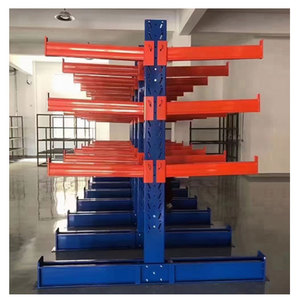
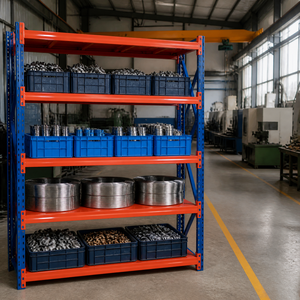
DJ Heavy-Duty Steel Adjustable Cantilever Rack Warehouse Storage
- Load Capacity: 500kg - 2000kg / Arm
- Structural Grade: Q235B / Q355B Steel
- Application: Bar stock, pipe, lumber
Precision-engineered roll-formed and structural steel profiles manufactured under ISO 9001:2015 and CE certification standards, load-rated up to 5,000 kg per storage level for harsh distribution environments.
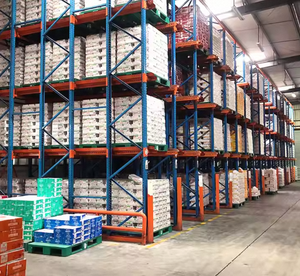
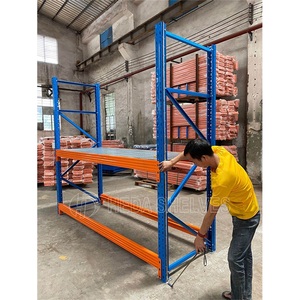
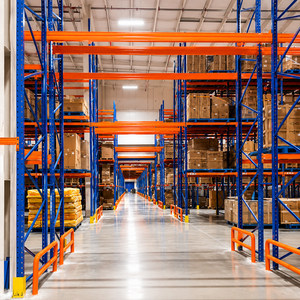
A comprehensive technical analysis for warehouse operations directors, structural engineers of record (EOR), and institutional intralogistics procurement leads navigating complex global supply chains.
Modern distribution infrastructure demands an uncompromising convergence of volumetric spatial density, high cyclic throughput efficiency, and life-safety seismic compliance. In this context, selecting a premier heavy duty pallet racking system supplier & exporter goes far beyond comparing nominal metric-ton steel prices. It necessitates an advanced forensic review of steel metallurgy, finite element analysis (FEA) modeling, automated roll-forming roll pass line repeatability, and rigorous electrostatic surface passivation treatments capable of enduring decades of chemical exposure and forklift mechanical abuse.
The foundation of structural warehouse racking lies in the metallurgical homogeneity of the base steel coils. Tier-1 manufacturers utilize certified Q235B and Q355B cold-rolled structural steel grades, characterized by minimum yield strengths ranging from 235 MPa to 355 MPa, with strict elongation limits exceeding 20% to prevent sudden brittle catastrophic collapse during low-frequency seismic vibrations or heavy forklift impact vectors.
By implementing precise continuous multi-station cold roll-forming lines, cold-work hardening is strategically leveraged to increase yield strength along critical bends and return lips of the upright profile without creating localized micro-fractures in the crystalline matrix. This guarantees that columns absorb dynamic torsional and bending moments without progressive deformation.
For installations throughout North America, Western Europe, and seismic circum-Pacific zones, compliance with RMI (Rack Manufacturers Institute) ANSI MH16.1 and European Standard EN 15512:2020 is non-negotiable. Pallet rack systems act as unbraced frames in the longitudinal direction and braced frames in the transverse direction, requiring rigorous analysis of semi-rigid beam-to-column connector rotational stiffness.
Furthermore, engineering calculations must explicitly factor in transverse and longitudinal flue spaces (typically mandatory 6-inch vertical openings) mandated by NFPA 13 standards to allow early fire suppression water penetration from ceiling ESFR (Early Suppression, Fast Response) sprinklers down through bottom pallet bays.
This comparative engineering matrix illustrates the structural trade-offs between selective access, storage volumetric density, operating aisle requirements, and operational equipment kinematics.
| Racking Architecture | Pallet Selectivity | Floor Space Utilization | Inventory Rotation | Typical Beam Load (Pair) | Optimal Logistics Scenarios |
|---|---|---|---|---|---|
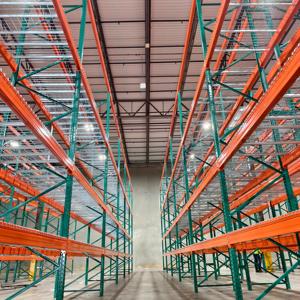
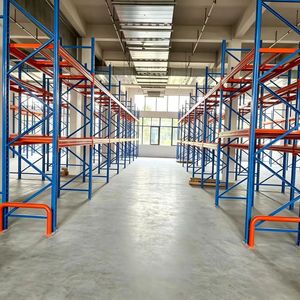
| Standard Selective | 100% (Instant) | 35% - 40% | FIFO / LIFO | 1,000kg - 4,500kg | High SKU variety, fast pick rates, 3PL multi-tenant facilities. |
| Double-Deep Reach | 50% (Secondary Deep) | 50% - 60% | LIFO | 1,500kg - 3,200kg | Medium SKU consolidation, reach truck equipped dry/ambient warehouses. |
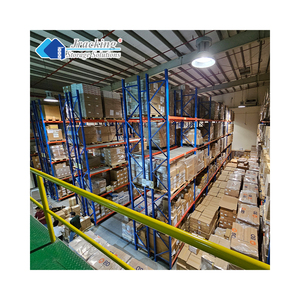
| Very Narrow Aisle (VNA) | 100% (High-Bay) | 55% - 65% | FIFO / LIFO | 1,500kg - 4,000kg | Cubic height utilization up to 16m; guided turret truck operations. |
| Drive-In / Drive-Thru | Last Pallet Face | 65% - 75% | LIFO (Drive-In) / FIFO | 1,000kg - 1,800kg/lane | Homogeneous bulk goods, seasonal reserves, cold storage facilities. |
| Gravity Pallet Flow | Automatic Front Face | 70% - 80% | Strict FIFO | 800kg - 1,500kg/pos | Perishable food/beverage distribution, pharmaceutical expiry control. |
| Push-Back (Cart Type) | Front Lane Pick | 60% - 70% | LIFO | 1,000kg - 1,500kg/cart | 2 to 6 pallets deep per lane; buffer storage with low operational dwell. |
| Radio Shuttle Automation | Lane Dynamic Access | 80% - 85% | Hybrid FIFO/LIFO | 1,000kg - 2,000kg/pos | Deep lane semi-automation; cold chain energy optimization to -30°C. |
| Heavy Duty Cantilever | 100% Unobstructed | Variable / Open | Unrestricted | 500kg - 3,000kg/arm | Pipes, structural timber, sheet metal packs, extrusions. |
Before issuing requests for quotation (RFQ) or committing capital allocations, project procurement teams must evaluate manufacturers across these critical structural and export capabilities.
Top-tier exporters run multi-roll progressive tooling lines with automated punching tolerances of ±0.1mm. Consistent beam pitch and upright column geometry eliminate assembly field binding and guarantee interchangeable replacement parts.
Raw steel requires thorough pre-treatment. Reliable manufacturers deploy continuous 9-stage pickling, phosphating, and electrostatic powder coating lines yielding salt spray resistance exceeding 500 hours under ASTM B117 standards.
A legitimate exporter provides complete stamped structural calculations showing critical limit state load combinations (Dead Load, Live Load, Seismic Equivalent Lateral Forces, and Forklift Impact Factor) verified by Finite Element Analysis.
Pallet rack uprights and box beams are susceptible to transit impact, flexing, and ocean humidity. Superior exporters bundle steel with customized timber cradles, corner steel protectors, and desiccants to prevent transit corrosion.
Project lead times depend on initial layout approvals. Leading suppliers field dedicated civil and mechanical design teams capable of delivering complete DWG plan views, cross-sections, and 3D architectural renders within 24 hours.
Reliable exporters welcome third-party inspections (SGS, TÜV, Bureau Veritas) and maintain internal tensile test machines, weld coupon micro-section analysis, and dynamic deflection drop rigs directly within their manufacturing facilities.
As industrial automation, rising industrial land values, and supply chain decarbonization reshape the global supply chain, procurement executives must anticipate fundamental structural changes in pallet storage hardware.
Traditional manually operated warehouses tolerate ±3mm beam deflection. However, automated storage and retrieval systems (AS/RS) and autonomous mobile robots (AMRs) demand strict structural tolerances within ±1.0mm to prevent optical sensor faults during high-speed pallet extraction.
Global logistics REITs and European enterprise buyers increasingly audit embodied carbon. Suppliers utilizing Electric Arc Furnace (EAF) scrap steel and solvent-free low-VOC thermosetting powder coatings will capture market preference in formal ESG-weighted tenders.
Next-generation heavy-duty pallet racks will integrate fiber-optic or piezoelectric strain gauges and wireless accelerometers embedded inside upright base plates, continuously streaming real-time structural deflection and impact overload alerts to warehouse management systems.
To maximize land utilization while lowering civil construction costs, warehouse developers are eschewing standard steel portal frame buildings. Instead, rack-supported building structures (where the racking system supports the roof and external wall cladding directly) are becoming the primary procurement architecture for high-bay logistics centers exceeding 30 meters in vertical height.
Founded in 2001, Guangzhou Heda Shelves Co., Ltd. has established itself over nearly a quarter century as an authoritative global manufacturer and exporter of heavy-duty pallet racking systems, multi-tier mezzanines, and industrial logistics infrastructure.
Operating from a massive 30,000 square meter (approx. 323,000 sq ft) manufacturing campus powered by automated roll-forming lines, computerized multi-head punching presses, and dual electrostatic powder coating tunnels, our facility delivers an astounding 30,000 metric tons of finished structural steel per month.
With an experienced technical force of over 300 skilled specialists and senior structural engineers, we have engineered, manufactured, and exported solutions for more than 10,000 warehouse projects across the United States, Canada, Europe, Latin America, and Southeast Asia. We provide end-to-end accountability: from raw coil testing and seismic structural calculation to factory container stuffing and on-site assembly guidance.
Clear, definitive technical answers to assist logistics facility managers and purchasing directors throughout the global sourcing cycle.
Our engineering department utilizes specialized finite element analysis software to model dynamic frame responses against local building codes (e.g., IBC 2024 and ASCE 7 in the United States, or Eurocode 3 / EN 15512 in Europe). We incorporate site-specific Spectral Response Accelerations (Ss, S1), soil site classes, and importance factors into the rack design. We supply certified shop drawings, baseplate weldment details, concrete slab point-load calculations, and chemical anchor bolt embedment specifications ready for formal stamping by your local licensed Professional Engineer (PE / EOR).
Yes. For North American facilities handling standard 48" wide x 40" deep GMA pallets, our standard beam span is 96" or 108" for two-pallet configurations and 144" for three-pallet configurations, paired with standard 42" or 44" upright frame depths. This creates the optimal 3" longitudinal clearance between adjacent pallets and allows a safe 3" overhang over front and rear load beams. For European customers handling EUR 1 pallets (1200mm x 800mm) or EUR 2 pallets (1200mm x 1000mm), frames are manufactured at standard depths of 1100mm and spans of 2700mm to comply with FEM/EN guidelines.
Q235B is a standard carbon structural steel offering a minimum yield strength of 235 MPa (equivalent to ASTM A36), delivering exceptional ductility, weldability, and impact toughness at high cost efficiency. It is the global standard for light-to-medium uprights, wire decking, and secondary bracing. Q355B (equivalent to ASTM A572 Grade 50) is a high-strength low-alloy steel with a minimum yield of 355 MPa. We specify Q355B for high-bay upright columns exceeding 9 meters, heavy lower-tier structural frames carrying upwards of 20,000 kg frame loads, and cantilever rack uprights exposed to heavy eccentric torsional moments.
Export packaging is a science of load stabilization and environmental mitigation. Beams and uprights are nested with high-density foam spacers and heavy corrugated edge board to prevent powder coat friction abrasions. Bundles are bound with high-tensile PET or steel strapping onto customized structural timber blocks designed for four-way forklift tines. The exterior of every bundle is wrapped in water-resistant polyethylene film, and multiple silica-gel desiccants are placed inside 40HQ ocean containers to absorb dew point condensation during cross-equatorial ocean voyages.
Absolutely. We operate a fleet of interchangeable CNC punching presses capable of punching traditional 2-inch pitch North American teardrop patterns (fully interchangeable with major US brands), European 50mm pitch trapezoidal slots, 75mm Australian pitch slots, or custom multi-hole patterns for private-label distributor programs. Our engineering department can duplicate your exact legacy punching profile, beam end connector plates, and safety lock configurations to integrate seamlessly into existing warehouse expansions.
Every export shipment from HEDA Shelves includes a complete commercial document set: Clean on Board Ocean Bill of Lading (B/L), itemized Commercial Invoice specifying HS Code (typically 7308.90 for structural steel structures), detailed Packing List with container seal and bundle weights, Certificate of Origin, and Mill Test Certificates (MTC). For the US and Canada, we provide wood packaging heat treatment certifications (ISPM 15 compliance) for all wooden dunnage, along with complete technical spec sheets to substantiate harmonized tariff classifications.