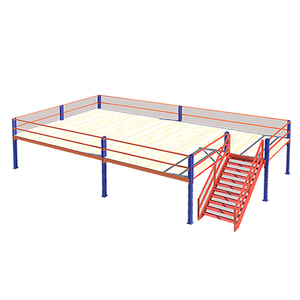
Multi-Tier Storage
Heavy Duty Industrial Storage Pallet Racks Mezzanine Floor
High Clearance
300-1000 kg/m²
Get Catalog
Precision roll-formed steel profiles tested under rigorous static and dynamic load conditions. Fully compatible with North American GMA 48"x40" pallets, European standard containers, and custom footprint geometries.


A granular investigation into high-density volumetric efficiency, forklift guide rail mechanics, seismic baseplates, and dynamic stress dissipation in high-throughput distribution environments.
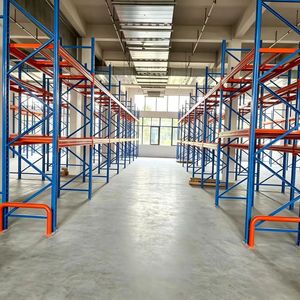
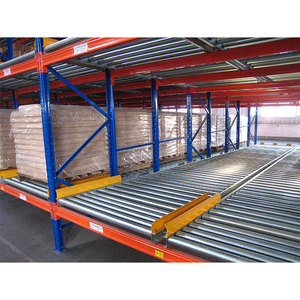
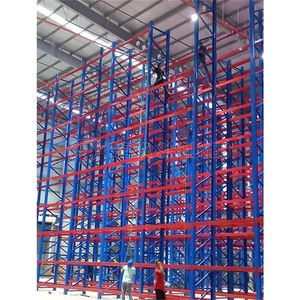
Drive-In racking eliminates operating aisles by dedicating forklift travel directly into multi-deep storage bays. By consolidating access aisles, structural footprint efficiency surges to up to 85% total cubic space utilization. Our cold-formed cantilevered rail arms allow pallets to rest along structural load rails rather than transverse beams, maximizing vertical clearance across multi-tier storage bays.
Because lift equipment navigates inside the frame envelope, frame damage risks increase. HEDA Shelves addresses this through wrap-around column protectors, floor-anchored steel guide angles, and double-flanged upright posts. Furthermore, upper transverse top-ties and portal beams establish structural continuity, preventing torsional twisting under seismic loads or accidental rack bump forces.
Refrigerated air compression demands substantial power consumption. Drive-In racking drastically curtails refrigerated cubic space loss, achieving unprecedented SKU density in sub-zero freezers down to -30°C. Special ductile steel alloys and low-temperature powder coatings ensure our uprights resist cold embrittlement and coating delamination over decades of operation.
Directly benchmark structural load characteristics, inventory rotation patterns, and floor footprint efficiencies across leading high-density pallet storage configurations.
| Racking Architecture | Inventory Principle | Footprint Utilization | Lane Depth Limits | Forklift Intrusion | Ideal SKU Velocity |
|---|---|---|---|---|---|
| Drive-In Racking | LIFO (Last-In, First-Out) | 75% – 85% | Up to 12 Pallets Deep | Yes (High Mast/Reach) | Low-Mid Velocity, High SKU Volume |
| Drive-Through Racking | FIFO (First-In, First-Out) | 70% – 80% | Dual Entry Access | Yes (Drive-Through) | Batch Production & Staging |
| Gravity Pallet Flow | Strict FIFO | 80% – 90% | Up to 20 Pallets Deep | No (Exterior Face Only) | High-Turnover, Perishables |
| Radio Shuttle System | FIFO or LIFO | 85% – 92% | Up to 40 Pallets Deep | No (Automated Shuttle) | Ultra-Dense Cold Chains & 3PL |
| Selective Pallet Racks | 100% Random Access | 40% – 50% | Single/Double Deep | No (Standard Aisles) | Broad SKU Count, Fast Turnover |
How automation integration, structural sensor arrays, and regional seismic mandates are fundamentally transforming industrial storage procurement.
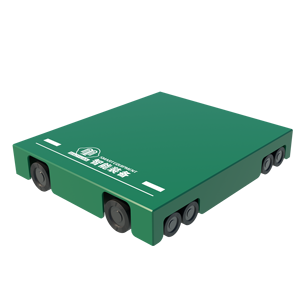
Modern supply chains are rapidly transitioning from human-operated counterbalanced forklifts to automated guided vehicles (AGVs) and autonomous reach trucks. Drive-in systems require tight manufacturing tolerances to accommodate laser-guided vehicle channels. Future procurement demands millimeter-precise guide rails, reflective sensor cutouts, and reinforced base floor brackets designed for repetitive AGV operations.
Global logistics facilities are subject to stringent regional building code inspections. Procurement teams increasingly reject generic steel profiles in favor of documented finite element analysis (FEA). Future orders demand full metallurgical traceability, certified yield strength reports (such as certified Q235B or structural high-tensile grades), and stamped calculation packages tailored to regional seismic site classes.
Static storage investments must hedge against SKU volatility. Progressive manufacturers now engineer modular rail brackets that allow classic drive-in lanes to seamlessly upgrade to semi-automated radio shuttle tracks without requiring column replacement or structural welding. This forward-looking modularity protects client capital expenditures as warehouse throughput requirements expand.
ESG procurement standards among global enterprises have made coating toxicity and carbon metrics critical selection factors. HEDA Shelves utilizes automated, non-toxic electrostatic powder coating systems preceded by closed-loop pickling and phosphating lines. This creates an ultra-durable, corrosion-resistant surface that withstands corrosive industrial chemicals and freezing conditions without volatile emissions.
A vertically integrated manufacturing and global export infrastructure dedicated to eliminating intermediary markups, providing rapid CAD turnarounds, and delivering reliable structural racking.
Provide your building dimensions, clear roof heights, pallet parameters, and forklift turning radius. Our structural engineering department delivers comprehensive 2D CAD layouts, clearance diagrams, and photorealistic 3D structural renderings within 24 hours.
Every beam, upright, and support profile is produced under strict ISO 9001:2015 Quality Management protocols (Cert No. 18624Q00169R0M) and verified with CE Marking (No. 2435-CPR-8605159) and RoHS material testing, ensuring smooth customs clearance and code approval.
Racking shipping efficiency depends on bundle nesting. Our logistics specialists calculate container volume using custom pallet chocks, specialized steel strapping, and moisture barrier wrapping. Uprights and beams are bundled for rapid, damage-free uncrating at major ports globally.
Essential technical, regulatory, and logistics answers for warehouse directors, supply chain procurement leads, and facility engineering managers.
Drive-in systems do not use traditional operating aisles inside the rack; the bay itself matches your pallet width plus standard cantilever arm clearances. However, the outer staging aisle must accommodate your lift equipment's 90-degree turning radius—typically 12 to 14 feet for standard counterbalanced trucks, or 9 to 10 feet for specialized reach trucks.
Yes. We regularly supply detailed shop drawings, engineering calculation packages, and load capacity plaques in both imperial units (pounds, inches, feet) and metric specifications (kg, mm). This ensures smooth review by your local engineer of record and municipal building inspectors.
Pallet quality is critical in drive-in racking because pallets rest solely on side rails rather than cross-beams. We engineer support rails with generous landing widths (typically 65mm–80mm) and recommend GMA Grade-A or heavy-duty perimeter-base skids to prevent sagging under loads up to 1,500 kg (3,300 lbs) per position.
Standard production runs for a 40-foot high-cube container of customized drive-in or selective pallet racking typically take 15 to 20 business days from approved CAD drawings. Ocean freight transit depends on destination port, with direct services to North America, Europe, Australia, and the Middle East.
We configure systems with structural floor guide angles (steel angles anchored directly to your concrete slab), wrap-around upright column protectors, reinforced lower front legs, and high-visibility powder coating on outer entry portals to deflect tire impact and protect uprights.
Yes. Our modular punching pitch and standardized cantilever bracket connections allow rear cross-bracing to be reconfigured for dual-access drive-through flows, or upgraded with low-profile runner rails designed to support intelligent automated 4-way shuttles as needs evolve.
Submit your facility floor plan, clear roof height, and pallet specifications today. Our senior structural design team will deliver an itemized quote, clearance schematics, and an engineering layout within 24 hours.