Engineered High-Bay & Tall Racking Systems
Our OEM/ODM manufacturing facility fabricates heavy-gauge cold-rolled steel storage frameworks engineered to withstand static, dynamic, and seismic forces across global distribution hubs.
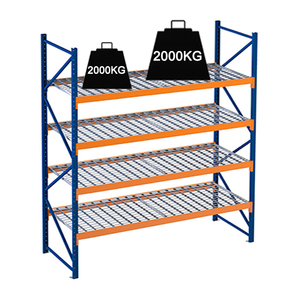
Stackable Storage Pallet Racking Systems
Heavy-duty modular racking calibrated for multi-ton palletized cargo with reinforced base plates and seismic-grade interlocking uprights.
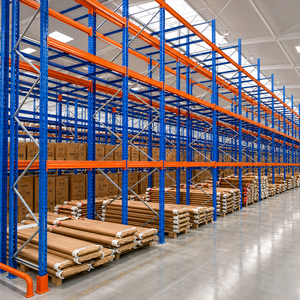
Adjustable Selective Beam Pallet Rack
100% SKU selectivity featuring precision punch pitch (50mm/75mm) for seamless vertical adaptability and high-turnover logistics.
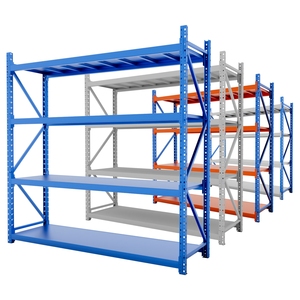
Industrial Multi-Layer Pallet Shelving
High-rigidity roll-formed box beams paired with step beams for secondary wire mesh or steel decking installations in mixed cargo warehouses.
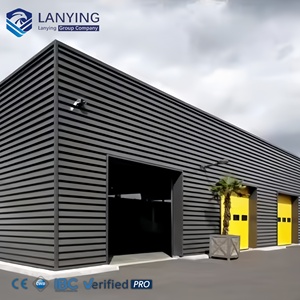
Prefabricated Warehouse Steel Structure
Rack-supported building shells and pre-engineered primary frames that merge building envelope architecture with high-bay rack columns.
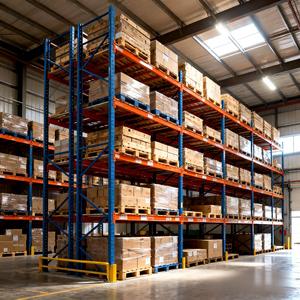
Tall Heavy-Duty High-Rise Beam Racking
Ultra-tall vertical column arrays purpose-built for narrow aisle (VNA) forklifts, high-reach mast trucks, and integrated distribution hubs.
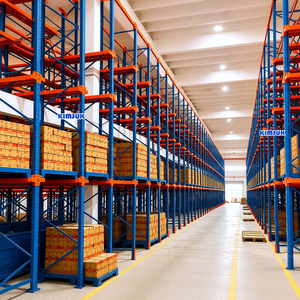
Tall Drive-In High-Density Pallet Racking
Deep-lane LIFO/FIFO storage reducing aisle footprint by up to 75%. Manufactured with structural entry guide rails and heavy-gauge column guards.
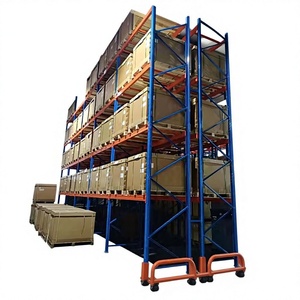
Sub-Zero Cold Storage Tall Racking
Manufactured with cold-resilient steels and specialized zinc-rich electrostatic coatings engineered to withstand -30°C thermal condensation cycles.
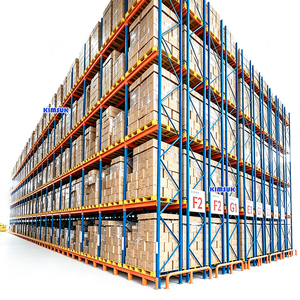
Full-Height Distribution Center Pallet Rack
Engineered for extreme structural capacity across regional 3PL fulfillment hubs. Fully customized hole pitch and beam lengths for GMA/Euro pallet footprints.
Enterprise Manufacturing Infrastructure & Engineering Capabilities
Founded in 2001, Guangzhou Heda Shelves Co., Ltd. operates as a vertically integrated tier-one OEM/ODM manufacturer of high-bay warehouse racking, structural mezzanines, and industrial logistics systems.
Architectural Rigor in Tall Storage: Overcoming Second-Order Deflection
As warehouse roof clear heights climb from traditional 7-meter standards to 12m, 15m, and upwards of 30 meters in clad-rack facilities, racking structures cease to function simply as shelving; they become complex, dynamically loaded civil structures. At these elevations, the structural engineer must design for the P-Delta effect—secondary moments induced by axial compression acting upon deflected upright geometries under full dead, live, and seismic wind conditions.
Our OEM/ODM manufacturing facility deploys cold-roll continuous roll-forming mills featuring 24 to 32 rolling passes. This progressive forming sequence eliminates residual internal stress in premium cold-rolled Q235B and Q355B structural steel, ensuring upright perpendicularity tolerances strictly within 1/1000 of overall height. Continuous automated punching systems guarantee center-to-center pitch fidelity across continuous 15-meter upright spans, mitigating bolt slop, frame slippage, and cumulative leaning.
All load-bearing beam profiles undergo proprietary robotic submerged arc and CO2 gas shielded welding, bonding five-hook connector brackets with integral mechanical safety pins. Surface preparation is executed via a rigorous 9-stage bath cycle: immersion degreasing, twin rinses, acid pickling for rust ablation, iron phosphating for micro-crystalline adhesion, followed by electrostatic thermosetting polyester powder coating. The resulting finish exhibits zero flaking at 500 hours of continuous salt spray testing (ASTM B117 compliance), safeguarding vertical storage assets in temperature-cycled or humid environments.
Finite Element Analysis (FEA)
Every tall rack elevation undergoes computer-simulated structural stress testing (ANSYS / SAP2000), modeling joint stiffness, beam-end connector moment-rotation characteristics, and second-order elastic plastic buckling limits.
Certified Code Compliance
Our production protocols are independently certified to ISO 9001:2015 standards, CE marking under European EN 15512 / EN 15620 guidelines, and aligned with North American RMI (Rack Manufacturers Institute) MH16.1 specifications.
Turnkey OEM/ODM Engineering
From CAD layout conception and seismic anchor bolt load calculations to overseas container pack balancing and bilingual installation drawings, our 300+ engineering and fabrication personnel provide unified accountability.
Tall Warehouse Racking Structural Matrix
A comparative structural evaluation of high-rise storage topologies to align facility clear height, forklift kinematics, and pallet storage density.
| System Architecture | Maximum Practical Height | Cubic Volumetric Efficiency | Material Handling Interface | Seismic & Static Deflection Control | Ideal Procurement Application |
|---|---|---|---|---|---|
| Tall Selective Pallet Racking | Up to 12.5 meters (41 ft) | Moderate (35%–40% net volume) | Standard reach trucks / Counterbalance | Standard horizontal/diagonal bracing; 50mm pitch | Fast-moving retail, 3PL FMCG with 100% SKU access |
| Very Narrow Aisle (VNA) High-Bay | Up to 16.5 meters (54 ft) | High (55%–65% net volume) | Wire/rail guided turret trucks, man-up order pickers | Precision floor tolerance (Superflat F-min 100); top-tie struts | High-density fulfillment centers with high SKU diversity |
| Tall Drive-In / Drive-Through | Up to 12.0 meters (39 ft) | Very High (65%–75% net volume) | Direct aisle entry counterbalance forklifts | Top bracing beams, portal frames, rear cross-ties | Cold storage, raw material buffers, homogenous batch lots |
| Automated AS/RS Clad-Rack Systems | Up to 35.0+ meters (115 ft) | Maximum (80%–88% net volume) | Automated Stacker Cranes (SRM), robotic shuttles | Integral building structural frame, wind-load dissipation | Fully automated mega-distribution hubs & pharmaceutical vaults |
| Tall Multi-Tier Rack Mezzanine | Up to 12.0 meters (3–4 tiers) | High (Multi-level floor utilization) | Vertical reciprocating conveyors (VRC), manual carts | Heavy-duty boxed column uprights, dynamic floor load plates | Automotive aftermarket, garment sorting, e-commerce split-case |
Future Trends in Tall Racking Procurement & System Design (2025–2030)
Strategic analysis for supply chain directors, procurement officers, and warehouse design consultants preparing for next-generation automated material handling ecosystems.
Convergence with Mobile Robots (AMR/AGV)
Future tall racking procurement is pivoting away from purely manual forklift interaction. Upright columns and bottom beam levels are now engineered with recessed base plates, robotic docking guides, and integrated magnetic/optical reference targets. Racking tolerances must align with sub-millimeter robotic scanner thresholds.
IoT Structural Health Monitoring (SHM)
Enterprise procurement specifications increasingly require built-in fiber-optic strain sensors and micro-electromechanical (MEMS) accelerometers embedded within critical upright posts. These smart telemetry modules monitor real-time beam sag, impact kinetic forces from material handling equipment, and seismic sway.
Micro-Alloy High-Strength Green Steels
With environmental, social, and corporate governance (ESG) mandates impacting multinational supply chains, tier-one manufacturers are transitioning to scrap-based Electric Arc Furnace (EAF) micro-alloyed steels. These steels yield higher tensile yield strengths (Q355B and above) while reducing product carbon intensity by up to 38%.
Pre-Engineered Clad-Rack Construction
Rising industrial land valuations in North America, Europe, and Asia-Pacific are driving logistics developers toward rack-supported building structures (Clad-Rack). By utilizing the upright steel grid as the load-bearing framework for exterior wall siding and roofing, enterprises reduce construction schedules by 25% to 40%.
Low-Temperature Cold-Chain Thermal Ducting
As frozen food and biopharmaceutical distribution surge, modern tall rack uprights feature precision-engineered air-foil perforation patterns. These perforations promote laminar vertical chilled air circulation throughout 15-meter vertical stacks, reducing cooling compressor runtime and eradicating thermal micro-pockets.
Total Cost of Ownership (TCO) Sourcing Models
Procurement teams are moving away from evaluating initial steel weight/price per metric ton toward a comprehensive 15-year TCO calculation. This model factors in beam deflection limits (1/200 vs 1/300), impact vulnerability, modular bay relocation flexibility, and container-optimized ocean shipping packing density.
Frequently Asked Questions on Tall Warehouse Racking Procurement
In-depth structural, logistical, and compliance guidance addressed by our chief structural engineering team for project managers and procurement specialists.
Maximum frame height is governed by the structural slenderness ratio (K*L/r) of the upright columns, the base-plate anchoring moment resistance, slab concrete compressive capacity (f'c), and the seismic design category (SDC A through F according to IBC / ASCE 7). Beyond 10 meters, racking systems must be engineered with heavy box-profile uprights or structural tie-backs connected to adjacent double rows. Vertical deflection limits are kept within L/200 to L/300 of beam span under full load, while aisle clearances must account for mast sway of high-reach materials handling equipment.
Our engineering division utilizes finite element dynamic response-spectrum analysis to evaluate spectral acceleration parameters (Ss and S1) specific to the client's site coordinates. We customize upright web thicknesses, increase base plate surface area and gauge (up to 16mm–25mm hot-rolled steel plates), specify dual-wedge mechanical or chemical epoxy anchors, and integrate spine/cross-aisle seismic vertical bracings. Structural calculation packets can be cross-verified for submission to local building authorities and third-party Professional Engineer (PE) review.
In compliance with NFPA 13 standards for high-pile storage, racks exceeding 7.6 meters typically require longitudinal and transverse flue spaces (minimum 6-inch / 150mm clear vertical chimney) to permit heat rise and early sprinkler activation. For solid pallet loads storing Class I to IV commodities or plastics, in-rack sprinkler barrier pipes and ESFR (Early Suppression, Fast Response) ceiling-level sprinkler heads must be accommodated within our beam elevation drawings. We supply custom beam spacing, drop-in pallet stops, and open wire mesh decking with open areas >70% to facilitate unhindered water penetration.
Standard manufacturing turnaround for custom-engineered tall racking systems (500 to 5,000 pallet positions) averages 20 to 30 calendar days upon final approved shop drawings. Upright frames exceeding 11.8 meters are manufactured with precision splice joints engineered to fit inside standard 40-foot High Cube (40HQ) ocean shipping containers. Bundles are wrapped in heavy-duty polyethylene barrier film with corrugated corner protectors, banded by steel strapping, and seated on heavy timber skids for roll-on, roll-off forklift unloading at the destination port.
Yes. As a pure OEM/ODM partner, we provide complete custom powder-coating matching any designated RAL or Pantone color code using automated GEMA powder guns. We supply universal teardrop hole patterns for the North American market, standard diamond/butterfly punch for European markets, or proprietary slot configurations for equipment integrators. Private labeling, custom laser-etched capacity rating plates, and branded component packaging are available for global distributor partners.
Accelerate Your High-Bay Logistics Project
Send us your building architectural drawings (DWG/PDF), clear height, pallet dimensions, and target storage capacities. Our engineering team will deliver a comprehensive 2D CAD layout, 3D visualization, and factory-direct quotation within 24 hours.