High-Density Static & Dynamic Pallet Racking Systems
Manufactured using cold-formed Q235B and Q355B certified structural coil steel. Each configuration conforms to ANSI/RMI MH16.1, EN 15512, and AS4084 international testing protocols, delivering verified pallet capacities up to 10,000 lbs per beam level.
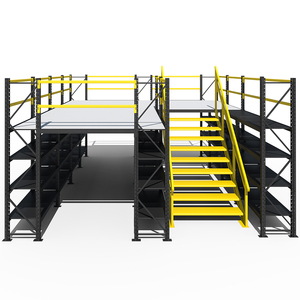
Heavy Duty Warehouse Mezzanine Floor Racking System
- Doubles operational footprint without structural civil expansion
- Load ratings: 300 kg to 1,500 kg per m² (61–307 psf)
- Cold-rolled interlocking steel grating or B-deck options
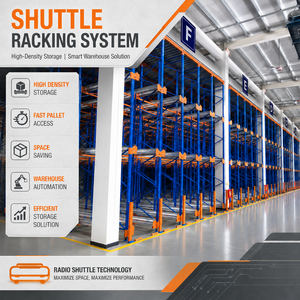
Heavy Duty Radio Pallet Shuttle Racking System
- Semi-automated deep lane storage; zero mast aisle entry
- Lithium-powered radio carriers with cold-room rating (-25°C)
- Supports both FIFO picking and high-density LIFO staging
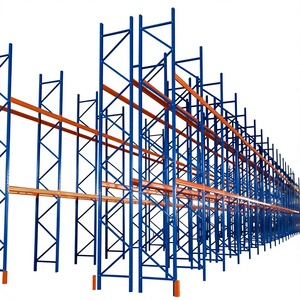
Hongxin Heavy-Duty Multi-Level Steel Racking
- High-durability powder-coated industrial blue/orange finish
- 50mm/75mm adjustable pitch with dual-action spring safety pins
- Configurable for counterbalance, reach, and VNA turret trucks
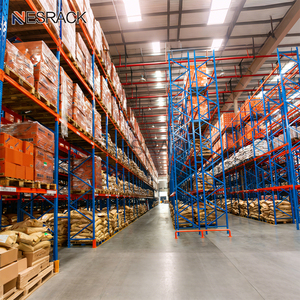
Galvanized Double Deep Industrial Pallet Racking
- Cuts aisle ratios by 50% compared to standard selective setups
- Designed for pantograph and deep-reach material handlers
- Pre-galvanized or electro-galvanized finish for high abrasion zones
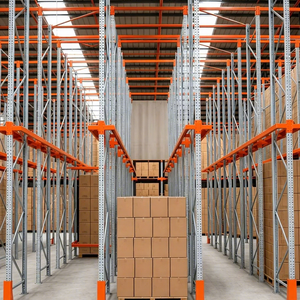
Industrial Heavy Duty Drive-In Rack Storage System
- Maximum cube utilization for uniform SKU batches & cold storage
- One-piece formed cantilever pallet support arms eliminate snags
- Ground guidance rails protect structural upright upright base points
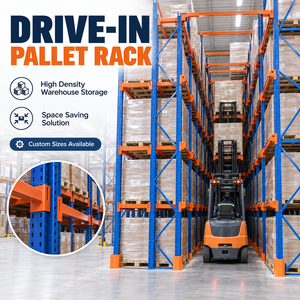
Drive-In Pallet Racking System for Bulk Storage
- Heavy structural top-tie bracing frames ensure rack rigidity
- Increases storage capacity by up to 75% over selective layouts
- Engineered specifically for food processing, FMCG, and freezers
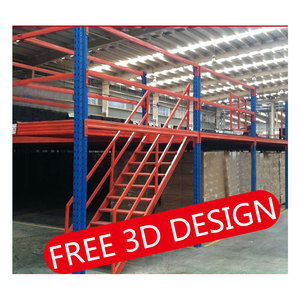
Warehouse Loft Platform Attic Pallet Rack Mezzanine
- Heavy-duty upright frames double as primary structural pillars
- Integrated staircase, kick-plates, and pivot safety loading gates
- Ideal for e-commerce picking tiers, archive hubs, and light assembly
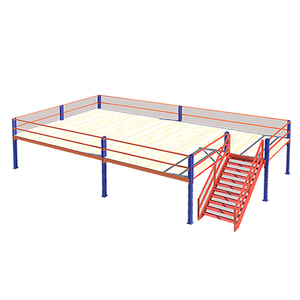
Heavy Duty Warehouse Racks Mezzanine Platform
- Multi-level vertical utilization supporting upper-tier walkaways
- High stiffness box-beams with 3-hook / 4-hook precision stamped lugs
- Custom modular expansion options designed for OEM supply chains
Engineering Authority, Global Reach & Factory Scale
Operating since 2001, Guangzhou Heda Shelves Co., Ltd. serves logistics integrators, material handling dealers, and Fortune 500 supply chains across North America, Europe, and Australasia. We deliver end-to-end structural engineering with zero outsourcing.
ISO 9001 & CE Certified
Strict structural compliance verified by CE Marking (No. 2435-CPR-8605159) and ISO 9001:2015 Quality Management System (Cert 18624Q00169R0M). Every production heat is traceable back to certified mill test reports.
Free 24-Hour CAD & 3D Engineering
Submit your warehouse clear heights, slab core ratings, and SKU profiles. Our structural engineering department provides comprehensive AutoCAD layouts, capacity calculations, and 3D isometric BIM models within 24 hours.
OEM & ODM Profile Customization
Custom teardrop hole configurations, speedlock patterns, upright return lips, connector brackets, and specialized gauge dimensions (11GA, 12GA, 14GA, 16GA). We provide private-label powder coating, labeling, and barcoding for regional dealers.
Continuous Pre-Treatment & Powder Coating
Our automated 10-stage immersion pickling, degreasing, and silane/iron phosphating line eliminates microscopic rust. Followed by 180°C electrostatic curing of lead-free, non-toxic thermoset polyester powder, yielding 80–120μm dry film thickness.
Container-Optimized Ocean Packaging
High-cube 40HQ bundle planning prevents maritime damage and transit deflection. Steel frames are nested using custom nylon chocks, corner protectors, waterproof poly-wrapping, and heavy-duty strapping to expedite unassisted container de-stuffing.
North American & European Direct Logistics
Frequent project deliveries to key entry gateways: Los Angeles / Long Beach, Houston, Savannah, New York / New Jersey, Vancouver, Rotterdam, Hamburg, and Melbourne. Full DDP, CIF, and FOB documentation prepared with zero customs delays.
Engineering Evaluation: Static vs. Semi-Dynamic Warehouse Racking
Choosing the correct storage geometry determines your long-term cost per pallet position, floor area utilization, and material handling capital expenditure. Review our engineering specifications before finalizing warehouse layouts.
| Racking System Type | Pallet Selectivity | Space Utilization | Typical SKU Density | Handling Equipment Required | FIFO / LIFO Mode | Relative Cost / Position |
|---|---|---|---|---|---|---|
| Standard Selective Racking | 100% Immediate | 40% – 50% | High SKU / Low Volume | Standard Counterbalance, Reach Truck | FIFO or LIFO | Baseline (Low) |
| Double Deep Racking | 50% Direct | 55% – 65% | Medium SKU / Multi-Pallet | Deep-Reach Pantograph Mast Forklift | Strictly LIFO | Low - Medium |
| Drive-In / Drive-Thru | 15% – 25% | 70% – 85% | Low SKU / High Bulk Batches | Narrow Counterbalance, Reach Truck | LIFO (Drive-In) / FIFO (Thru) | Moderate |
| Radio Shuttle System | 30% – 50% | 80% – 90% | Low-Medium SKU / Deep Lanes | Standard Forklift + Automated Shuttle | Both FIFO & LIFO Flexible | High (High ROI) |
| Rack-Supported Mezzanine | 100% (Multi-Tier) | 100% – 180% | E-commerce, Mixed Industrial, Parts | Forklifts, Vertical Cargo Lifts, Hand Carts | Manual Batch Picking | Moderate - High |
The Structural Evolution & Future Procurement Trends of Industrial Static Racking
A technical analysis of metallurgical developments, automated integration dynamics, and international procurement standards shaping modern intralogistics infrastructure through 2030.
1. Metallurgical Optimization: High-Yield Lightweight Cold-Formed Steels
The industrial static pallet racking industry is experiencing an accelerated technological migration toward ultra-high-yield micro-alloyed hot-rolled structural steel coils (such as Q355B and specialized micro-alloy formulations). Historically, standard Q235B cold-rolled profiles dominated structural designs. While economical, these sections necessitated higher cross-sectional gauges (e.g., 11GA / 3.0mm to 12GA / 2.5mm) to safely carry pallet loads exceeding 2,500 lbs (1,134 kg) per position under non-braced lateral frame conditions.
By shifting to advanced cold-roll forming lines equipped with multi-stage roller tooling, our Guangzhou plant achieves precise yield strengths exceeding 355 MPa without introducing residual micro-cracking at bend radiuses. This enables upright frames to reduce self-weight by up to 14% while concurrently increasing structural buckling resistance and rotational stiffness. For multinational buyers and large integrators, this metallurgical optimization yields direct shipping freight economies: an additional 250 to 380 pallet locations can be accommodated per 40ft High Cube container, reducing per-pallet landed logistics costs.
Ensure OEM suppliers specify certified steel grades with minimum yield (Fy) and tensile (Fu) properties backed by batch-specific chemical spectrum analysis and Charpy V-notch impact toughness tests, particularly when specifying racks for cold-chain freezers down to -30°C.
Furthermore, structural optimization is validated through advanced Finite Element Analysis (FEA) modeling. Under RMI MH16.1 (Specification for the Design, Testing and Utilization of Industrial Steel Storage Racks) and European EN 15512 guidelines, beam-to-column connector tightness, torsional displacement, and second-order P-Delta effects are rigorously quantified before metal slitting begins.
2. Seismic Resilience & Dynamic Site-Specific Design Protocols
Modern warehouse logistics facilities are increasingly constructed in geotechnically complex regions, including high-seismic zones along the North American West Coast (IBC/ASCE 7 Seismic Design Categories D, E, and F), Southern Europe, New Zealand, and Latin America. In these environments, pallet racking cannot be treated as commoditized steel shelving; it is legally categorized as a civil storage structure subject to severe earthquake accelerations, base shear forces, and live-load mass amplification factors.
Structural resilience relies on engineered ductility. In our OEM manufacturing programs, standard baseplates are upgraded to heavy structural baseplates with double-shear anchor configurations and anchor hole offsets to avoid rebar damage. The upright columns are engineered with closed or optimized omega-profile open channels that exhibit predictable plastic deformation characteristics rather than sudden catastrophic brittle buckling during lateral spectral ground accelerations.
Every export static pallet racking system must be delivered with comprehensive engineering calculations ready for PE (Professional Engineer) stamping in your specific municipal jurisdiction, factoring in live load reduction coefficients, building framing interaction, and soil profile classifications.
In addition to seismic compliance, dynamic floor interactions from adjacent Automated Guided Vehicles (AGVs) and Autonomous Mobile Robots (AMRs) impose continuous cyclic micro-vibrations. Upright column base protectors, heavy-duty wraparound guide angles, and tubular run spacers with diagonal sway bracing are now engineered standard across all high-density layouts.
3. Future Procurement Trends: Modular Scalability & Automation-Ready Racking
Global warehouse procurement is pivoting away from rigid, single-purpose static installations toward flexible, modular infrastructure that can seamlessly scale alongside future automated handling equipment. Supply chain volatility, e-commerce SKU proliferation, and skyrocketing commercial industrial real estate costs dictate that racking installed today must be capable of retrofitting tomorrow.
Our OEM/ODM engineering programs integrate three critical future-proofing procurement vectors:
1. Universal Profile Geometries & Hybrid Pitch Compatibility: We manufacture uprights with universal 50mm, 75mm, and 76.2mm (3-inch) pitch punching. This allows regional system integrators to stock standardized interchangeable box beams, step beams, and structural shelves compatible with teardrop styles or European teardrop equivalents.
2. AMR & Shuttle-Ready Substructure: Static selective racking runs are designed with precise beam-level tolerances (±1.0mm levelness) to facilitate the retrofitting of pallet flow gravity rollers, carton live storage tracks, or automated radio shuttles without requiring upright column replacements or structural welding on site.
3. Rack-Supported Vertical Integration: Instead of building single-level static storage, operations invest in rack-supported mezzanine infrastructures that utilize full warehouse clear heights (up to 40 ft / 12m), effectively multiplying accessible picking tiers and integrating spiral conveyors, package chutes, and sorting loops overhead.
4. Advanced Surface Engineering: Environmental Durability & Cold-Chain Performance
Surface durability is a direct determinant of static pallet racking operational lifespan. Minor scratch damage in humid, sub-zero, or chemical-vapor environments initiates subsurface structural oxidation, compromising critical column load-bearing cross sections over 5 to 10 years of aggressive forklift interactions.
To eliminate coating delamination, our Guangzhou facility utilizes a fully enclosed automated 10-stage chemical pretreatment line. Traditional spray washing is replaced with full deep-immersion multi-tank baths: alkaline degreasing, ultrasonic cleaning, acid descaling/pickling, iron/silane phosphating, and deionized water cascade rinsing. This pre-treatment creates an impenetrable crystalline conversion layer that guarantees salt spray corrosion resistance exceeding 500 hours (ASTM B117).
Components receive continuous electrostatic application of TGIC-free polyester or epoxy-polyester hybrid powder resins, cured at an accurate 180°C–200°C thermal gradient. For cold-storage applications down to -30°C, ductile elastomeric powder additives prevent coating embrittlement and micro-cracking.
For high-abrasion exterior yards, marine ports, or chemical fertilizer facilities, we provide hot-dip galvanizing complying with ASTM A123 / ISO 1461, achieving a bonded zinc coating thickness of 65–85μm that provides galvanic sacrificial protection for over 25 years of outdoor exposure.
Frequently Asked Questions by Project Engineers & Procurement Teams
Comprehensive answers regarding technical specifications, international regulatory certifications, shipping logistics, seismic approvals, and OEM/ODM private-label capabilities.
We use structural certified cold-rolled and hot-rolled prime coils primarily conforming to Chinese standard GB/T 700 (Q235B) and GB/T 1591 (Q355B), which correlate with ASTM A36 / ASTM A1011 SS Grade 36 and Grade 50, as well as European EN 10025 S235JR and S355JR. Original Mill Test Certificates (MTC) indicating heat batch numbers, yield strength, ultimate tensile strength, elongation percentages, and chemical spectral compositions (carbon, silicon, manganese, sulfur, phosphorus) accompany every container shipment.
Yes. We regularly manufacture standard frame depths of 42 inches (1,067mm) and 48 inches (1,219mm) engineered specifically for standard North American 48"x40" GMA pallets, utilizing beam lengths of 96 inches (2,438mm), 108 inches (2,743mm), and 144 inches (3,658mm). For European, Australasian, and Asian distribution centers, frame depths of 1,000mm and 1,100mm with beam lengths of 2,700mm (accommodating three Euro-pallets) or 3,900mm (four pallets) are standard production items.
Yes. Guangzhou Heda Shelves Co., Ltd. provides comprehensive engineering document packages upon layout sign-off. These include structural loading tables, sectional modulus data, beam deflection curves (limited to L/200 under maximum rated load per ANSI MH16.1 or L/300 for sensitive automated systems), anchor bolt pull-out calculations, and axial compression calculations. These calculation packages are structured to streamline review and stamping by your local licensed Professional Engineer (PE) or structural consultant.
Standard stock component configurations have an MOQ of one 20ft container (approx. 15 to 18 metric tons of steel). For customized roll-formed profile designs, proprietary hole punch dies, or custom RAL corporate colors, our baseline project MOQ is one 40ft High Cube container (approx. 22 to 26 metric tons). Production lead times typically range from 18 to 25 working days from approved shop drawings and deposit confirmation, supported by our 30,000-ton monthly factory output.
Long-haul ocean freight through equatorial corridors subjects steel cargo to significant thermal cycling and container condensation ("cargo sweat"). All open box and roll-formed sections are pre-treated, cleaned, and powder-coated to eliminate exposed bare steel. Beams and upright frames are separated by non-abrasive closed-cell polyethylene foam dividers, shrink-wrapped in micro-perforated vapor barrier poly-film, edge-protected by heavy gauge compressed paperboard corners, banded with steel strapping, and fitted with industrial calcium chloride desiccant bags inside every container.
Yes. We act as an OEM and ODM manufacturing partner for dozens of material handling equipment dealers, racking distributors, and storage system integrators across the globe. We can emboss or laser-etch your corporate logo on upright protectors, load capacity plaques, and beam ends. Customized barcode labels, part numbers, and specialized hardware kit boxes are packed precisely according to your corporate warehousing specifications.
Our ISO 9001:2015 audited facility implements strict three-stage inspection: Incoming raw coil ultrasonic thickness and hardness testing; In-line continuous dimensional checking of punch hole pitch (tolerance ±0.15mm), upright camber/sweep (tolerance less than 1/1000 of overall length), and connector weld penetration depth via microscopic cut-section testing; and Outgoing coating dry film thickness (DFT 80-120μm via electromagnetic Elcometer gauges) and cross-hatch adhesion testing (ISO 2409 Grade 0 / ASTM D3359 5B).
To provide an optimized AutoCAD layout and itemized quotation within 24 hours, our engineering department requires: 1) Architectural building layout (DWG or PDF) with clear interior heights, column grid locations, and overhead obstructions (HVAC, fire sprinklers); 2) Pallet specifications (Width x Depth x Height including cargo, and maximum pallet gross weight); 3) Forklift specifications (minimum aisle turning radius, maximum mast lift height, outrigger requirements); and 4) Seismic zone classification or project postal code.
Accelerate Your Warehouse Capacity: Request an Engineered Layout
Partner directly with one of Asia's largest static pallet racking and mezzanine manufacturers. Submit your floor dimensions or project tender documents today for a free structural CAD layout, load capacity calculation, and landed container pricing within 24 hours.