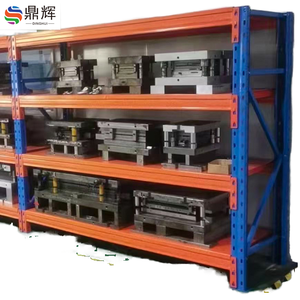
Selective Medium Duty Cold Rolled Steel Pallet Rack Frame System Upright Column
Continuous roll-formed upright columns designed for standard 48"x40" GMA pallets with 50mm–75mm beam adjustment increments and high torsional rigidity.
Explore our heavy-duty cold-rolled structural steel warehousing configurations. Built from certified high-yield Q235B and Q355B coil, these systems support up to 5,000 kg (11,000 lbs) per pallet level with sub-millimeter punching accuracy and scratch-resistant electrostatic powder coatings.
Continuous roll-formed upright columns designed for standard 48"x40" GMA pallets with 50mm–75mm beam adjustment increments and high torsional rigidity.
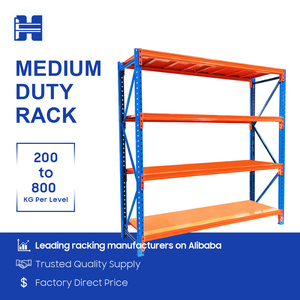
Hot-dip galvanized, interlock snap-in assembly engineered for cleanroom, automotive micro-fulfillment, cold store, and chemical distribution applications.
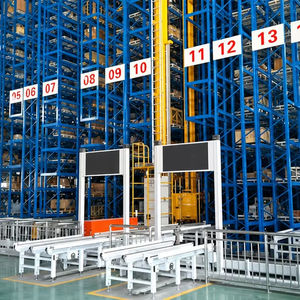
High-precision structural high-bay infrastructure engineered up to 40 meters tall, interfacing seamlessly with SRM cranes, transfer cars, and AGV/AMR fleets.
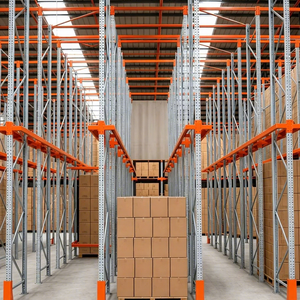
Eliminates multiple travel aisles to expand volumetric storage capacity by up to 80%; equipped with cantilevered support rails and ground guidance tracks.
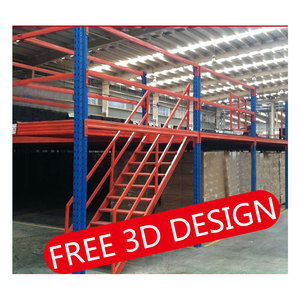
Doubles or triples usable square footage without new construction. Combines heavy upright structural framing with steel decking, stairways, and safety gates.
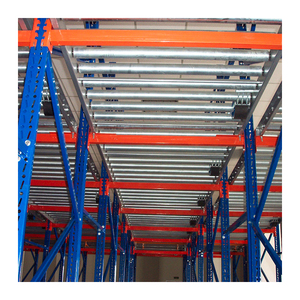
Inclined steel roller beds equipped with centrifugal speed controllers and entry guides for automatic first-in, first-out stock rotation in cold chain and perishables.
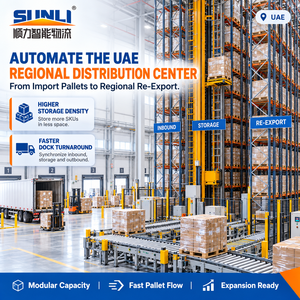
Alloy structural steel design rated for 500kg–1500kg payloads per pallet position. Optimized for robotic shuttles, pick-and-place gantry, and lights-out operations.
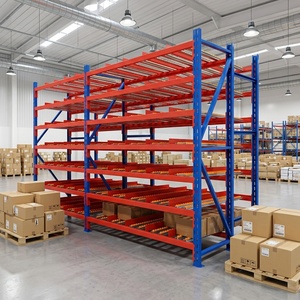
Engineered roller tracks and custom lane dividers designed for rapid split-case, carton order assembly, and continuous assembly line feed operations.
In modern high-cube fulfillment, manufacturing, and temperature-controlled facilities, selecting heavy-duty industrial shelving is no longer merely an equipment procurement decision; it is a critical structural engineering safeguard. Industrial shelving and pallet racking systems operate under dynamic cyclic loading, seismic excitations, and vehicular impact forces from forklifts, automated guided vehicles (AGVs), and autonomous mobile robots (AMRs). Understanding the mechanical parameters of continuous cold-formed steel sections, connection moment capacities, and geotechnical slab interactions is paramount to mitigating rack collapse risks, maximizing floor space utilization, and achieving long-term capital cost efficiency.
All OEM and ODM rack manufacturing under our supervision adheres strictly to ANSI MH16.1 (Specification for the Design, Testing and Utilization of Industrial Steel Storage Racks), RMI (Rack Manufacturers Institute) guidelines, EN 15512 (Steel Static Storage Systems), and ISO 9001:2015 certified quality assurance systems. Every structural beam and column component is calculated with safety factors exceeding 1.65 to 1.95 against yield failure.
The foundation of structural heavy-duty shelving begins at the steel slitting line. We utilize prime certified coils sourced exclusively from tier-one steel mills. Depending on seismic classification, upright height, and bay load criteria, our engineering department specifies either standard structural carbon steel (Grade Q235B) or high-yield low-alloy structural steel (Grade Q355B).
| Steel Grade (Standard) | Yield Strength (Fy, MPa) | Tensile Strength (Fu, MPa) | Elongation (%) | Impact Toughness (Charpy V-Notch) | Typical Application Scenario |
|---|---|---|---|---|---|
| Q235B (ASTM A36 Equiv.) | ≥ 235 MPa (34.1 ksi) | 370 – 500 MPa | ≥ 26% | +20°C ≥ 27J | Standard selective racking, medium-duty longspan shelving, carton flow levels |
| Q355B (ASTM A572 Gr 50 Equiv.) | ≥ 355 MPa (51.5 ksi) | 470 – 630 MPa | ≥ 21% | +20°C ≥ 34J | High-bay AS/RS uprights (>12m), drive-in cantilever arms, structural mezzanines |
| Q355D / Q355E (Cold Chain Special) | ≥ 355 MPa (51.5 ksi) | 470 – 630 MPa | ≥ 21% | -20°C to -40°C ≥ 27J – 34J | Blast freezers (-30°C), refrigerated distribution centers, sub-zero shuttle storage |
A rack frame is not merely a combination of posts and beams; it is a semi-rigid unbraced portal frame in the down-aisle direction and a braced truss in the cross-aisle direction. Our CNC-controlled 24-station cold-roll forming lines produce omega-shaped upright posts with up to 12 cold-rolled bends, increasing the moment of inertia and radius of gyration without redundant steel deadweight. The automated column punching process stamps interlocking diamond, teardrop, or rectangular pitch profiles with a pitch tolerance of ±0.15mm, guaranteeing instantaneous connection lock and uniform load distribution across all locking teeth.
Our heavy-duty box beams feature a twin-C interlocked welding configuration with continuous automated submerged arc welding. Heavy-gauge steel end connectors (available in 3, 4, or 5-claw configurations) provide enhanced rotational stiffness (K-factor) to resist beam rotation under extreme pallet deflection thresholds (standardized at L/200 or L/250 in accordance with European and North American fire protection and automated handling clearances).
Every industrial project undergoes Finite Element Analysis (FEA) to verify base plate anchorage, concrete anchor pullout resistance, and lateral drift under Zone 1 through Zone 4 seismic acceleration profiles.
From proprietary hole-punch patterns and custom corporate RAL color schemes to galvanized outdoor racks and specialized fork-entry clearances, we produce customized components with 100% tooling compatibility.
Pre-treated via automatic multi-stage immersion degreasing, ultrasonic rust removal, and zinc phosphating prior to 180°C–200°C electrostatic powder coating to ensure >500 hours neutral salt spray resistance (ASTM B117).
Every metric ton of steel manufactured in our Guangzhou production campus passes through an unbroken chain of digitized quality verification checkpoints, ensuring traceability from the raw steel mill heat number down to the final container bundle.
Spectrometric alloy analysis and ultrasonic coil thickness verification.
High-speed rotary shear slitting with strict edge deburring tolerance.
Multi-punch progressive die presses delivering pitch accuracy within ±0.15mm.
Continuous multi-pass progressive roller bending preventing internal micro-cracks.
Heavy-duty open and closed section forming with real-time laser alignment.
Rotary shot blasting and mechanical smoothing to remove mill scale.
CO2 gas-shielded robotic welding of connectors and reinforced baseplates.
Full-dip 4-stage chemical pre-treatment for superior polymer bonding.
Automated electrostatic spray booths with non-toxic epoxy polyester powder.
Coating adhesion cross-hatch tests, load testing, and containerized seaworthy packing.
Enterprise procurement managers, EPC logistics contractors, and global distribution network planners face unprecedented volatility in structural steel pricing, maritime supply lines, and building footprint costs. Over the next decade, strategic procurement of heavy-duty industrial shelving will be defined by five pivotal shifts:
Traditional procurement cycles relied heavily on regional distribution intermediaries, who marked up factory pricing by 35% to 60% while providing limited structural engineering adaptability. Supply chain directors now establish direct OEM/ODM relationships with large-scale manufacturers. Direct sourcing grants access to free customized CAD/3D layouts within 24 hours, stamped calculations ready for review by local Professional Engineers (PE) or Engineers of Record (EoR), and direct factory price indexing against international hot-rolled coil (HRC) commodities.
Ocean freight rates directly dictate delivered rack costs. Forward-thinking suppliers design racking profiles not only for load capacities, but also for nested volumetric containerization. By engineering beam-in-beam nesting profiles, multi-tiered flat-pack upright bundles, and custom steel stillages, our loading engineers routinely achieve 26 to 28 metric tons per 40-foot High Cube (40HC) container. This increases container volumetric efficiency by up to 35%, slashing transoceanic landed freight costs per pallet position.
Warehouses built today must accommodate the robotic technologies of tomorrow. Sourcing teams are increasingly avoiding standalone, inflexible shelving systems. Instead, the procurement trend points decisively toward hybrid modular racking: base levels engineered with clear spans and floor-mounted magnetic guidance lanes for automated mobile robots (AMRs) and automated lift trucks (ALTs), while upper levels support dense pallet staging or rack-supported multi-tier mezzanine pick-modules.
With regulations like the European Union's Carbon Border Adjustment Mechanism (CBAM) and corporate Scope 3 decarbonization mandates gaining momentum across North America, procurement criteria now evaluate the environmental footprint of steel fabrication. Our production operations prioritize high-efficiency electric arc furnace (EAF) feedstock, closed-loop water treatment in pickling facilities, and zero-VOC heavy-metal-free thermosetting powder coatings.
The industrial storage industry is undergoing a digital transformation. Shelving is evolving from passive steel frameworks into dynamic, sensor-integrated cyber-physical warehouse nodes. Industrial facilities are adopting new hardware and material innovations at an unprecedented pace:
Strain gauge sensors, triaxial MEMS accelerometers, and optical fiber Bragg gratings embedded directly onto key upright columns and seismic cross-bracing to detect micro-deflections, unauthorized beam alterations, and critical forklift impact events in real time.
Eliminating the traditional warehouse building envelope entirely. The heavy-duty rack structure itself serves as the load-bearing skeleton supporting roof trusses and exterior wall cladding, lowering civil construction budgets and achieving vertical storage reaching over 45 meters.
Advancements in magnetic eddy-current braking systems inside gravity flow tracks and carton roller beds ensure constant deceleration speeds regardless of pallet weight variations (from 200 kg empty wood pallets to 1,500 kg dense liquid packaging).
Cold storage energy consumption represents up to 60% of operational warehouse expenditures. As refrigerated logistics expands worldwide, static wide-aisle pallet racking is being rapidly replaced by high-density radio shuttle and deep-lane flow racking systems. By compressing the refrigerated air volume per pallet position by 30% to 50%, cold storage operators realize millions of kilowatt-hours in annual electrical savings while maintaining strict FIFO/LIFO lot traceability for perishable food items and pharmaceuticals.
Critical engineering, regulatory, testing, and logistics insights for technical procurement managers, structural engineers, and facility directors.
Every shelving and pallet racking structure is engineered to order. For projects in the United States and Canada, designs comply with ANSI MH16.1 and RMI standards, calculated against local International Building Code (IBC) seismic ground acceleration spectral data (Ss, S1). In Europe, designs adhere strictly to EN 15512 and Eurocode 3 (EN 1993-1-3) cold-formed steel regulations. We provide verified component section properties, connection moment-rotation curves, and calculations ready for local Professional Engineer (PE) stamping.
Under ANSI MH16.1 and RMI provisions, maximum allowable vertical beam deflection under design dead plus live pallet loads must not exceed L/180 (where L is the clear span of the horizontal beam). In automated AS/RS or deep-lane shuttle installations, where clearance tolerances for automated optical sensors are tighter, our engineering team designs for stringent thresholds of L/250 or L/300 to eliminate sensor false-trips and uneven pallet transfer.
Thermoset polyester powder coating (average 60–80 microns thickness) is ideal for ambient temperature indoor storage, offering superior resistance against chipping, customized corporate aesthetics, and smooth wipe-down maintenance. Hot-dip galvanization (HDG, conforming to ASTM A123 / ISO 1461, yielding 70–100+ microns of zinc protection) is strongly recommended for outdoor yard storage, coastal locations with high salinity, high-humidity agricultural fertilizer sheds, and chemical facilities subject to acidic fumes.
To provide an engineered quote and layout drawing within 24 hours, our engineering department requires: (1) Architectural building footprint showing column grids, clear ceiling height, slab thickness, and overhead obstructions; (2) Pallet dimensions (width, depth, overall height including cargo overhang) and maximum gross weight; (3) Forklift or material handling equipment specifications (turning radius, mast height, reach capability); and (4) SKU velocity profiles requiring FIFO or LIFO rotation.
Yes. As a full OEM/ODM partner, our facility maintains dedicated stamping tooling for major international profiles including American Teardrop, European 50mm metric pitch, Australian slotted pattern, and Speedlock compatible profiles. We can supply interchangeable replacement uprights, universal beams, wire mesh decks, and row spacers that match your legacy warehouse systems seamlessly.
With an expansive 30,000 square meter (323,000 sq ft) production facility and over 300 skilled technical personnel, our monthly steel output exceeds 30,000 metric tons. Standard containerized OEM orders are fabricated, powder-coated, inspected, and palletized for export within 15 to 25 business days following formal shop drawing sign-off.
Whether you require a turn-key selective pallet rack distribution center, custom rack-supported structural mezzanine, or high-bay AS/RS engineering, our certified engineers are ready to assist. Receive a complimentary CAD optimization layout, capacity audit, and comprehensive factory-direct landed quote within 24 hours.