Engineered Industrial Shelving & Pallet Racking Series
Tested under rigorous ANSI MH16.1, RMI, and FEM load specifications. Explore our core OEM/ODM pallet racking configurations built with premium Q235B/Q355B structural steel.
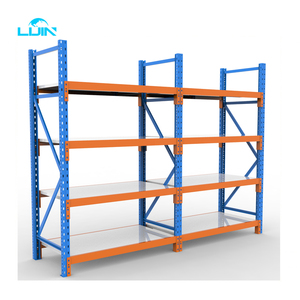 Boltless Selective
Boltless Adjustable Industrial Heavy Duty Pallet Racking System Warehouse Steel Metal Storage Racks Shelving Units
High-strength teardrop and diamond-lock structural uprights allowing tool-less beam height adjustments every 50mm or 75mm, purpose-built for fast-paced logistics fulfillment centers.
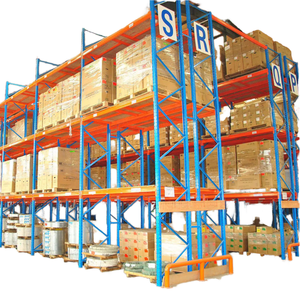 Anti-Corrosion
Adjustable Steel Industrial Warehouse Rack Pallet Storage Shelf Heavy Duty Shelving System Corrosion Protection Customizable
Surface-treated with automated pickling, phosphating, and electrostatic resin-baked powder coating to protect against aggressive chemical fumes, coastal humidity, and cold-storage condensation.
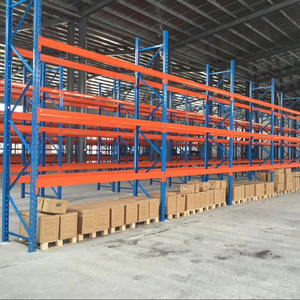 High-Bay Storage
Heavy Duty and High Level Racking Pallet Shelf Strong Load Bearing Space Saving Convenient Goods Classification
Maximized vertical air rights storage engineered for VNA (Very Narrow Aisle) man-up turrets, reach trucks, and high-bay distribution hubs handling intensive multi-SKU categorization.
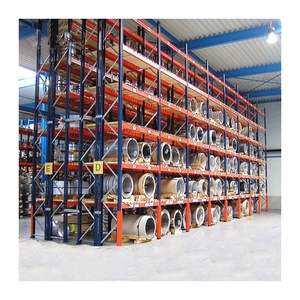 Standard Beam Rack
Heavy Duty Warehouse Storage Pallet Racking System
Classic interlocking box-beam and step-beam engineering offering 100% direct pallet accessibility, seamless integration with wire mesh decking, drop-in pallet supports, and safety bar dividers.
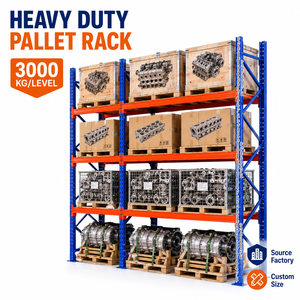 3000KG Extreme Duty
3000KG Heavy Duty Warehouse Shelf Rack for Pallet And Carton Storage 4 Levels for Pallet Storage
Formulated with reinforced horizontal and diagonal K-bracing, solid footplate anchorage, and high-tensile 3-claw/4-claw beam connectors rated for 3,000kg uniformly distributed loads per level.
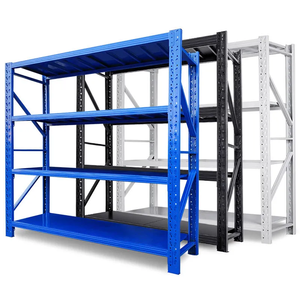 Longspan Shelving
Easily Assemble Heavy Duty Steel/Iron Garage Storage Racks 4 Layers Long Span Warehouse Shelving Rack Set with 10 Year Warranty
Multi-purpose hand-loaded longspan system featuring drop-in galvanized steel panels or solid particle boards, engineered for tool cribs, workshop staging, and e-commerce picking zones.
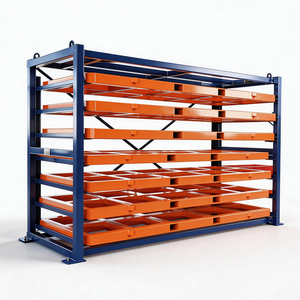 CE Certified Steel
CE Certified Industrial Warehouse Steel Shelving System Heavy Duty Storage Racks Metal Racking Durable Cargo Shelves
European Standard EN 15512 and CE conforming storage rack structure with standardized cold-formed omega uprights, certified seismic deflection limits, and robust safety clip fasteners.
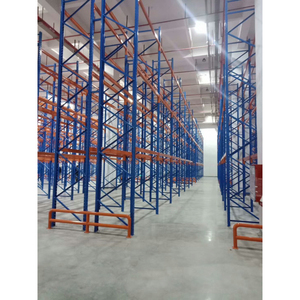 Modular Hybrid
Easy Assemble Light Duty Steel Shelving Rack Shelves Shelving Warehouse Storage Rack High Bay Racking Heavy Duty Shelves
Hybrid high-bay and low-bay combination racking providing structural foundations for catwalks, multi-tier mezzanine floors, and versatile multi-level order picking platforms.



Engineered Reliability & Factory-Direct Export Advantages
Direct supply-chain transparency eliminating middleman premiums while guaranteeing structural compliance with American RMI, Canadian CSA, and European FEM racking codes.
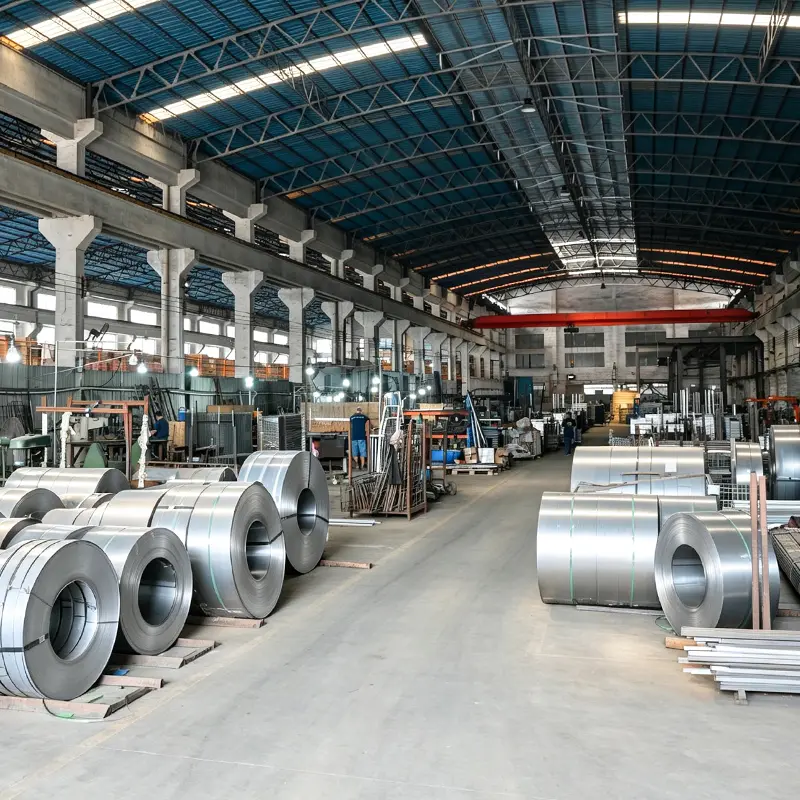 EST. 2001

25+ Years Industrial Mastery
Over 10,000+ completed storage projects worldwide. Our seasoned engineering team leverages deep metallurgical data to design profiles with optimal strength-to-weight ratios.
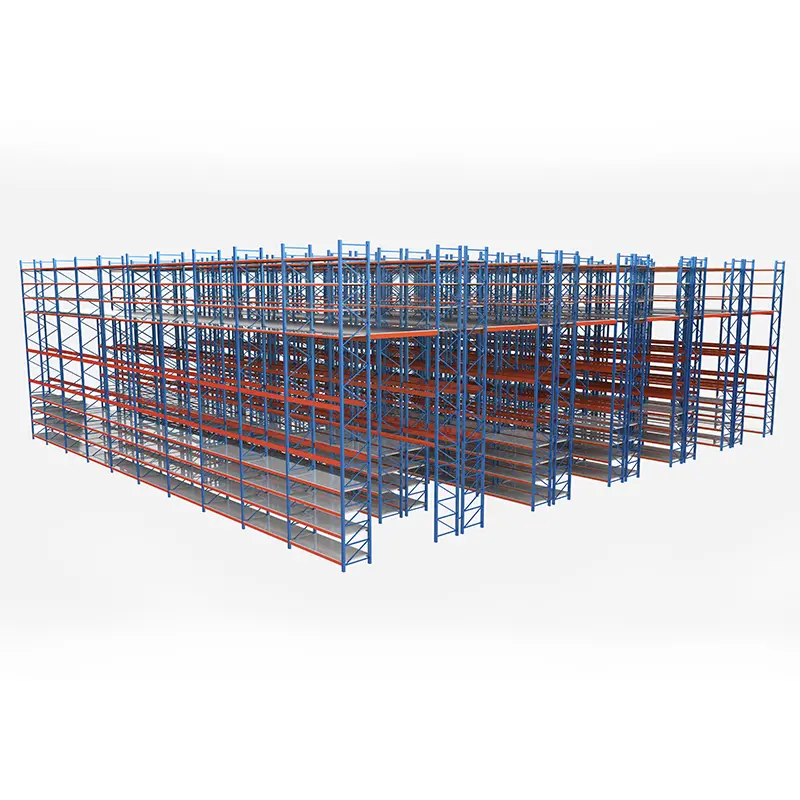 24H CAD

24-Hour Free CAD & 3D Design
Receive comprehensive 2D floor plans, 3D parametric renderings, and structural load calculations formatted in imperial (lbs/ft) or metric units ready for municipal permit filing.
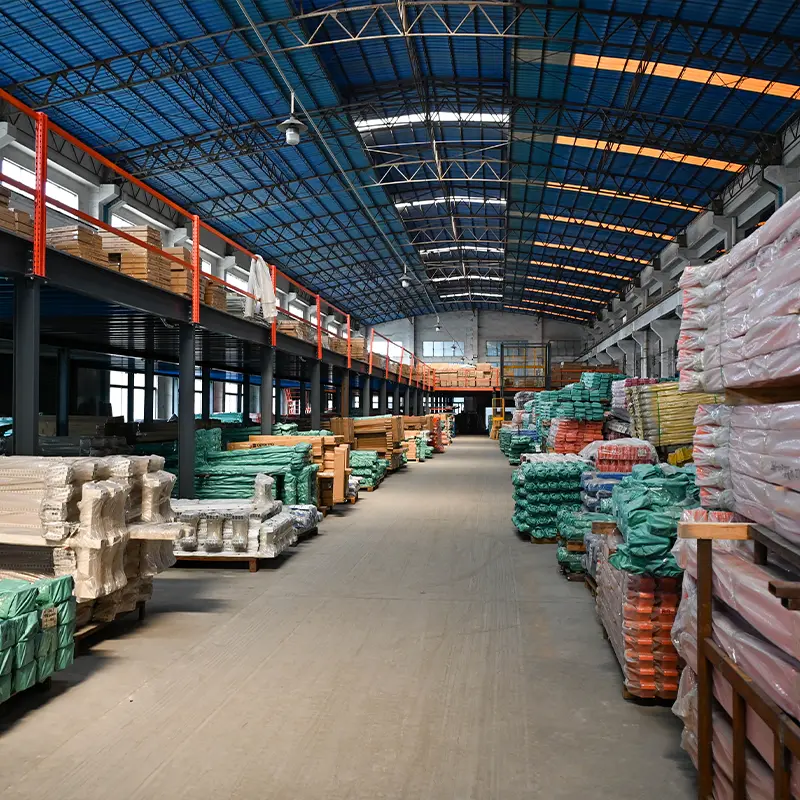 ISO 9001:2015

Certified Material Integrity
Manufactured using certified prime steel mill coils. Full ISO 9001:2015 and CE EN 1090 traceability with multi-stage ultrasonic weld inspections and destructive load tests.
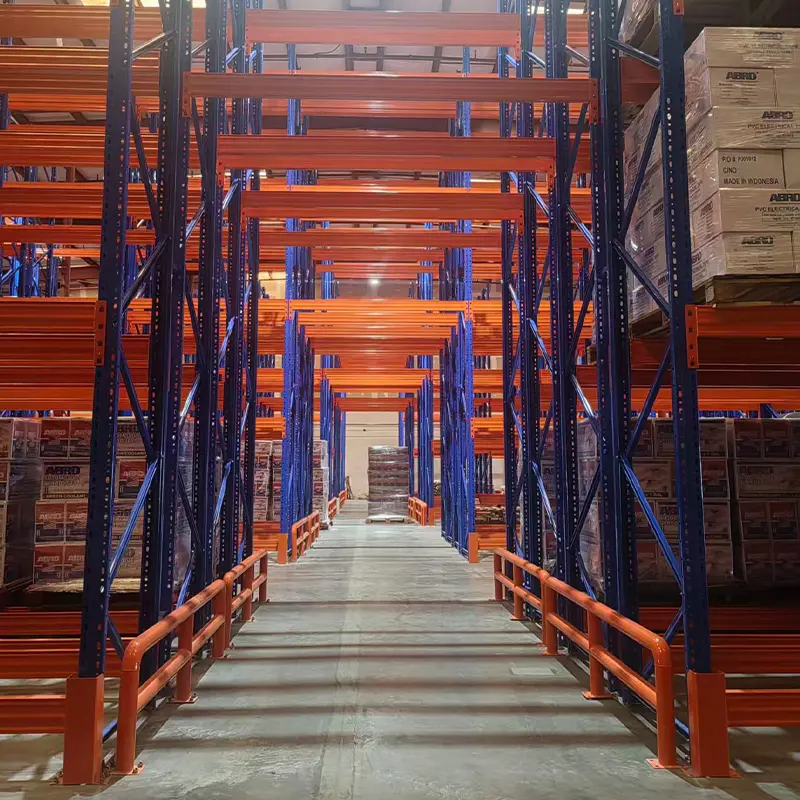 OEM / ODM

Bespoke OEM / ODM Tailoring
Custom punching dies (teardrop, hex, diamond), proprietary beam profile roll-forming, private labeling, custom RAL powder finishes, and container bundle nesting optimization.
Engineering Whitepaper: Structural Mechanics & Steel Profiling
Understanding the critical engineering variables in pallet racking systems is vital to ensuring regulatory compliance, operator safety, and long-term structural durability. Below is an engineering overview of our manufacturing criteria, steel metallurgy, and load rating calculations.
Cold-Roll Formed Profile Optimization
The structural load-bearing capacity of an upright frame is fundamentally dictated by the cold-work hardening achieved during the roll-forming process. Our factory utilizes multi-station automated roll-forming lines that impart precise cold-work stress directly to the steel strip corners:
- Continuous Omega Upright Sections: Fabricated with up to 12 distinct bending bends that enhance torsional rigidity and resistance against lateral column buckling.
- Optimized Hole-Punch Geometry: Teardrop and slot configurations punched prior to roll-forming to preserve metallurgical grain boundary integrity and avoid shear concentration.
- Box Beams vs. Step Beams: We supply twin-interlocking box beams for standard heavy pallets and step beams engineered specifically to accommodate flush wire decking and drop-in panel inserts.
Seismic Engineering & Anchorage Mechanics
In high-seismic zones across North America (such as California, the Pacific Northwest, and the St. Lawrence Valley), warehouse racking must be calculated as a building-like structural framework under IBC and ASCE 7 provisions:
- Ductility & Base Plate Sizing: Heavy gauge structural footplates oversized to disperse dynamic seismic moments into the concrete slab via wedge or screw anchors.
- Torsional Splice Joints: Column extensions utilize internal and external sleeve splices bolted through the neutral axis, ensuring full bending moment continuity across elevations.
- Beam-to-Column End Connectors: High-tensile forged 4-claw connectors providing rigid frame moment resistance against longitudinal sway deflection.
Automated Surface Pretreatment & Finishing
Corrosion mitigation is critical for longevity, especially in unconditioned warehouses, food cold storage facilities, and sea-freight transit:
- Multi-Stage Chemical Immersion: Automated degreasing, hot water rinsing, acid pickling (rust removal), and zinc phosphating ensure superior molecular powder adhesion.
- Electrostatic Powder Deposition: Application of TGIC-free polyester or epoxy-polyester thermosetting powder coatings baked at 180°C to 200°C.
- Thickness & Impact Testing: Maintained coating thickness between 60–90 microns, passing ASTM D3359 cross-hatch adhesion and ASTM D2794 impact resistance tests.
Quality Assurance & Destructive Batch Testing
Every production campaign undergoes verifiable mechanical and dimensional validation before release:
- Raw Coil Verification: Mill test certificates checked for yield strength (≥235 MPa for Q235B; ≥355 MPa for Q355B) and chemical composition.
- Weld Integrity: Robotic CO2 gas shielded arc welding inspected for continuous throat thickness without porosity, undercut, or incomplete penetration.
- Live Distributed Load Trials: Hydraulic compression rigs conduct prototype beam deflection trials, holding load at a safety factor of 1.65 to 1.95 without permanent deformation.
Inside Our 10-Step Controlled Fabrication Sequence
From prime hot-rolled strip to sea-freight container loading, every component adheres to a tightly audited workflow.
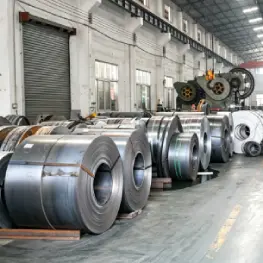 STEP 01
Prime Raw Coil
Traceable prime steel coils rigorously checked for tensile yield and clean surface profile.
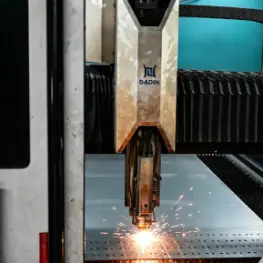 STEP 02
Precision Slitting
High-speed slitting lines cut wide master coils to precise strip widths with minimal edge camber.
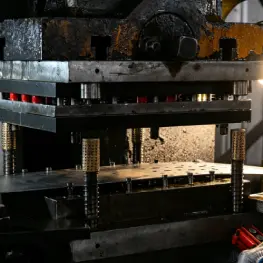 STEP 03
CNC Punching
Fully synchronized high-tonnage punch presses stamp pitch holes at micro tolerances.
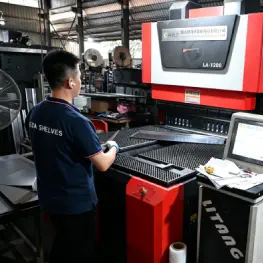 STEP 04
Cold Forming
Progressive multi-roll forming tooling hardens profiles into rigid, high-load shapes.
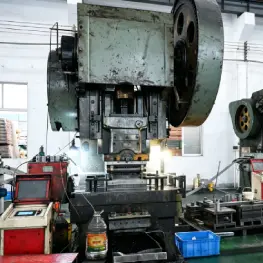 STEP 05
Profile Straightening
In-line hydraulic straighteners eliminate twist and bow, guaranteeing beam linearity.
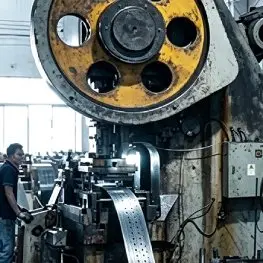 STEP 06
Deburring & Polish
Automated abrasive brushing removes sharp slag, spatter, and cutting burrs.
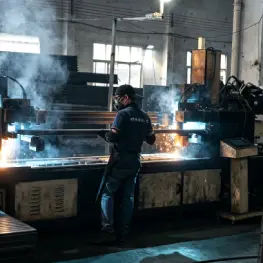 STEP 07
Robotic Welding
Automated multi-axis robotic cells fuse beam connectors with deep, uniform penetration.
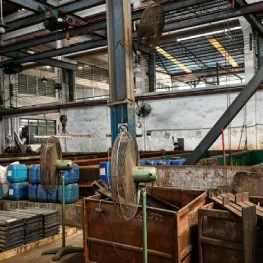 STEP 08
Pickle Pretreatment
Chemical dip stages strip scale and deposits zinc-phosphate conversion coatings.
 STEP 09
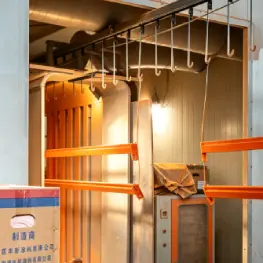
Powder Coating
Electrostatic guns apply smooth thermoset powder baked in computer-regulated ovens.
 STEP 10
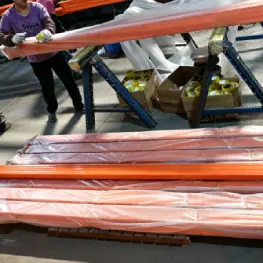
QC & Ocean Bundling
Batch caliper checks, protective corrugated wrapping, steel strapping, and container stuffing.
Pallet Racking System Architecture Comparison
Compare operational characteristics, floor space utilization, and SKU selectivity to match your material handling workflow.
| Racking Typology | Stock Rotation | Selectivity | Space Density | Forklift Compatibility | Target Industry Profile |
|---|---|---|---|---|---|
| Selective Pallet Racking | FIFO / LIFO | 100% Direct | Standard (35–40%) | Counterbalance, Reach, VNA | 3PLs, E-commerce, Retail DCs, General Freight |
| Double-Deep Racking | LIFO | 50% Immediate | High (50–55%) | Deep-Reach Pantograph Truck | Dry Grocery, Fast-Moving Consumer Goods (FMCG) |
| Drive-In / Drive-Thru | LIFO / FIFO | Low (Lane-based) | Very High (70–80%) | Standard Counterbalance, Reach | Cold Storage Freezers, Beverage Bottling, Raw Ingredients |
| Push-Back Carts | LIFO | Front of Lane | High (60–70%) | Standard Counterbalance, Reach | Food Distributors, Manufacturing Buffer Lines (2–6 deep) |
| Pallet Flow (Gravity) | True FIFO | Lane Face | Ultra High (75–85%) | Standard Forklifts (Separate Aisles) | Perishable Foods, Pharmaceuticals, Expiry-Tracked SKUs |
| Radio Shuttle Automation | FIFO & LIFO | Channel Terminal | Maximum (>85%) | Standard Forklifts + Battery Cart | Deep-Freeze Warehouses, Mega 3PLs, Automated Logistics |
| Rack-Supported Mezzanine | Multi-Tier Manual | Direct Walk-Up | Floor Area 200–300% | Forklifts (Load Gates) + Manual Carts | Auto Parts, Small-Box Parcel Picking, Garments, Archives |
Future Trends in Warehouse Racking & Pallet Storage
How automation, ESG benchmarks, and structural resilience are reshaping warehouse design through 2030.
1. AMR & Shuttle-Ready Tolerances
The transition toward Autonomous Mobile Robots (AMRs) and automated four-way shuttles demands millimeter-level profile tolerances. Upright straightness deviations (1/1000) and laser-calibrated rail levels are replacing loose structural allowances to eliminate automated vehicle travel jams.
2. Ultra-High Density & Vertical Expansion
With industrial land leasing rates climbing globally, facility builders are capitalizing on vertical clear heights up to 40 meters (130 ft). High-bay clad-rack architectures—where the pallet racking system forms the structural backbone carrying wall and roof cladding—are drastically reducing building construction costs.
3. Green Steel & Eco-Responsible Powder Coatings
Procurement directors increasingly prioritize low-carbon footprint suppliers. HEDA Shelves utilizes scrap-recycled EAF (Electric Arc Furnace) prime coils, zero-VOC heavy-metal-free thermoset powder coatings, and closed-loop chemical wastewater treatment plants that satisfy stringent ESG environmental audits.
4. Modular Reconfigurability for 3PLs
Dynamic consumer fulfillment requires modular, non-destructive beam repositioning. Universal teardrop punching compatible with traditional North American teardrop pins allows rapid warehouse layout reconfiguration as clients onboard different SKU footprints without replacing upright structures.
5. Smart Safety & IoT Impact Sensor Integration
Modern pallet racks are integrating structural telemetry. OEM/ODM custom uprights are manufactured with dedicated channels for wireless IoT strain gauges and accelerometer nodes, notifying warehouse managers via dashboard alerts if an upright sustains a high-energy forklift collision.
6. Tariff-Optimized CKD Packing Architecture
Rising global ocean freight rates necessitate Completely Knocked Down (CKD) engineering. Upright frames are flat-shipped with unbolted bracing and nested beam profiles, maximizing ocean container cubing efficiency up to 26–28 metric tons per 40ft High Cube container.
Frequently Asked Questions for B2B Importers
What specific engineering data is required to generate a 24-hour CAD layout and quotation?
To deliver an accurate architectural CAD drawing and itemized quotation, our engineering team requires: (1) Warehouse clear height to roof obstructions or sprinkler heads; (2) Building architectural column grid layout; (3) Pallet dimensions (Length × Width × Height inclusive of product overhang); (4) Maximum gross weight per pallet; (5) Forklift model, maximum lift height, and minimum right-angle stacking aisle width; and (6) Municipal seismic zone classifications if known.
How do you ensure compatibility with standard 48" × 40" GMA pallets used in North America?
We manufacture standardized beam lengths (typically 96", 108", or 144" clear span) and frame depths (42" or 48" deep) designed around the ubiquitous 48" × 40" Grocery Manufacturers Association (GMA) pallet. This geometry guarantees the mandatory 3-inch overhang on front and back beams while providing adequate flue spaces required by NFPA 13 sprinkler guidelines.
Can HEDA Shelves supply structural calculation packages for local PE (Professional Engineer) stamping?
Yes. Every OEM/ODM project can be paired with comprehensive structural finite element analysis (FEA) reports, material mill test certifications, section property data, and component load capacity charts. These engineering packages are drafted in imperial units (pounds, feet, inches) to streamline review and stamping by your local licensed Professional Engineer of Record for city building permit approvals.
What OEM / ODM customization options are supported for racking distributors and integrators?
We provide comprehensive private-label OEM manufacturing: (1) Custom column punch patterns including American Teardrop, Newstyle Diamond, and European 50mm/75mm pitches; (2) Custom roll-formed beam profiles; (3) Stamped client brand logos on end-plates and column protectors; (4) Custom RAL corporate powder coat color matching; and (5) Custom bilingual English/Spanish warning plaques and load capacity safety signs.
How are oversized steel components protected against corrosion and shipping damage during ocean transit?
Uprights are nested with cushioning corrugated cardboards between levels, wrapped in multi-layer stretch film, strapped with heavy-gauge PET/steel bands, and fitted with timber skid dunnage for damage-free forklift container unloading. Beams are packed in uniform bundles with protected connector tabs. Moisture-absorbing desiccant bags are distributed inside every 20GP/40HC container to prevent sea-sweat condensation corrosion.
Engineering Consultation Desk
Looking to review an existing rack layout, expand storage density, or benchmark container-landed pricing against domestic fabricators?
- ✦ Complete CAD Layout & 3D Modeling
- ✦ Beam Deflection & Seismic Math Verification
- ✦ FOB, CIF, DDP North American Shipping Terms
- ✦ ISO 9001:2015 & CE EN 1090 Mill Certificates
- ✦ Direct Ex-Factory Pricing With Zero Surcharges