Enterprise Whitepaper • Global Supply Architecture
China Wholesale Modular Pallet Racking Supplier & Suppliers
Precision-Engineered Heavy Duty Storage Systems, Turnkey CAD/BIM Layouts, Automated Shuttle Interfacing, and Factory-Direct Compliance to RMI, ANSI MH16.1, and EN 15512 Standards.
2001+
Founded • 25+ Yrs Expertise
30,000m²
323,000 Sq Ft Factory Site
30,000t
Monthly Cold-Forming Capacity
10,000+
Global Warehouse Deployments
Engineered Product Portfolio
Standardized & High-Density Modular Racking Systems
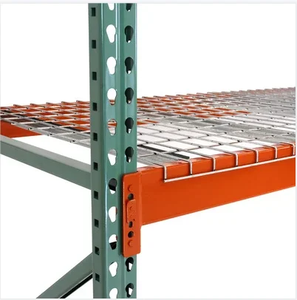
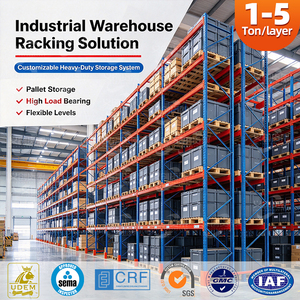
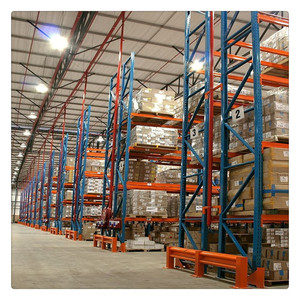
Continuous roll-formed box beams and upright profiles for instant direct access to every pallet position. Adaptable to counterbalanced and reach trucks.
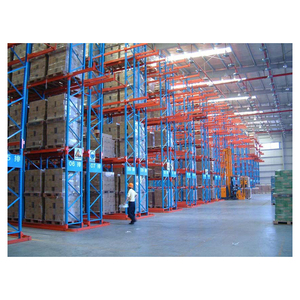
High-bay design reaching up to 16 meters. Shrinks operating aisle clearance down to 1.6-1.8m when paired with turret trucks and mechanical or wire-guided rails.
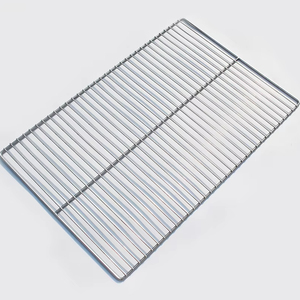
Heavy-gauge electropolished SUS304 food-contact wire mesh grid. Heat-resistant up to 400°C for mobile bakery trolleys, cleanroom batching, and pharmaceutical drying.
Structural Mechanics of Modular Pallet Racking in Wholesale Logistics
Modern industrial supply chains require wholesale racking infrastructure that balances raw yield tensile capacity, dynamic deflection elasticity, and effortless modular reconfigurability. As warehouses scale up vertically to combat escalating real estate leases, modular pallet racking transitions from a passive static frame to an active, engineered asset directly coupled with Material Handling Equipment (MHE).
1. Steel Metallurgy: Cold-Formed High-Strength Coils (Q235B vs. Q355B vs. ASTM A1011)
The structural backbone of high-capacity warehouse racking relies on continuous automated cold-roll-forming mills. High-grade structural carbon steel Q235B (yield strength ≥ 235 MPa, tensile strength 375–500 MPa) and micro-alloyed Q355B (yield strength ≥ 355 MPa, tensile 470–630 MPa) form the foundation of our upright columns and step/box beam profiles. For North American distribution deployments, these match or exceed ASTM A36 and ASTM A1011 SS Grade 50 standards. Precise roll-forming sequences create multi-flanged, closed-profile sections with cold-work strain hardening, elevating the actual load capacity of upright frames while reducing deadweight per square foot.
In semi-rigid frame structures, the connection between the horizontal beam and the vertical upright dictates the sway tolerance of the entire warehouse system. Utilizing multi-tooth connector claws (3-rivet to 5-rivet cold-stamped brackets) mechanically wedged into tapered teardrop or omega slot profiles ensures an interlocking mechanical lock. Under structural loading, gravity engagement tightens the joint, generating critical rotational restraint (moment resistance stiffness) that limits unbraced buckling lengths according to RMI ANSI MH16.1 and European FEM 10.2.02 guidelines.
Architectural Decision Matrix
Technical Specification & Throughput Benchmark
Comprehensive comparative performance matrix mapping volumetric utilization against SKU accessibility, equipment cycle times, and structural floor loadings.
System Topology
Volumetric Efficiency
Selectivity Rate
Standard Pallet Load
Typical Aisle Width
Primary MHE Required
Cycle Time / Throughput
Selective Pallet Racking
40% – 45%
100% Direct Access
500 – 2,500 kg / level
3.0 – 3.8 meters
Standard Counterbalance / Reach
Ultra-Fast (60+ pallets/hr)
Very Narrow Aisle (VNA)
65% – 75%
100% Direct Access
800 – 1,800 kg / level
1.6 – 1.8 meters
Turret Truck / Order Picker (Wire-guided)
High (45 – 55 pallets/hr)
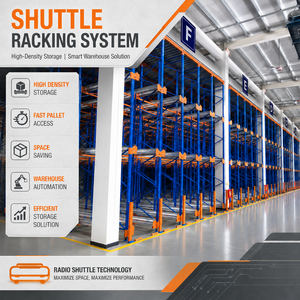
Radio Pallet Shuttle
80% – 88%
LIFO or True FIFO
500 – 1,500 kg / pallet
2.6 – 3.0 meters
Standard Forklift + Autonomous Shuttle
Very High (Shuttle travels 1.2 m/s)
Drive-In / Drive-Through
70% – 80%
Low (Batch LIFO)
1,000 – 1,500 kg / pallet
Integrated Drive Lane
Counterbalance / Reach Truck
Moderate (Driver enters rack)
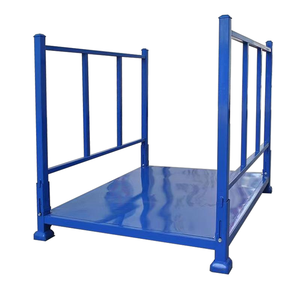
Portable Stacking Racks
55% – 65%
Batch Block Stacking
1,000 – 2,000 kg / tier
Dynamic Yard / Floor
Standard Forklift
Flexible (Zero fixed footprint)
Factory Prowess & OEM Authority
Why Tier-1 Importers & 3PL Integrators Partner With HEDA
Two decades of certified Chinese manufacturing excellence serving warehouse projects across North America, Europe, Southeast Asia, and the Middle East.
Turnkey 24h CAD/BIM Layouts
Send facility blueprints, clear heights, and pallet specifications. Our in-house engineering team delivers full 2D CAD layouts, 3D renderings, and structural loading calculations within 24 hours.
ISO 9001:2015 & CE Marking
Independently verified manufacturing certified to ISO 9001:2015 (Cert No. 18624Q00169R0M) and CE Factory Production Control (No. 2435-CPR-8605159), ensuring seamless building permit sign-offs.
Continuous Automated Lines
10-step precision manufacturing pipeline: uncoiling, automated multi-punching, precision roll forming, CNC robotic welding, pickling/phosphating chemical wash, and electrostatic powder curing.
Ocean Freight Dunnage & Packing
Optimized 40ft HQ container loading algorithms eliminate transit deformation. Heavy upright bundles strapped with timber dunnage, protective corner guards, and corrosion-inhibiting vapor barrier wrap.
Strategic Procurement Horizon
Future Procurement & Technological Trends in Racking Systems
Actionable intelligence for logistics executives, asset management directors, and wholesale buyers projecting warehouse infrastructure requirements through 2030.
1. Convergence of Modular Racking with AMR & AS/RS
The boundary between static pallet racks and automated storage is blurring rapidly. Racking systems are now engineered with tighter deflection tolerances (L/300 to L/400 instead of standard L/200) to allow automated guided vehicles (AGVs), Autonomous Mobile Robots (AMRs), and mini-load crane mast interfaces to operate without robotic sensor blinding.
2. Cold Chain Thermal Resilience
With explosive global demand in refrigerated logistics, cold-tolerant racking steels are mandatory. Standard carbon steels suffer ductile-to-brittle transition below zero degrees Celsius. Future procurement trends focus on low-temperature impact-tested steels (e.g., Q355D/E) combined with specialized zinc-rich epoxy powder coatings that resist thermal-shock cracking and condensation peeling down to -30°C.
Major multinational 3PLs are enforcing Scope 3 greenhouse gas reporting across their supply chain infrastructure. Sourcing wholesale racking manufactured using electric arc furnace (EAF) recycled scrap steel and solvent-free TGIC powder coatings ensures sustainable regulatory compliance. Fully bolted, weld-free modular frameworks enable warehouses to dismantle, relocate, and reconfigure systems with zero scrap loss.
Procurement & Technical FAQ
Frequently Asked Questions for Wholesale Racking Buyers
Direct answers addressing structural certification, material specifications, seismic engineering, and logistics clearance.
What documentation is provided to support local building permit & PE stamp reviews?
We supply comprehensive engineering packages including detailed 2D/3D shop drawings, component profile cross-section properties, finite element analysis (FEA) reports, and structural calculations calculating unbraced length, seismic spectral acceleration ($S_s, S_1$), and anchor pullout forces. These documents are directly formatted for review and stamping by your local licensed Professional Engineer (PE).
How do Chinese steel grades like Q235B compare to North American ASTM standards?
Q235B is an industry-standard structural carbon steel with a guaranteed minimum yield strength of 235 MPa (approx. 34,100 psi) and ultimate tensile strength of 375–500 MPa, directly equivalent to North American ASTM A36. For heavier upright columns requiring higher axial capacity, we utilize Q355B (355 MPa / 51,500 psi yield), which matches ASTM A572 Grade 50 or ASTM A1011 HSLAS Grade 50.
What deflection limits are calculated for horizontal pallet beams?
In adherence with ANSI MH16.1 and EN 15512 specifications, our beam load capacities are calculated based on a maximum vertical deflection limit of L/200 under uniform static pallet distribution (where L represents the clear beam span, e.g., max 13.7 mm on a 2743 mm / 108" beam). For robotics, AS/RS, or fragile loads, we can engineer custom beam profiles to L/300 or L/400 stiffness.
What surface treatment and corrosion protection methods are standard?
Components pass through automated 4-stage chemical pre-treatment (degreasing, acid pickling to eliminate mill scale, surface neutralisation, and zinc phosphating). Following pre-treatment, parts enter an automated electrostatic spray booth applying 60 to 90 microns of polyester powder coating, cured in ovens at 180°C–200°C. Hot-dip galvanization is available for outdoor or high-humidity cold-storage applications.
How are wholesale orders packaged to prevent container damage during sea shipment?
Upright frames and beams are bundled with high-tensile steel strapping over corrugated edge-protectors and non-slip timber skids designed for fork-truck unloading. Drop pins, safety bolts, leveling shims, and floor anchors are sealed in moisture-proof heavy-duty wooden crates with desiccant packs to prevent transit rust and maritime humidity damage.
Can you manufacture teardrop profiles compatible with existing US racking?
Yes. Our automated punch presses feature tooling for standard North American inverted-teardrop hole configurations spaced on 2-inch (50.8 mm) vertical increments. This allows seamless interchanging and expansion of existing racking systems in the USA and Canada, including step beam safety locks and wire deck drops.
Direct Factory Engagement
Request a Free Warehouse CAD Layout & Wholesale Quotation
Consult directly with our structural engineering team. Submit your building dimensions, clear heights, pallet configurations, and forklift parameters to receive an optimized 2D/3D system layout and factory-direct price schedule within 24 hours.