Featured Very Narrow Aisle (VNA) & High-Density Storage Systems
Precision-formed using certified high-tensile Q235B and Q355B structural steel, our VNA series integrates seamless floor guide-rail channels, wire guidance compatibility, and heavy-duty load capacities up to 4,000 kg per beam tier.
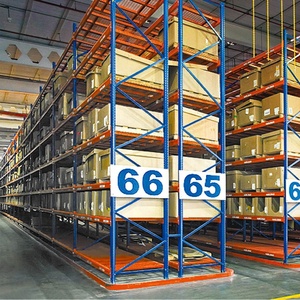
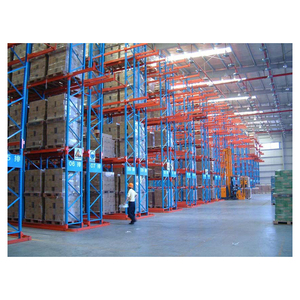
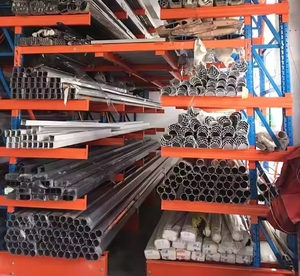
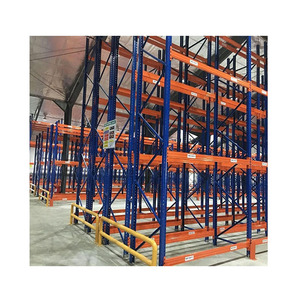
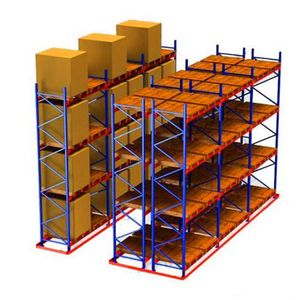
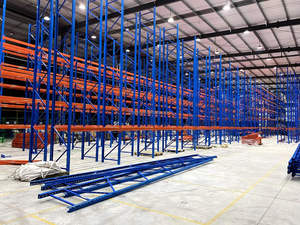
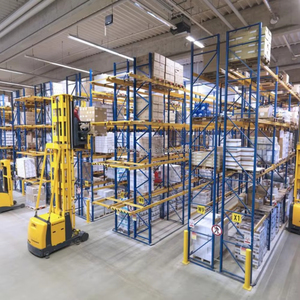
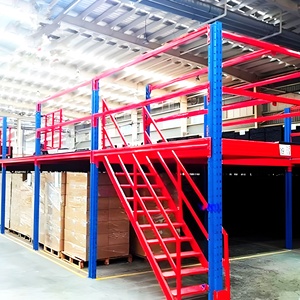
Comparative Technical Analysis: VNA vs. Conventional Systems
Evaluating spatial volumetric efficiency, operational throughput, guide-rail tolerances, and material handling vehicle capital expenditure.
| System Configuration | Working Aisle Width | Vertical Clear Height | Floor Utilization Ratio | Selectivity | Guidance Method | Annual Throughput Index |
|---|---|---|---|---|---|---|
| Very Narrow Aisle (VNA) | 1,500 mm – 1,850 mm | Up to 16,500 mm | 85% – 90% | 100% Direct Access | Steel Profile or Wire Induction | High (Continuous Turret Truck Duty) |
| Standard Selective Racking | 3,200 mm – 3,800 mm | Up to 8,000 mm | 40% – 45% | 100% Direct Access | Visual Line Driving | Moderate (Counterbalance / Reach) |
| Double-Deep Pallet Racking | 2,800 mm – 3,200 mm | Up to 10,000 mm | 55% – 60% | 50% Immediate Selectivity | Free-Steer Telescopic Fork | Medium (Requires Pallet Shuffling) |
| Drive-In Storage System | Intermittent Lanes | Up to 11,000 mm | 75% – 80% | Low (LIFO / Batch Strict) | Internal Structural Channel | Low-to-Medium (Batch Handling) |
Future Procurement Trends for VNA Infrastructure: The Next Decade in Automated Material Handling
Global supply chain logistics have entered a new era characterized by rapidly compounding square-foot commercial leasing overhead, high carbon taxation, and chronic labor shortages across primary distribution hubs. In North America and Europe, prime industrial warehouse rents have surged by over 42% over recent fiscal periods. In response, modern procurement directors are decoupling warehouse growth from geographic land acquisition, opting instead to maximize internal vertical cubic volume through high-bay VNA racking systems.
Strategic procurement is transitioning from disconnected component buying to comprehensive infrastructure integration. Today’s high-density VNA systems must be designed concurrently with Very Narrow Aisle turret trucks (Man-Up or Man-Down) and Autonomous Mobile Robot (AMR) high-bay navigation architectures. Key engineering benchmarks currently governing large-scale enterprise tenders include:
1. Laser Superflat Floor Statics & Tolerances: Because VNA equipment lifts heavy pallets to heights exceeding 15 meters within aisles narrow enough to allow only 100mm of lateral clearance, standard industrial flooring is insufficient. Buyers must align racking upright design with strict DIN 18202 and VDMA 15251 flat-floor standards. Factory engineers now provide dynamic base-plate footprints that distribute high point-loads cleanly into the concrete slab, eliminating differential settlement risks.
2. Hybrid AGV/AMR Guided Interoperability: While conventional VNA traditionally deployed mechanical angle-iron or rail profiles anchored to the concrete floor to stabilize operator-driven turret trucks, forward-looking procurement favors in-floor inductive wire guidance and RFID location transponders. Modern cold-rolled box beams feature pre-drilled datum slots and integrated optical reflectors to support automated optical guided vehicles (AGVs) operating without human intervention.
3. High-Tensile Thin-Walled Cold-Formed Steel Efficiency: As ESG frameworks, embodied carbon accounting, and cross-border steel emissions penalties (such as the EU Carbon Border Adjustment Mechanism - CBAM) take center stage, engineers use finite element analysis (FEA) to engineer complex upright geometry. By increasing the number of bends and stiffeners across the cold-rolled profile, structural load capacity is enhanced while overall steel mass per pallet location drops by up to 14%, directly lowering ocean shipping costs and embodied carbon metrics.
Technological Advancements: Surface Treatment, Precision Forming & Structural Safety
Operational safety in high-density VNA configurations is paramount. Because upright frames routinely exceed 12 meters, structural tolerances must be controlled down to fractions of a millimeter. Leading export factories employ continuous multi-station CNC roll-forming lines. Automated laser-guided punching maintains consistent hole pitch across entire 12-meter continuous sections, preventing twist, camber, and residual internal stresses.
Surface treatment chemistry has evolved significantly beyond basic liquid painting. Modern enterprise installations require automated 9-stage degreasing, zinc-phosphating, and continuous electrostatic epoxy-polyester powder coating cured at 180°C-200°C. This process produces a scratch-resistant, impact-resistant finish certified to withstand over 500 hours of continuous salt-spray exposure. In demanding cold-chain freezers (-30°C) or high-humidity coastal settings, hot-dip galvanization (conforming to ASTM A123 / ISO 1461) delivers lifelong corrosion resistance without surface flaking or micro-fracturing under low temperatures.
Why Top Global Brands & 3PL Integrators Choose Us
Operating as Guangzhou Heda Shelves Co., Ltd., we combine 25+ years of heavy manufacturing mastery with turnkey export engineering across 100+ countries.
30,000 m² Intelligent Production
Equipped with automated continuous roll-forming mills, automated robotic welding stations, and high-capacity electrostatic powder coating lines with monthly output exceeding 30,000 metric tons.
Rapid Free CAD & 3D Statics (24h)
Our 30+ senior structural engineers prepare complete CAD floor plans, 3D renderings, and detailed load calculations in metric and imperial units (lbs/ft) within 24 hours of receiving site dimensions.
ISO 9001:2015 & CE Certified
Complete compliance with EN 15512, FEM 10.2.02, and RMI standards. Certified factory quality tracking guarantees raw-material mill certificates, weld integrity testing, and full traceability.
Container-Optimized Export Packing
Custom heavy-gauge steel bundling, protective interleaving, and computerized 3D container packing simulations maximize cube utilization in 40ft HQ containers while eliminating transit abrasion.
Full OEM / ODM System Customization
Custom tooling profiles, specialized beam connector configurations, custom corporate powder colors (RAL standards), and custom private-label branding for regional distribution partners.
On-Site & Remote Installation Support
Comprehensive step-by-step 3D visual installation drawings, pre-labeled bundling systems, and available on-site supervisory dispatch to ensure rapid, error-free system commissioning.
Frequently Asked Questions for Global VNA Procurement
Direct engineering answers addressing aisle clearance, guide rails, seismic certifications, floor slab requirements, and export logistics.
What is the standard clear aisle width required for a VNA racking installation?
Typical VNA aisle widths range between 1,600 mm and 1,850 mm, depending on pallet dimensions (1200x1000mm or 1200x800mm) and the specific model of Very Narrow Aisle turret truck or articulated reach truck. This delivers up to 50% aisle width reduction compared to standard counterbalance forklift aisles (3,200 mm – 3,800 mm).
How are VNA mechanical guide rails integrated into the system?
We supply high-strength structural angle steel (typically 100x75x8mm or 125x75x10mm) anchored directly to the warehouse slab with heavy chemical anchor bolts along both sides of the aisle. The system features low-profile run-in entry horns at every aisle entrance to guide turret truck side-guide rollers smoothly into the narrow corridor.
What concrete slab floor tolerances are required for tall VNA installations?
For mast operating heights over 10 meters, floor flatness must comply with DIN 18202 (Table 3, Line 4) or VDMA 15251 Category F. Superflat floor specifications prevent dynamic mast sway and truck tilt, which can cause severe impacts at top beam tiers. Our engineering package includes complete base-plate point load calculations for your structural engineer.
Can your factory provide load calculation data in imperial units (lbs, ft, in)?
Yes. We routinely engineer projects for distribution centers across the USA, Canada, and Mexico. All CAD layout proposals, installation schematics, beam load capacity plaques, and structural engineering calculation reports can be provided in both imperial and metric units for smooth municipal permitting and review.
How are international ocean freight shipments protected against damage?
All upright frames and beams are bundled with steel strappings over heavy corrugated board corner protectors and wooden dunnage. Small components, base plates, leveling shims, safety locks, and hardware are crated in seaworthy, fumigated wooden cases. Bundles are systematically coded to match CAD installation sheets, speeding up container unloading and assembly.
What is the standard production lead time for a 50-container VNA project?
Standard manufacturing time for large-scale enterprise contracts (20 to 50 containers) ranges between 20 to 30 working days following final CAD sign-off and color specification. Our rolling capacity of 30,000 metric tons per month ensures continuous production schedules without bottlenecking downstream installation timelines.