VNA / High Bay
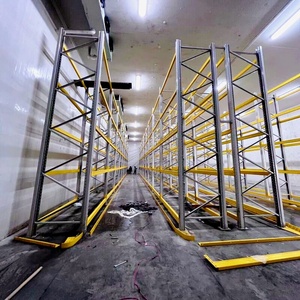
Heavy Duty VNA & Adjustable Metal Boltless Single Deep Warehouse Racking
- Aisle Width: 1,600 mm – 1,800 mm
- Bay Capacity: Up to 15,000 kg
- Guide Rail & Turret Truck Optimized
Manufactured from high-yield SS400/Q235B cold-rolled coil, engineered for 48"x40" GMA, EUR, and custom container configurations with verifiable beam load compliance.
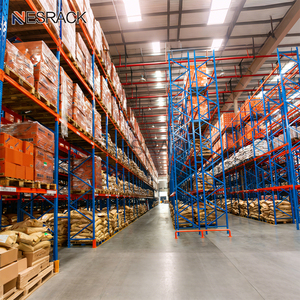
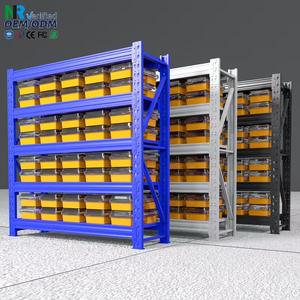
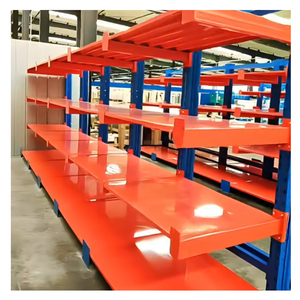
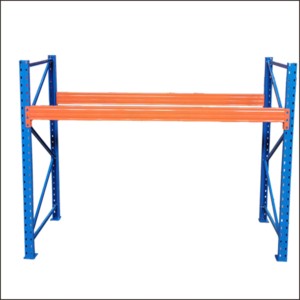
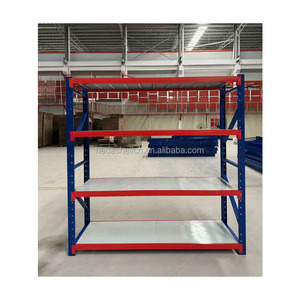
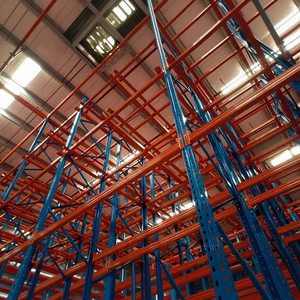
Why single-deep selective configurations remain the golden structural baseline for global distribution networks requiring 100% immediate SKU selectivity without inventory honeycombing.
Our upright columns utilize a multi-ribbed Omega (Ω) geometric section cold-formed continuously across 24 rolling stations. Manufactured from certified Q235B and high-yield Q355B micro-alloyed steel, this profile minimizes residual torsional stresses and raises torsional rigidity against accidental forklift impacts by up to 28% compared to generic C-channels.
Punching pitches are precision-calibrated at 50 mm (European standard) or 75 mm / 76.2 mm (3-inch North American teardrop pitch), executed on multi-ton servo-hydraulic CNC punch presses to guarantee pitch consistency within ±0.1 mm over a 12-meter continuous span.
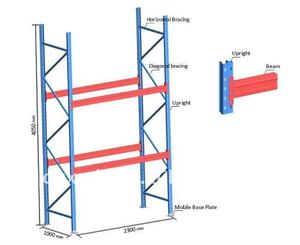
Load beams are fabricated from twin C-sections cold-nested and seam-welded via automated submerged arc lines, creating a unified closed-box hollow structural section. This configuration provides symmetric moments of inertia in both vertical and horizontal axes, preventing structural roll under asymmetric pallet weights.
Heavy-gauge 3-prong, 4-prong, or 5-prong cold-stamped beam end connectors are automatically welded with robotic MIG tracking. Each connector integrates dual safety shear-lock pins tested to withstand upward dislodgment forces exceeding 1,000 kg (2,204 lbs) per hook according to EN 15512 safety protocols.
Every single deep rack installation is computed using finite element analysis (FEA) under second-order P-Delta non-linear geometric conditions. Beam live-load deflections are strictly engineered to satisfy L/200 under maximum rated uniformly distributed loads (UDL), preventing dynamic pallet slip and premature fatigue of horizontal members.
Upright frame bracing combines heavy diagonal and horizontal structural tubes formed in a continuous K-truss or Warren-truss architecture, transmitting horizontal seismic and operational braking loads seamlessly to baseplates anchored with heavy Hilti-equivalent wedge anchors into C25/30 concrete slabs.
A rigorous engineering and financial comparison to help warehouse operators, 3PL managers, and supply chain directors choose the precise configuration for operational ROI.
| Storage System Type | Direct Selectivity | Floor Space Utilization | Aisle Width Reqd. | Forklift Capex Demand | Honeycombing Loss | Optimal Throughput Velocity |
|---|---|---|---|---|---|---|
| Single Deep (Selective) | 100% (Instant) | 35% – 42% | 2.8 m – 3.2 m (Standard Counterbalance) | Low (Standard Class I/IV/V) | 0% None | High to Ultra-High (Fast Turn) |
| Single Deep (VNA Config) | 100% (Instant) | 50% – 58% | 1.6 m – 1.8 m (Wire/Rail Guided) | High (Specialized Turret/Man-Up) | 0% None | High (Precision Staging) |
| Double Deep Racking | 50% (Requires Shifting) | 55% – 62% | 2.9 m – 3.2 m (Pantograph Reach) | Moderate (Deep-Reach Mast) | 15% – 25% (SKU Mismatch) | Moderate (Batch Staging) |
| Drive-In / Drive-Thru | < 15% (LIFO / Block) | 65% – 75% | Aisles Replaced by Lanes | Low-Moderate (Counterbalance) | 30% – 45% (High Vacancy Risk) | Low (Seasonal Bulk SKUs) |
| Radio Shuttle Automation | Variable by Lane Depth | 70% – 82% | 2.8 m (Loading Face Only) | Very High (Robotic Shuttles) | 10% – 20% (Lane Saturation) | High (Cold Chain & Buffer) |
Note: Volumetric efficiency calculations based on standard 1,200 mm × 1,000 mm ISO/EUR pallet profiles under a clear ceiling height of 10.5 meters. Actual facility capacities must consider column spacings and sprinkler flues.
The transformation of static industrial shelving into automated-ready, digitally validated, and structurally adaptive intralogistics nodes.
Modern distribution facilities are rapidly shifting away from conventional manual forklifts toward autonomous mobile robots (AMRs) and reach-truck automated guided vehicles (AGVs). This transition demands tighter manufacturing tolerances: beam sag must not exceed L/250 to avoid optical LiDAR reflection errors, and bottom tier floor clearances require integrated cantilevered docking shoes for autonomous charging base stations.
Global building codes (IBC 2024, ASCE 7-22, Eurocode 8) now impose heightened site-specific ground acceleration parameters (Ss and S1). Future procurement trends prioritize cold-formed uprights fabricated from high-ductility micro-alloy steels with elongation ratios exceeding 18%, engineered with energy-dissipating baseplate anchorages that buckle predictively to absorb cyclic seismic shock without catastrophic progressive frame collapse.
Forward-thinking enterprises are integrating industrial IoT sensors directly into key upright bays. Micro-electromechanical strain gauges (MEMS) and triaxial wireless accelerometers monitor accidental mast collisions in real time, transmitting load imbalance warnings, baseline foundation shift alerts, and fatigue cycles directly to warehouse management software (WMS) before structural failure occurs.
Corporate ESG directives are reshaping vendor qualifications. Our manufacturing facility has replaced traditional solvent-based painting lines with fully automated 9-stage non-phosphate zirconium pre-treatment wash tunnels, paired with TGIC-free electrostatic epoxy-polyester powder coating recovery systems that achieve 99.2% powder utilization, zero volatile organic compound (VOC) emissions, and up to 500-hour salt spray resistance (ASTM B117).
Unlocking deep factory-direct cost efficiencies without risking shipping damage, port delays, or non-compliant local building permits.
Ocean freight represents a major percentage of landed racking costs. We custom-bundle our upright frames and box beams using nested wooden dunnage, high-tensile PET strapping, and vapor corrosion inhibitor (VCI) shrink-wrapping. By nesting Omega upright sections back-to-back, a single 40ft High Cube (HQ) container accommodates up to 24 to 26 metric tons of steel components without exceeding maritime road weight limits.
Navigating US municipal permits or EU safety directives requires rigorous calculation documentation. We deliver complete project submittal packages within 24 hours of CAD layout freeze, including 3D AutoCAD DWG layouts, slab load anchor pull-out computations, beam deflection certificates, and material mill test certificates (MTRs) formatted to facilitate local Professional Engineer (PE) stamping across any jurisdiction.
Every steel coil undergoes incoming spectrometer verification for carbon, manganese, phosphorus, and sulfur content. Tensile yield tests are performed per batch. During roll-forming, laser triangulation sensors continuously audit upright straightness within 1:1,000 mm tolerances. Finished powder coatings undergo cross-hatch adhesion tests (ISO 2409 Class 0) and impact deformation resistance checks (ASTM D2794).
In-depth technical, logistics, compliance, and warranty clarifications directly answered by our senior racking engineering directorate.
Engage with our senior structural racking engineers today. Receive custom 2D/3D CAD layout drawings, detailed load stress calculations, and a comprehensive factory-direct quotation within 24 hours.