Flagship Gravity Flow Racking Systems
Custom-fabricated dynamic roller racking systems built with high-yield Q235B/Q355B structural steel, centrifugal braking rollers, and integrated load separators for uncompromising logistics efficiency.
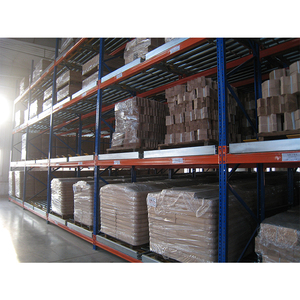
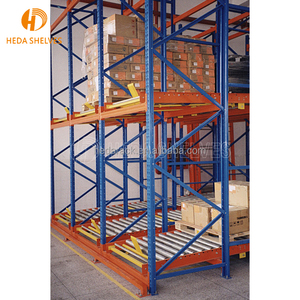
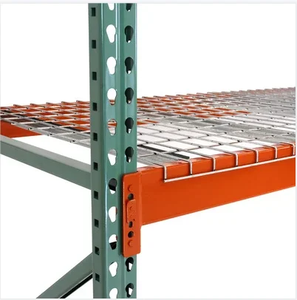
Engineering Fundamentals of Dynamic Gravity Flow Racking
A deep architectural evaluation of gravity-driven pallet movement, kinetic velocity governance, and modular structural integration for North American & European supply chain infrastructures.
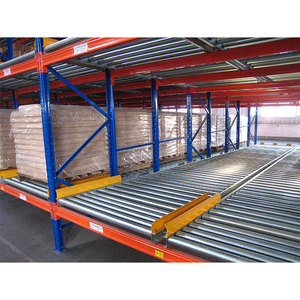
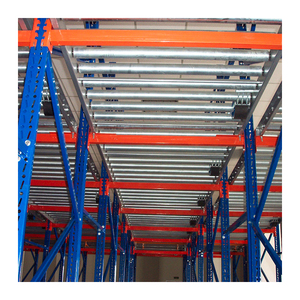
A Gravity Racking System (frequently termed Pallet Flow Racking or Live Storage Racking) operates on a deeply efficient premise: transforming natural gravitational potential energy into regulated kinetic movement. By pitching dynamic roller tracks at a micro-calculated incline—typically between 2.5% and 3.5% (1.5° to 2.0°)—pallets loaded at the rear replenishment aisle traverse smoothly toward the front unloading face under controlled velocity. This mechanism yields an autonomous First-In, First-Out (FIFO) material progression without external power lines, servo motors, or continuous hydraulic consumption.
Structural Reliability Notice: In dynamic live storage, kinetic momentum must never be left unchecked. Our proprietary engineering calculations determine the exact placement interval of mechanical centrifugal braking rollers to prevent high-mass runaway velocities, neutralizing structural impact shocks and product displacement across lanes up to 100 feet deep.
Kinematic Physics: The Critical Mechanics of Velocity Management
The operational integrity of an industrial pallet flow system is dictated by kinematic stability. As pallet mass fluctuates across SKUs—ranging from 500 lbs (225 kg) up to 4,400 lbs (2,000 kg)—the opposing mechanical friction must scale dynamically. We utilize three core subsystems to achieve failsafe speed regulation:
1. Internal Centrifugal Speed Controllers: Embedded directly within heavy-wall seamless steel rollers, these internal planetary gear assemblies expand friction pads outward against the roller’s internal tube wall as rotational velocity increases. When a pallet accelerates above 0.3 m/s (approx. 59 ft/min), braking resistance increases exponentially, pinning terminal velocity strictly between 0.15 m/s and 0.25 m/s.
2. Progressive Pallet Separation Mechanisms: Backpressure is one of the most severe hazards in deep-lane gravity racking. In a 20-pallet-deep lane, the cumulative forward hydrostatic force exerted on the discharge pallet can exceed 8,000 lbs, endangering forklift operators during extraction. Our automatic mechanical safety separators mechanically lock the trailing queue 12 inches behind the front pallet. The separator only disengages when the front pallet is completely lifted off the roller bed, shielding operators and preventing pallet binding.
3. Dynamic Entry Guides & Self-Centering Geometry: Misaligned forklift entry creates catastrophic roller rail jamming. Our entry zones incorporate 4-inch flared lead-in guides constructed from 6mm hot-rolled structural plate, steering pallets to the lane's true geometric centerline before kinetic roll begins.
Gravity Flow vs. Competing High-Density Systems
Data-driven engineering comparison examining space utilization, mechanical wear, operational labor, and total capital investment profile.
| Storage Methodology | Inventory Rotation | Footprint Utilization | Throughput Speed | Equipment Reliance | Power Consumption |
|---|---|---|---|---|---|
| Gravity Pallet Flow | Strict FIFO (100%) | Up to 85% Active Cube | Ultra-High (Separated Aisles) | Standard Forklifts / AGVs | 0 kWh (Pure Gravity) |
| Push Back Racking | LIFO Only | Up to 70% Active Cube | Moderate (Single Aisle) | High-Torque Reach Trucks | 0 kWh (Tractor Force) |
| Drive-In Racking | LIFO Only | Up to 65% Active Cube | Low (High Collision Hazard) | Standard Mast Forklifts | 0 kWh (Truck Entry) |
| Radio Shuttle System | FIFO or LIFO | Up to 88% Active Cube | High (Automated Shuttle) | Automated Carrier + Trucks | Rechargeable Lithium Batteries |
| Selective Pallet Rack | Any (100% Selective) | 40% (60% Wasted Aisles) | High (Individual Access) | All Standard Forklifts | 0 kWh |
Future Procurement & Technological Trends (2025–2030)
How automation, cold-chain energy efficiency, and predictive maintenance technologies are reshaping the procurement specifications of warehouse dynamic gravity racking.
As industrial supply chains absorb rapid disruptions in labor costs, micro-fulfillment pressures, and corporate decarbonization targets, the specifications required when sourcing warehouse gravity racking systems from China have fundamentally pivoted. Tier-1 buyers and EPC system integrators no longer evaluate gravity racking merely as static bent sheet metal; it is treated as a high-precision, non-powered automated conveyor interface.
1. Symbiosis with Autonomous Mobile Robots (AMRs) and AGVs
The standard interface between human-operated counterbalanced forklifts and pallet flow systems allowed for generous operational tolerances. However, the aggressive adoption of automated guided vehicles (AGVs) demands extreme repeatability. Pallet discharge positioning tolerances have contracted from ±25 mm down to ±3 mm. Modern procurement requires magnetic inductive proximity flags, optical retro-reflective target mounts integrated directly into the structural uprights, and precision spring-damped stops that bring pallets to a mathematically calibrated standstill for laser-guided robotic pick arms.
2. Cold Chain Real Estate Compression
Refrigerated and blast-freezer warehouse square footage costs up to 4.5 times more to build and condition than ambient dry space. Storing pallets in wide-aisle selective configurations bleeds massive cooling tonnage through air convection currents. Gravity pallet flow maximizes cubic thermal density by eliminating interior operating aisles, creating a solid block of thermal mass. Furthermore, the absence of active lithium batteries—which lose over 40% of their operational charge cycle efficiency below -20°C in powered shuttle systems—makes passive gravity flow the most reliable dynamic mechanism for sub-zero frozen storage facilities.
3. Low-Carbon Mandates & Embodied Energy Compliance
With Scope 1, 2, and 3 carbon disclosures becoming mandatory across North American and European enterprises, automated high-bay warehouses face scrutiny over operational electricity consumption. A continuous roller bed operating solely on Newtonian physics delivers identical high-throughput FIFO pallet sequencing as powered electric chain conveyors, eliminating hundreds of kilowatt-hours per hour of continuous parasitic electrical draw.
Why Global Logistics Leaders Partner with Our Plant
Combining heavy-tonnage structural manufacturing capacity with millimeter-accurate cold forming and stringent quality management standards.
ISO 9001 & CE Certified Metallurgy
Fabricated using verified prime structural coil (Q235B & Q355B / equivalent to ASTM A570 Grade 50). Full compliance with European EN 15512 and North American RMI (ANSI MH16.1) structural performance codes.
Free 24-Hour CAD & 3D Engineering
Our 30+ full-time technical engineers produce comprehensive layout plans, elevation calculations, pallet clearance diagrams, and stamped structural load tables in imperial (lbs/ft) or metric units within 24 hours.
High-Volume 30,000 Ton Scalability
Operating a continuous 323,000 sq.ft facility in Guangzhou equipped with automated CNC roll-forming lines, dual-head robotic laser cutters, and advanced multi-station automatic powder coating lines.
Frequently Asked Engineering & Sourcing Questions
In-depth responses to critical logistical, structural, and international procurement considerations for project directors and supply chain engineers.
What specific pallet specifications and quality thresholds are required for gravity flow?
How do you calculate braking roller frequency and placement intervals along deep lanes?
How does gravity racking accommodate seismic design criteria (IBC / Eurocode 8)?
What export packaging and ocean container load optimization protocols do you implement?
What fire suppression considerations (NFPA 13) apply to deep-lane gravity flow racks?
Accelerate Your Warehouse Velocity Today
Send your building dimensions, clear ceiling heights, pallet specs, and turnover targets. Our structural engineering group will deliver a preliminary CAD layout, capacity optimization report, and landed pricing quote within 24 hours.
Inquire Now