Precision-Engineered Drive Through & Drive-In Systems
Explore our heavy-duty industrial storage racks manufactured with automated continuous cold-roll forming, multi-tier cantilever support arms, and laser-punched column profiles.
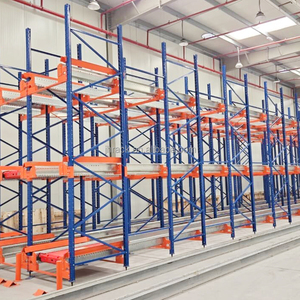
Industrial Heavy-Duty Shuttle Car Racks for Automated Pallet Warehouse Rack System Warehouse Shuttle System LIFO Shuttle Racking
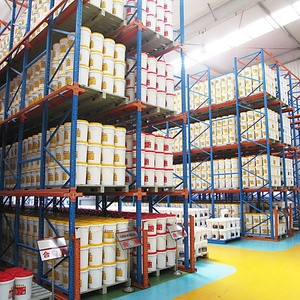
APLUS Heavy Duty Adjustable Drive-in Pallet Rack System Warehouse Storage Drive In Racking System
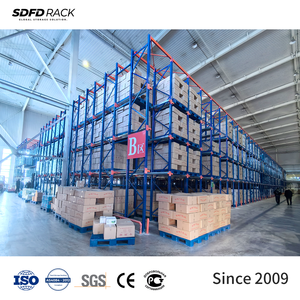
Efficient Drive-In Rack Drive-Through Pallet Racking System Cold Rolled Steel Rivet Racking Heavy Duty Card Slot Assembly
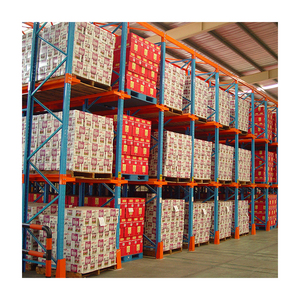
Factory Price Drive-in Rack Multi-tier Through Racking System Customized Industrial Warehouse Rack Heavy Duty Pallet Rack System
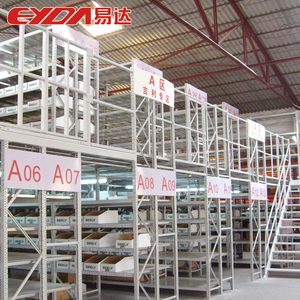
Eyda Industrial Steel 5-Layer Heavy Duty Drive-Through Mezzanine Floor Racking System Anti-Rust Finish 1000kg/sqm Load Capacity
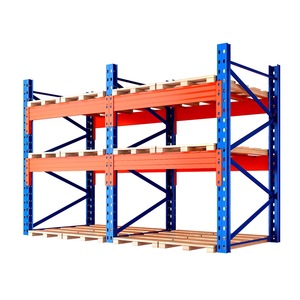
Heavy-Duty Beam-Type Steel Industrial Warehouse Drive-In Storage Racks Detachable Thickened Multi-Tier
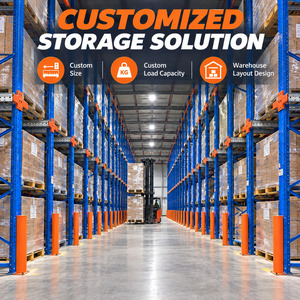
ODM OEM Q235 Steel Heavy Duty High Density Coldroom Coldstore Drive in Through Pallet Racking Warehouse Storage System
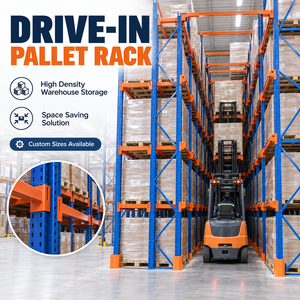
Heavy Duty Drive-in Pallet Racking System for High Density Warehouse Storage
Structural Mechanics, Kinematics & Volumetric Efficiency
A rigorous examination of drive-through racking configurations, cantilever moment resistance, down-aisle stiffness, and the mathematical divergence between FIFO throughput and LIFO storage blocks.
In modern industrial logistics, warehouse cubic volume represents one of the most expensive operational assets. Standard selective racking systems allocate upwards of 60% of total facility floor space purely to forklift operating corridors. For enterprises managing high-volume, homogenous SKUs—such as fast-moving consumer goods (FMCG), cold-chain refrigerated distribution, pharmaceutical cold storage, and chemical manufacturing—traditional layout models generate unacceptable structural overhead and excessive climate-control energy consumption.
Drive-Through Pallet Racking (alongside its single-entry counterpart, Drive-In Racking) solves this geometric bottleneck by eliminating intermediate picking aisles. In a Drive-Through system, forklift trucks enter directly into the storage bays from both opposing sides: loading occurs at the input face while extraction occurs at the discharge face. This open-ended architecture establishes a strict First-In, First-Out (FIFO) stock rotation workflow, critical for date-sensitive items, perishable agricultural produce, pharmaceuticals, and temperature-controlled bulk goods.
Volumetric Density Optimization
Increases warehouse cubic volume utilization up to 85% compared to selective racking (35-40%), cutting per-pallet refrigeration, real estate, and lighting amortization costs.
True FIFO Material Flow
Unlike Drive-In racks that operate strictly on LIFO (Last-In, First-Out), Drive-Through configurations provide independent loading and unloading aisles, ensuring zero expired inventory risks.
Multi-Braced Rigidity Frame
Because continuous horizontal load beams cannot cross the interior driving lanes, structural integrity is engineered through top portal tie beams and overhead horizontal roof trusses.
Structural Comparison: Drive-Through vs. Alternative High-Density Systems
To help warehouse planners, structural engineers, and corporate procurement directors make data-backed investments, the following comparative engineering matrix outlines functional characteristics across dense warehouse racking methodologies.
| System Classification | Access Methodology | Rotation Principle | Space Utilization | Forklift Travel In-Bay | Capital Cost / Position |
|---|---|---|---|---|---|
| Drive-Through Racking | Dual-End (Entry & Exit) | Strict FIFO | Up to 85% | Yes (High Mast Travel) | Moderate |
| Drive-In Racking | Single-End Entry | Strict LIFO | Up to 85% | Yes (Single Access) | Moderate |
| Radio Shuttle Racking | Remote Semi-Automated | FIFO or LIFO | Up to 90% | No (Shuttle Enters Lane) | High (Includes Robotics) |
| Push Back Racking | Nested Gravity Carts | Strict LIFO | Up to 70% | No (Aisle Operation) | Moderate-High |
| Selective Pallet Racking | Direct 100% Selectivity | Random Access | 35% - 45% | No (Aisle Operation) | Low (Benchmark) |
Cantilever Arm Moments and Guide Rail Engineering
The structural vulnerability of drive-through systems originates from the absence of traditional front-to-back load-supporting horizontal beams. Pallets rest directly on specialized continuous pallet support rails (also designated as pallet runners), which are held by one-sided or double-sided formed cantilever bracket arms bolted or slotted into the upright columns.
Under loaded equilibrium, every pallet generates an eccentric torsional moment upon the vertical column. When multiple pallets are staged continuously across vertical levels, the cumulative unbraced column length ($L_{cr}$) undergoes significant flexural-torsional buckling stresses governed by the Euler-Bernoulli column theory. To counteract this deflection without impeding forklift travel paths, leading Chinese racking factories deploy:
- Structural Top Portal Bracing: Rigid boxed beams positioned at the very summit of the rack structure, connecting adjacent frame columns into an unyielding monolithic portal frame.
- Overhead Plan Horizontal Trusses: Cross-bracing profiles configured along the top horizontal plane that transfer lateral down-aisle sway directly to external reinforced anchor towers.
- Heavy-Gauge Heavy-Duty Base Plates: Base connections utilizing dual structural anchor bolts (typically M12 to M16 grade 8.8 expansion or chemical anchors) with floor shims certified to counter high overturning base moments.
- Ground Steel Guide Channels: Hot-rolled C-channel or heavy angle steel guide tracks bolted along the driving floor lanes. These ensure the forklift stays within a millimeter-precise path, eliminating impact collisions against delicate cantilever arms.
Guangzhou HEDA Shelves: Global Manufacturing Powerhouse
Established in 2001, Guangzhou Heda Shelves Co., Ltd. operates one of the most technologically advanced storage rack production facilities in Southern China, engineering compliant systems for top-tier international distributors, 3PL logistics corporations, and industrial plants.
Unlike trading intermediaries, HEDA Shelves owns and controls the entire metallurgical conversion cycle. Our manufacturing campus integrates computer-controlled uncoiling, high-precision slitting, continuous automated roll-forming lines, 100-ton hydraulic punching units, robotic weld cells, and a fully automated continuous electrostatic powder-coating pretreatment and baking tunnel.
Every structural upright profile is roll-formed from premium certified Q235B and Q355B cold-rolled structural steel coils sourced directly from first-tier Chinese state-owned steel mills (such as Baosteel and Ansteel). This metallurgical purity guarantees zero micro-fissuring during profile bending, consistent tensile yield strengths exceeding 235–355 MPa, and exceptional ductility in seismic stress scenarios.
End-to-End Production Process & Quality Control
Drive-Through systems demand stricter manufacturing tolerances than any other static racking design. A 2mm variation in cantilever arm projection can cause pallet dislodgement or rail jamming.
Continuous Roll Profile Precision
Raw steel coils pass through multi-station automated roll-forming machines with digital optical encoders. Column hole pitches are punched at consistent 50mm or 75mm increments with an absolute tolerance of ±0.1mm, ensuring effortless field boltless interlocking.
Multi-Stage Pickling & Phosphating
Prior to powder deposition, fabricated steel components traverse automated acid pickling and immersion phosphating baths to eradicate surface scale, grease, and oxidation. This creates a dense, microscopic crystalline zinc-phosphate anchor layer for lifelong paint adhesion.
Thermoset Electrostatic Coating
Automated Swiss Gema powder application guns deposit lead-free polyester resin cured at 180°C–200°C. Standard dry film thickness ranges from 60 to 90 microns, passing 500-hour neutral salt-spray testing (ASTM B117) and cross-hatch adhesion standard DIN EN ISO 2409.
Sub-Zero Cold Store Metallurgy: When drive-through racks are destined for industrial blast freezers operating at temperatures between -25°C and -35°C, standard low-carbon steels undergo a ductile-to-brittle transition, significantly magnifying risk of catastrophic shear fracture under dynamic forklift impact. HEDA Shelves addresses this through specified Q355D or low-temperature impact-tested steel grades with verified Charpy V-notch energy absorptions at -20°C, combined with specialized anti-frost powder formulations or hot-dip galvanization conforming to ISO 1461 standards.
Future Procurement Trends in Industrial Racking (2025–2035)
As warehouse construction costs climb globally, international supply chain executives are modernizing how they specify, evaluate, and procure high-density racking assets.
Hybrid Shuttle Migration
Buyers are increasingly procuring drive-in and drive-through steel frameworks that are pre-punched and retrofittable with four-way pallet shuttle automation, enabling future migration from manual forklift driving to lights-out AS/RS robotics.
Green Steel & EPD Verification
North American and European enterprise tenders now demand Environmental Product Declarations (EPD). Procurement is prioritizing electric arc furnace (EAF) mills utilizing scrap recycling and low-VOC thermosetting polymer coatings.
Structural Digital Twins
Procurement specifications are shifting from paper CAD to complete Industry 4.0 BIM models. Uprights are fitted with IoT sensor brackets to monitor ongoing frame deflections, post-seismic settling, and accidental vehicle impact anomalies.
Total Landed Cost vs. Nominal Purchase Price: Sophisticated supply chain directors recognize that the factory-gate quotation represents merely 65% of the capital expenditure. The real financial driver is Container Volumetric Packing Efficiency. A poorly packed racking order results in 25–35% wasted cubic freight space inside ocean shipping containers. HEDA Shelves utilizes proprietary 3D algorithmic container packing software, bundling upright trusses, beam runs, and cantilever rails in custom-engineered nesting packages that achieve 98% space filling in standard 40-foot High-Cube (40HQ) ocean containers. This alone slashes ocean freight costs per pallet position by up to $18–$24 USD across transpacific shipping routes.
Engineering Evolution: Mitigating Operational Failure Modes
Because forklifts enter directly between the upright frames, drive-through and drive-in racks experience 400% more accidental vehicle impacts than conventional selective racks.
Historically, column failure in drive-in racking originated from repetitive, low-velocity forklift wheel hub impacts against the bottom 600mm of the front aisle posts. Over time, localized plastic deformation of the upright column reduces the section modulus, precipitating total progressive structural collapse under full load. HEDA Shelves addresses these catastrophic operational risks through four distinct metallurgical and design innovations:
Full-Height Column Reinforcement
Our front entry frames integrate an interior welded or nested reinforcement channel up to 1200mm high, tripling local impact resistance without restricting aisle clearance.
Tapered Pallet Runner Flanges
Our galvanized pallet support rails feature flared entry noses that actively guide skewed pallets into the center of the lane, preventing pallets from snagging and pulling the uprights sideways.
Continuous Heavy Floor Deflector Rails
Low-profile ground-level C-channels with beveled anchor edges capture the forklift wheels, physically separating the forklift chassis from the vertical uprights throughout the entire drive path.
Seismic Dissipation & Dynamic Damping: In active earthquake zones (such as western North America, Latin America, Japan, and the Mediterranean basin), drive-through racks behave as slender, flexible structures prone to deep resonant amplification. HEDA Shelves engineers utilize dynamic response spectrum analysis software to optimize intermediate roof bracing planes and baseplate anchor layouts in accordance with ANSI MH16.1, FEM 10.2.02, and AS 4084 building codes, ensuring safe dissipation of seismic shear forces without systemic joint disconnection.
Frequently Asked Questions for Global Procurement
Comprehensive engineering and commercial answers to the most common queries raised by international buyers, warehouse managers, and structural consultants.
What is the fundamental engineering difference between Drive-In and Drive-Through racking?
How does HEDA Shelves guarantee steel quality and dimensional tolerances for overseas buyers?
Can Drive-Through racking handle multiple pallet sizes within the same lane?
What slab floor requirements and concrete specifications are necessary for high-bay installations?
What are the lead times for custom OEM/ODM production and container shipping to North America or Europe?
Accelerate Your Storage Density with HEDA Engineering
Send us your warehouse CAD floor plan, ceiling clear height, forklift model specifications, and pallet parameters. Our senior structural racking engineers will return a complete 2D CAD layout, 3D visual rendering, structural calculation summary, and transparent factory direct quotation within 24 hours.