Choosing a Warehouse Racking System is not just a matter of comparing prices or steel thickness. A rack must match the goods, equipment, building, and daily movement of people. A narrow aisle that looks efficient on a drawing can become a bottleneck when forklifts turn with full pallets. Small details matter.
Warehouse systems specialist Alex Morgan puts it this way: “Good racking supports the work; it should never make the work harder.” That principle is useful when evaluating manufacturers in China. Ask how each supplier checks load requirements, documents materials, and manages production quality. Request drawings that show beam levels, aisle widths, and upright protection. Then compare the proposed layout with the actual forklift and pallet dimensions. A polished catalogue is not proof of a suitable design.
The strongest manufacturers do more than ship frames and beams. They explain installation needs, provide clear load information, and respond when site conditions change. References from similar facilities can help, though one customer’s experience cannot guarantee another’s result. Be cautious of vague capacity claims. A missing detail can matter later.
This guide introduces leading Chinese warehouse racking manufacturers and the factors buyers can use to assess them. It considers product range, engineering support, customization, quality controls, and service after delivery. No shortlist replaces a site-specific review. Measure the floor, check the inventory profile, and ask hard questions before signing. Even then, a good plan may need revision. That is worth admitting.
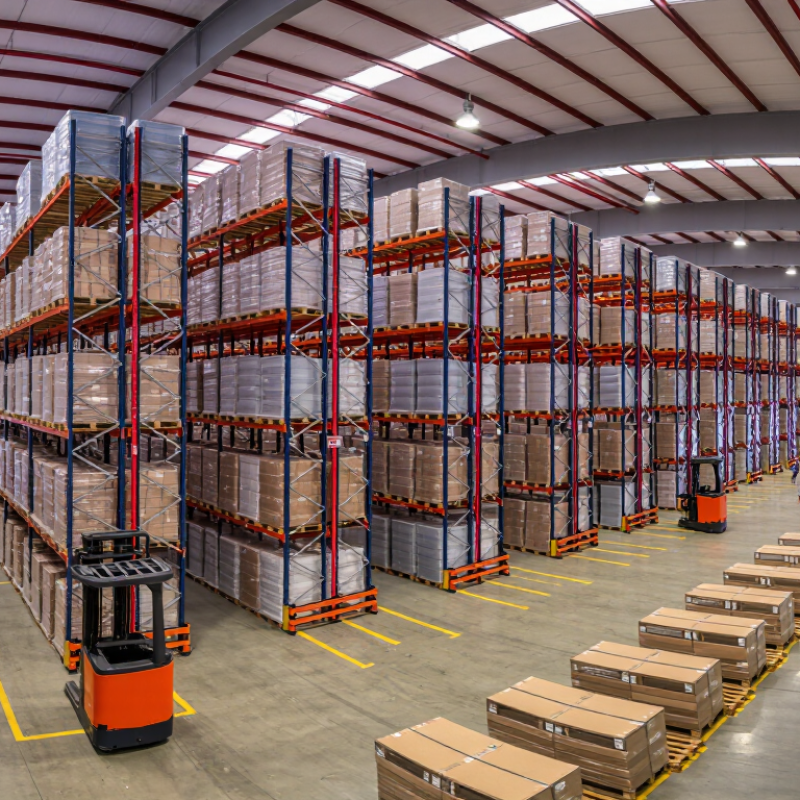
China’s warehouse racking system industry serves a wide range of operations, from small parts rooms to high-bay distribution centers. Manufacturers commonly produce selective pallet racks, drive-in systems, shelving, and mezzanine structures. The right design depends on the building, goods, handling equipment, and inventory movement—not just storage capacity.
Details matter. A site assessment should check floor condition, clear height, aisle width, sprinkler access, and forklift turning space. In practice, even a few centimeters can affect safe equipment clearance. Buyers should also review material specifications, weld quality, coating consistency, load documentation, and installation plans. These checks help distinguish a workable system from one that only looks efficient on a drawing.
Automation is influencing demand, but it is not suitable for every warehouse. Some facilities need flexible layouts because product sizes and order patterns change. Others benefit from denser storage, provided access and retrieval needs are understood. There is no universal layout. One weakness in many purchasing plans is giving too much attention to the initial quotation and too little to future expansion or maintenance. Comparing suppliers is more useful when the same load data, layout assumptions, and service requirements are used for each proposal.
Top Warehouse Racking System Manufacturers in China
How Warehouse Racking Manufacturers Are Evaluated
Evaluating a warehouse racking manufacturer takes more than comparing catalog prices. Request load tables that match your beam lengths, upright frames, and planned pallet weights. Confirm how those figures were tested and whether the drawings reflect your actual aisle layout. A generic specification sheet is not enough.
Small details matter. Check weld consistency, upright-hole spacing, beam connectors, and the finish on edges that forklifts may strike. Ask how steel batches are tracked and what inspections happen before shipment. If possible, review a production sample or visit the facility. Look closely. A clean showroom does not prove that routine production is equally consistent, and one inspection cannot reveal everything.
Experience also shows in the questions a supplier asks. A capable team should request site dimensions, floor conditions, handling equipment, and expected load patterns before recommending a configuration. Review installation instructions, packaging methods, replacement-part availability, and response times for technical questions. Speak with customers whose facilities have similar requirements, but treat references as useful evidence rather than a guarantee. Even a detailed proposal can miss a practical constraint, so have a qualified local professional verify the final layout and capacity before installation.
How to read this chart: These percentages are suggested weights for comparing warehouse racking manufacturers, not measured industry statistics or ratings of specific companies. Verify each factor using product specifications, test reports, certifications, and service terms.
Leading warehouse racking system manufacturers in China compete on more than steel price. Reliable suppliers turn SKU mix, pallet dimensions, forklift clearances, and floor conditions into a workable layout. Small errors matter. The China Federation of Logistics and Purchasing reported that China’s 2023 social logistics costs reached RMB 18.2 trillion, or 14.4% of GDP. That figure underscores the pressure to use warehouse space efficiently. MHI’s 2024 Annual Industry Report also identifies robotics and automation as growing priorities in supply-chain operations.
When comparing manufacturers, request load tables for your specific bay layout, not just a standard catalog. Check upright and beam specifications, weld and coating inspections, production traceability, and the supplier’s drawings for forklift and sprinkler clearances. Ask how the proposed rack supports future changes, such as deeper storage or automated handling. Measure twice. A low quotation can leave out installation details or protection for vulnerable uprights. Still, no single rack type suits every warehouse; dense storage can reduce selectivity, while easy-access layouts may use more floor space. A careful supplier should explain that trade-off plainly.
China’s warehouse racking manufacturers commonly offer selective pallet racks, drive-in systems, pallet shuttles, cantilever racks, and mezzanines. Selective racks suit mixed inventory and frequent access. Shuttle systems can improve storage density, but they need compatible pallets and disciplined operating procedures. For automated facilities, some suppliers integrate automated storage and retrieval systems with warehouse control software, scanners, and conveyor equipment. Steel thickness and load capacity matter. So does installation quality.
Technology choices should follow the operation, not the sales presentation. MHI’s 2024 Annual Industry Report found that 55% of surveyed supply-chain professionals planned to adopt robotics and automation within five years. That signals strong interest, not guaranteed savings for every warehouse. Ask manufacturers for load calculations, rack-layout drawings, seismic design assumptions, and clear inspection guidance. Request a demonstration using your actual pallet dimensions. Small mismatches can cause costly delays.
Tips: Compare beam capacity, upright specifications, coating, and replacement-part availability—not price alone. Check clearances around forklifts and sprinklers. A little awkward detail matters: operators may need extra training when switching to shuttle or automated systems. The layout can look efficient on paper and still frustrate workers. Ask for references from installations with similar loads and workflows.
Choosing a Chinese racking system manufacturer starts with your warehouse, not a catalogue. Measure aisle widths, clear height, floor condition, and the dimensions of your actual pallets. Share these details with each supplier. Ask for a layout drawing and load calculations that match your intended configuration. Small mismatches matter.
Check how the manufacturer verifies materials, welds, and finished components. Request sample inspection records, written load ratings, and installation guidance. A brochure is not proof. Ask who handles engineering changes and what happens if delivered parts do not match the approved drawings. Clear answers are a useful sign of a reliable process.
Compare quotations line by line, including packaging, freight, installation support, and spare components. Contact customers with similar warehouse needs, if possible. Look for specific feedback about delivery accuracy and problem-solving, not just general praise. Price still matters, but choosing the lowest bid can leave important details unresolved. I would also reconsider any supplier that promises a perfect fit before reviewing site measurements; even a good design may need adjustment once real conditions are checked.
| Selection Dimension | What to Evaluate | Evidence to Request | Why It Matters |
|---|---|---|---|
| Project and storage fit | Compatibility with the warehouse dimensions, clear height, aisle layout, pallet sizes, inventory profile, and material-handling equipment. | A layout drawing showing rack locations, aisle widths, clearances, and the proposed storage configuration. | A system should be designed around the building and operating process, not selected by rack type alone. |
| Load capacity and engineering | Specified pallet or unit loads, beam-level loads, bay loads, rack height, and the assumptions used in the design. | Project-specific structural calculations, design drawings, load tables, and clearly stated design assumptions. | Capacity depends on the complete rack configuration and loading conditions; a single generic capacity figure is not enough. |
| Applicable standards and safety | The standards and design requirements applicable to the project location, including relevant building, structural, seismic, and fire-safety requirements. | A written list of design codes and project requirements, plus calculations addressing site-specific conditions where applicable. | Requirements vary by jurisdiction and site. The buyer should confirm that the proposed design suits the installation location. |
| Materials and corrosion protection | Steel grade and thickness specifications, component finish, and suitability for the warehouse environment. | Material specifications, finish details, and inspection records or material documentation for the supplied components. | Material and finish choices affect structural performance, durability, and maintenance needs. |
| Manufacturing quality control | Controls for forming, welding where applicable, coating, dimensional accuracy, and final inspection. | Quality procedures, inspection checklists, sample inspection records, and traceability information where available. | Consistent production and inspection help reduce fit-up problems and defects during installation. |
| System components and compatibility | Compatibility of frames, beams, bracing, connectors, safety accessories, and any specified automated equipment interfaces. | A bill of materials, component drawings, connection details, and confirmation of compatibility for replacement parts. | Clearly specified components support safe assembly, future maintenance, and orderly replacement. |
| Installation and commissioning | Installation scope, installer qualifications, anchoring requirements, tolerances, and handover responsibilities. | An installation method statement, site-readiness requirements, inspection plan, and commissioning or handover checklist. | Correct installation and anchoring are essential to achieving the intended design performance. |
| Delivery and export documentation | Packaging, shipment schedule, delivery terms, document responsibilities, and handling of replacement parts. | A shipment plan, packing details, agreed delivery terms, and a list of documents supplied with the order. | Clear logistics planning helps coordinate site access, unloading, storage, and installation. |
| Warranty and after-sales support | Warranty coverage, exclusions, response process, availability of replacement components, and technical support arrangements. | Written warranty terms, service contact details, spare-parts information, and the procedure for reporting damage or defects. | Written terms make responsibilities and support expectations clearer throughout the system’s service life. |
Selection note: Compare suppliers using the same project brief and technical requirements. Verify all design capacities, standards, delivery commitments, and warranty terms against project-specific documents.
Request load tables for your beam lengths, upright frames, and planned pallet weights. Generic figures may not fit your layout.
Check weld consistency, upright-hole spacing, beam connectors, and sharp edges. Ask how steel batches are tracked and inspected. Small details matter.
It can reveal production practices, but one visit cannot prove every shipment is consistent. A clean showroom is not enough.
They should ask about site dimensions, floor conditions, handling equipment, and expected loads. If they do not, pause.
Selective racks support mixed inventory and frequent access. Drive-in systems, pallet shuttles, cantilever racks, and mezzanines serve other layouts.
Check pallet compatibility, operating procedures, training needs, and software or conveyor integration. Higher density is not always simpler.
Ask for load calculations, layout drawings, seismic assumptions, installation instructions, and inspection guidance. Have a qualified local professional verify capacity.
Compare beam capacity, upright specifications, coating, replacement parts, and response times. A low price can hide practical gaps. It happens.
China’s warehouse racking industry supports businesses seeking efficient ways to store, organize, and move goods. Manufacturers serve a range of needs, from standard storage layouts to systems designed for high-density inventory and automated operations. Comparing suppliers involves looking beyond price: production capability, material quality, engineering expertise, customization, delivery, installation support, and after-sales service all matter. Clear evaluation criteria help buyers assess whether a manufacturer can meet the demands of a particular facility.
A Warehouse Racking System may include pallet racks, drive-in racks, shelving, mezzanines, or solutions integrated with automated handling equipment. Buyers should consider storage capacity, available space, inventory turnover, equipment compatibility, and plans for future growth when comparing product options and technologies. Before selecting a Chinese manufacturer, define operational requirements, review technical specifications and quality controls, and confirm how design, installation, and ongoing support will be handled. A well-matched supplier can help create a safer, more organized, and adaptable warehouse.