Warehouse Pallet Racks do more than hold inventory. They shape aisle width, picking routes, equipment choices, and how safely a team can reach each load. The right system depends on the building, pallet dimensions, product turnover, and handling equipment. A busy distribution centre with forklifts may need a different layout from a compact facility storing slow-moving stock. Details matter.
The MHI 2024 Annual Industry Report found that 55% of surveyed supply-chain professionals planned to invest in robotics and automation within five years. That trend makes rack selection more consequential: automation often depends on consistent load positions and clear, predictable travel paths. Logistics scholar Martin Christopher captured the wider planning principle: “The winning companies of the future will be those that make the supply chain the centrepiece of their strategic thinking.” His point applies to storage decisions, too. A rack is part of a working system, not an isolated product.
This guide compares selective, double-deep, drive-in, push-back, pallet-flow, and cantilever racks. Each offers trade-offs in access, density, and product fit. No type wins everywhere. A dense layout can reduce access; a highly accessible one can consume valuable floor space. That tension is easy to underestimate. The practical choice starts with real inventory and traffic data, then checks the layout against site conditions and qualified design advice.
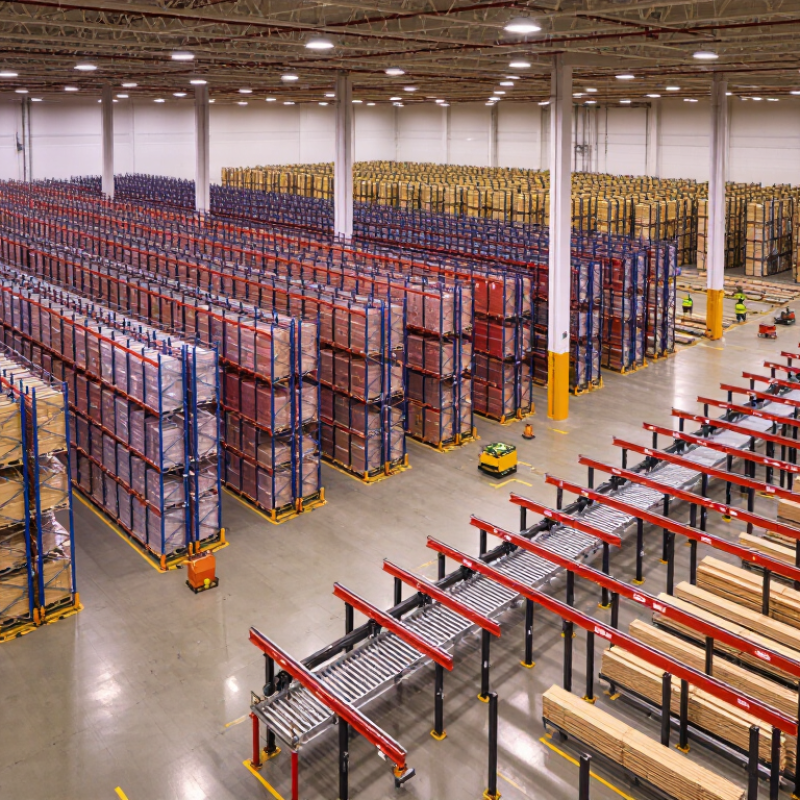
Warehouse pallet racking is built from connected steel components that transfer stored weight to the floor. Upright frames form the vertical supports, while horizontal beams lock into slots along the uprights. Together, they create bays where pallets sit at selected heights. Cross-bracing and diagonal bracing help keep each frame stable under load.
Beam levels can be fitted with wire decking, solid panels, or pallet supports, depending on how goods are stored and handled. A typical bay has two frames and several pairs of beams. Each connection must be fully engaged, and the listed capacity applies only to the specified configuration. Small changes matter. For example, moving a beam level can affect clearance and how loads are distributed.
Base plates spread forces at the bottom of each upright; floor anchors may help resist movement. Aisle width, forklift turning space, pallet dimensions, and ceiling height all shape the layout. Measure actual loads, not just average ones. Uneven pallets and damaged packaging can create awkward contact points. That detail is easy to miss. A qualified rack professional should verify the design, installation, and inspection plan for the site’s conditions.
Selective pallet racks give pickers direct access to each stored load. A forklift can reach a pallet without moving the one beside it. This layout suits operations with many SKUs, frequent order changes, or products needed throughout the day. Clearly marked beams and aisle labels can make locations easier to verify. The trade-off is lower storage density than systems that store pallets several positions deep. A wide aisle can also reduce usable floor space. That cost is easy to underestimate.
MHI’s 2024 Annual Industry Report drew on responses from more than 1,000 supply-chain professionals and reported growing investment in supply-chain technology. That finding does not prove one rack type is best. It does highlight why accurate inventory records and clear locations matter. In selective-rack aisles, scan each pallet movement and check that beam levels match the load plan. A bent upright or misplaced pallet can disrupt access. Small details count.
Tip: Mark each bay and level at eye height, and keep the load rating visible. Test the layout with a loaded pallet and the actual forklift before fixing aisle widths. A few centimeters can matter. Do not assume the first layout will work perfectly; observe picking during a busy shift and adjust.
Share of pallet positions directly accessible from the aisle in a typical rack-depth arrangement
Selective racks provide direct aisle access to every pallet position. The other examples assume two-deep or four-deep lanes, with only the aisle-facing position directly reachable at a time. Actual layouts and access depend on rack design and operating method.
Drive-in and drive-through racks store pallets several positions deep, using fewer aisles than selective rack. That can free valuable floor area. The trade-off is access. Forklifts enter the lanes, so pallet loads, rack protection, and operator visibility matter. A damaged pallet or uneven load can slow retrieval.
Drive-in racks usually load and retrieve from one face, creating last-in, first-out flow. They suit large quantities of the same SKU with predictable turnover. Drive-through racks open at both ends and can support first-in, first-out flow. But FIFO depends on disciplined loading from one side and retrieval from the other. Small detail. Big consequence.
MHI and Deloitte’s 2024 Annual Industry Report found that 55% of surveyed supply-chain leaders planned to increase technology investment. That figure does not measure rack efficiency. Still, it points to a practical need: connect lane locations to accurate inventory records and clear replenishment rules. Before choosing deep lanes, check pallet consistency, SKU count, daily throughput, and replenishment access. A dense layout can look excellent on a drawing and feel awkward on a busy shift. That caveat matters.
| Rack Type | Pallet Access | Typical Stock Rotation | Storage Density | Best Suited For | Key Consideration |
|---|---|---|---|---|---|
| Selective Pallet Rack | Direct access to each pallet from the aisle | Flexible; supports both FIFO and LIFO processes | Lower than compact systems because aisles are needed between rack rows | Warehouses with many product lines, frequent picking, or varied inventory | Offers high selectivity, but uses more aisle space per stored pallet. |
| Double-Deep Rack | Two pallet positions deep; the rear pallet is accessed after the front pallet is moved | Generally LIFO within each two-pallet lane | Higher than selective rack, with fewer access aisles | Warehouses seeking greater capacity while retaining access to multiple product lines | Requires a compatible deep-reach truck and reduces immediate access to rear pallets. |
| Drive-In Rack | Forklifts enter the rack lane from one end; pallets are stored on side rails | Typically LIFO: the last pallet loaded is generally the first retrieved | High; multiple pallet positions are stored deep in each lane | Large quantities of the same product, with relatively few product lines | Lane depth can improve space use, but access is less selective and forklift operation requires care. |
| Drive-Through Rack | Forklifts can enter the lane from either end | Can support FIFO when loading and retrieval are organized from opposite ends; actual rotation depends on operating practice | High; stores pallets in deep lanes with fewer aisles than selective layouts | High-volume inventory where access from both ends is practical | Needs access aisles at both ends, so it may require more aisle space than a comparable drive-in layout. |
| Push-Back Rack | Pallets are loaded and retrieved from the aisle; each lane typically holds multiple pallets deep | LIFO within each lane | High; reduces the number of access aisles compared with selective rack | Several pallets per product line where compact storage and quick aisle-side access are useful | Uses carts or inclined rails; lane capacity and pallet compatibility must be planned carefully. |
| Pallet Flow Rack | Pallets are loaded at the high end and move by gravity toward the retrieval end | FIFO by design when loading and picking occur at opposite ends | High; deep lanes can reduce the number of access aisles | Perishable goods, date-sensitive inventory, or high-volume products needing stock rotation | Requires suitable pallets, maintained flow components, and careful control of lane loading. |
Planning note: Storage density and capacity depend on aisle width, building height, pallet dimensions, equipment, fire-protection requirements, and the warehouse layout. Rack selection and structural design should be checked against site-specific loads and applicable safety requirements.
Push-back and pallet flow racks both use gravity to move pallets, but they handle stock rotation differently.
In a push-back system, a forklift loads pallets from the picking aisle, pushing earlier pallets deeper along inclined carts. When a pallet is removed, the next one rolls forward. This arrangement can store several pallets per lane while keeping loading and picking in the same aisle. It generally follows last-in, first-out access, so it suits goods where strict date rotation is not essential.
No rack is perfect.
Pallet flow racks use rollers or wheels and typically load from the rear, with picking at the front. Each new pallet moves the others forward, supporting first-in, first-out rotation for dated or time-sensitive inventory.
Small details matter.
Pallet dimensions, weight, and condition affect how reliably loads travel; a warped pallet may stall or move unevenly. Before choosing a system, review SKU turnover, aisle access, and handling routines with a qualified rack professional. Inspect brakes, guides, and rollers regularly, too.
The trade-off is easy to overlook: flow racks can improve rotation, but they need compatible pallets and consistent upkeep.
Rack choice starts with the SKU profile, not the catalog. Selective rack gives direct access to every pallet, making it useful for broad assortments and frequent picking. Its trade-off is aisle space. Double-deep and drive-in racks increase storage density, but limit immediate access and may complicate stock rotation. Drive-in systems suit uniform loads and planned replenishment; pallet-flow lanes support FIFO movement. Push-back racks suit deeper LIFO storage. Cantilever racks handle long items such as pipe or timber. Measure lift-truck turning space, beam levels, and pallet overhang before estimating capacity.
WERC’s 2024 DC Measures report puts median warehouse capacity utilization near 85%. Treat that figure as a benchmark, not a target. Map pallet moves by SKU, then compare storage density with pick frequency, replenishment effort, and clearances. High density looks impressive on paper. It can also slow every pick. A trial bay may reveal the difference. Plans can still miss what happens during a busy shift. Check rack loads, floor conditions, and operating procedures with qualified professionals before installation.
Upright frames support the structure, while horizontal beams create pallet bays. Cross-bracing and diagonal bracing help stabilize each frame. Base plates spread forces across the floor. Small connections matter.
Moving a beam changes clearance and load distribution. Capacity applies only to the specified configuration. Keep ratings visible and confirm every connection is fully engaged.
Consider pallet dimensions, actual load weight, aisle width, forklift turning space, and ceiling height. Test with a loaded pallet and the actual forklift. A few centimeters can matter.
It provides direct access to each pallet, helping facilities with many SKUs or frequent order changes. The trade-off is lower storage density and potentially wider aisles. That space adds up.
Operators load and retrieve pallets from the same aisle. New pallets push earlier ones deeper along inclined carts; removing one lets the next roll forward. It generally uses last-in, first-out access.
Pallets usually enter at the rear and move toward the picking face on rollers or wheels. This supports first-in, first-out access for dated inventory. Not every pallet travels smoothly.
Warped pallets, inconsistent dimensions, or unsuitable weights can stall loads or make them move unevenly. Check rollers, guides, and brakes regularly. Upkeep is easy to underestimate.
Have a qualified rack professional check the design, installation, and inspection plan against site conditions. Observe picking during a busy shift and adjust weak spots. I would not trust a quiet-hour test alone.
Warehouse Pallet Racks are designed to organize loads vertically and make better use of warehouse space. Their frames, beams, and supports create storage levels suited to different pallet sizes and handling methods. Selective racks provide direct access to every load, making them a practical choice when products vary or orders change frequently. For greater storage density, drive-in and drive-through systems allow forklifts to enter rack lanes, reducing the number of aisles while requiring more consistent pallet handling.
Push-back racks store pallets on nested carts, while pallet flow racks use inclined rollers to move loads through a lane. Both can support faster stock rotation and help limit forklift travel within storage areas. Choosing the right system depends on available space, inventory variety, access requirements, rotation practices, and the equipment used to move pallets. Matching these factors helps create an efficient layout that balances capacity with convenient access.