Pallet Rack Systems now sit at the center of modern warehouse planning. They support inventory density, safer movement, and faster order fulfillment. Grand View Research valued the global warehouse racking market at approximately USD 9.7 billion in 2023. Its report also projects strong growth through 2030, driven by e-commerce and automation. These figures show opportunity, but they do not guarantee a suitable rack design.
MHI’s 2024 Annual Industry Report identifies automation, labor pressure, and resilience as major warehouse priorities. In China, manufacturers and suppliers increasingly combine selective pallet racks, drive-in systems, shuttle racks, and automated storage solutions. John Nofsinger, a recognized Rack Manufacturers Institute industry specialist, expressed a practical principle: “Rack safety is a system, not a single component.” That idea matters when comparing China’s leading suppliers. Steel thickness, beam capacity, weld quality, seismic design, coatings, and installation control all deserve attention.
A reliable supplier should provide load calculations, certified drawings, inspection guidance, and traceable production records. Buyers should also verify compliance with applicable standards, including ANSI/RMI MH16.1 where relevant. A polished catalog is not enough. The floor may be uneven. The forklift aisle may be narrower than expected. Small planning errors can become expensive failures. This guide examines China’s top Pallet Rack Systems manufacturers and suppliers through product capability, engineering experience, quality control, customization, and after-sales support. The market is expanding quickly, yet “top” should remain a decision to verify, not a label to accept blindly.
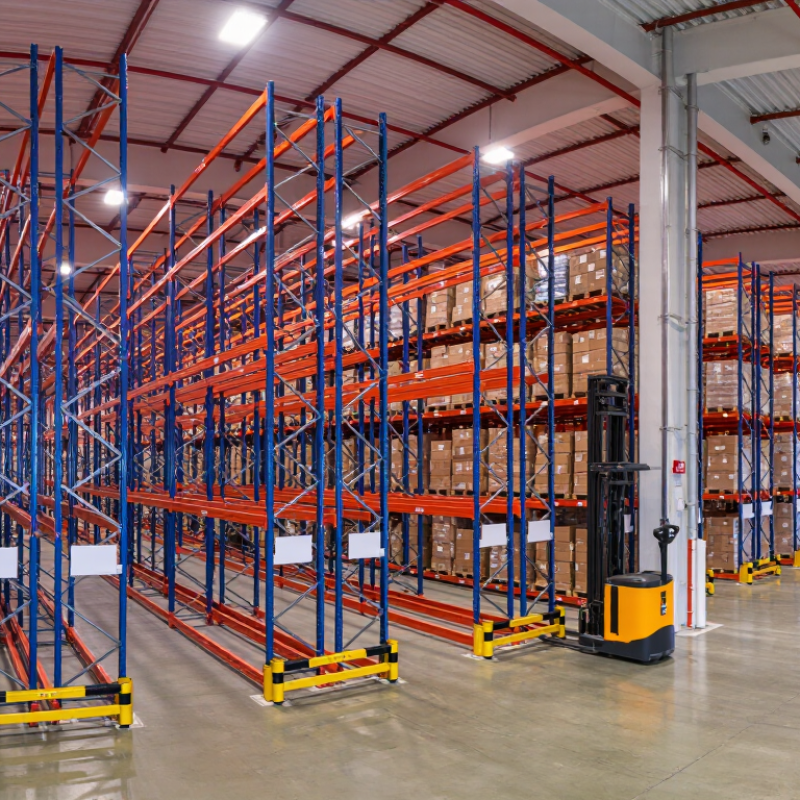
Pallet Rack Systems: Structure, Purpose, and Main Applications
Pallet rack systems use vertical frames, horizontal beams, braces, anchors, and decking to create organized storage levels. Their structure transfers loads from pallets through beams and uprights into the warehouse floor. Each component needs compatible dimensions and verified load capacity. A rack may look strong, yet a small design mistake can reduce stability.
The main purpose is to increase storage density while keeping products accessible to forklifts and workers. Selective pallet racks suit varied inventory and frequent picking. Drive-in systems improve density for similar goods, while double-deep layouts balance capacity and access. China’s pallet rack systems manufacturers and suppliers often provide customized heights, beam lengths, and surface treatments. However, buyers should request drawings, load calculations, material details, and installation guidance before approval.
Tips: Measure aisle width, pallet size, ceiling height, and floor condition first. Keep heavier pallets on lower levels. Install upright protectors near forklift routes. Inspect loose anchors, bent beams, missing pins, and damaged braces regularly. Local building and workplace requirements still matter. Do not rely only on a supplier’s catalogue. In practice, warehouse changes can make an original design unsuitable, so scheduled reviews are necessary. A tidy rack is not automatically a safe rack.
China Top Pallet Rack Systems Manufacturers Suppliers - Pallet Rack Systems: Structure, Purpose, and Main Applications
| System Type | Basic Structure | Primary Purpose | Typical Storage Method | Main Applications | Key Advantages | Important Planning Factors |
|---|---|---|---|---|---|---|
| Selective Pallet Rack | Two upright frames connected by horizontal beams, with pallet supports or decking. | Provide direct access to every pallet position. | Single or multiple pallet positions deep. | General warehouses, distribution centers, retail storage, spare-parts warehouses. | High accessibility, flexible layout, simple stock rotation, and relatively easy installation. | Aisle width, forklift turning radius, pallet dimensions, beam capacity, floor condition, and required storage height. |
| Drive-In Rack | Vertical upright frames and horizontal rails create deep storage lanes that forklifts enter. | Maximize floor-space utilization by reducing operating aisles. | Multiple pallets deep, generally stored in lanes. | Cold storage, bulk storage, and warehouses handling large quantities of similar products. | High storage density and efficient use of cubic space. | Limited selectivity, forklift operating skill, pallet quality, lane depth, and product turnover pattern. |
| Drive-Through Rack | Deep lanes with access from both ends, supported by uprights, rails, and bracing. | Support loading from one side and unloading from the opposite side. | Multiple pallets deep using first-in, first-out lane management. | Food distribution, beverage storage, manufacturing warehouses, and products with planned rotation. | Better stock rotation than drive-in storage and high space utilization. | Two-sided access, lane control, pallet compatibility, fire-protection requirements, and traffic separation. |
| Push-Back Rack | Inclined rails or nested carts installed within a rack structure. | Increase density while allowing access from the operating aisle. | Multiple pallets deep, usually loaded and retrieved from one side. | High-volume distribution, industrial storage, and products with several pallets per stock-keeping unit. | Good density, reduced aisle requirements, and faster operation than drive-in systems in some layouts. | Cart or rail capacity, pallet consistency, lane depth, product weight, and loading sequence. |
| Pallet Flow Rack | Roller or wheel tracks installed on a gravity incline between loading and picking sides. | Facilitate controlled first-in, first-out inventory movement. | Multiple pallets deep with separate loading and unloading faces. | Perishable goods, food and beverage distribution, pharmaceuticals, and date-sensitive inventory. | Excellent stock rotation, organized picking, and reduced forklift travel inside storage lanes. | Pallet underside quality, roller selection, lane slope, load stability, brakes, and maintenance access. |
| Narrow-Aisle Rack | High-density rack rows arranged with reduced aisles and specialized lifting equipment. | Increase pallet positions within a fixed warehouse footprint. | Single-deep or selected multi-level pallet storage. | Urban warehouses, high-bay distribution facilities, and sites with expensive floor space. | Improved space utilization while retaining relatively high pallet accessibility. | Truck type, aisle clearance, rail guidance, floor flatness, rack height, and operator training. |
| Double-Deep Rack | Two rows of pallet positions placed behind one another, normally served by reach equipment. | Provide greater density than selective rack with fewer aisles. | Two pallets deep per rack position. | Manufacturing, wholesale distribution, and warehouses with moderate product variety. | Higher density than single-deep storage and reasonable access to stock. | Lower selectivity for rear pallets, reach-truck requirements, load sequencing, and fire-clearance planning. |
| Mobile Pallet Rack | Rack rows mounted on motorized or mechanically driven mobile bases that move along floor rails. | Open only the aisle required for picking or replenishment. | Usually selective pallet storage on movable rows. | Cold rooms, archives, compact warehouses, and facilities with high space costs. | Very high floor-space efficiency and direct access to stored locations when the aisle is opened. | Floor load capacity, safety sensors, emergency stops, operating speed, power supply, and maintenance planning. |
| Cantilever Rack | Vertical columns with horizontal arms extending outward without front uprights. | Store long, oversized, or irregularly shaped materials. | Individual bundles or loose long loads on open arms. | Steel service centers, lumber yards, building-material warehouses, pipe storage, and furniture logistics. | Unobstructed front access and adjustable arm levels. | Load length, arm capacity, column stability, outdoor exposure, product overhang, and forklift clearance. |
| Shuttle Pallet Rack | Deep rack channels equipped with a motorized shuttle carrier operating on rails. | Automate pallet movement within deep storage lanes and reduce forklift entry. | High-density, multi-pallet-deep storage with lane-based loading. | Cold storage, high-volume manufacturing, food logistics, and uniform-load warehouses. | High density, reduced forklift travel, improved operator safety, and adaptable FIFO or LIFO operation. | Battery management, rail alignment, pallet uniformity, control systems, maintenance access, and emergency procedures. |
FAQS
It uses upright frames, beams, braces, anchors, and decking. Loads travel through these parts into the warehouse floor. Every connection matters.
They increase storage density while keeping pallets accessible. Forklifts and workers need enough room to move safely. More levels do not always mean better storage.
Selective racks work well for varied products and frequent picking. Adjustable beams can hold cartons, drums, and standard pallets. Access remains simple.
Drive-in racks suit large batches of similar goods. They reduce aisles and increase density. However, access becomes less flexible.
Measure pallet size, load weight, ceiling height, aisle width, and floor condition. Check forklift turning space too. Real pallets may differ from old drawings.
Request drawings, load calculations, steel-grade certificates, and material details. Welding records and coating-thickness results are also useful. Ask for batch traceability and independent load tests.
Check loose anchors, bent beams, missing pins, and damaged braces. Inspect uprights near forklift routes. Small damage can become a serious weakness.
Warehouse layouts, pallet weights, and forklift routes can change. An original design may no longer fit daily operations. A tidy rack is not automatically safe.
Review applicable EN, GB, building, workplace, and seismic requirements. Documented inspections support safer operation. Local rules still matter.
Compare tested capacity, installation support, replacement times, and usable storage. Do not compare price alone. A cheap layout may create narrow aisles and slower work.
Conclusion
Pallet Rack Systems are essential storage structures designed to organize, protect, and improve access to palletized goods in warehouses, distribution centers, and manufacturing facilities. Chinese manufacturers commonly offer selective pallet racks, drive-in racks, push-back racks, pallet flow systems, cantilever racks, and customized solutions for different load capacities, storage densities, and handling methods. Each system serves a specific purpose, from providing direct access to every pallet to maximizing available space for high-volume inventory.
When evaluating suppliers in China, buyers should consider structural safety, material quality, load-bearing performance, production consistency, and compliance with recognized industry standards. A reliable supplier should maintain clear manufacturing procedures, strict quality inspections, accurate welding and coating processes, and effective packaging for transportation. Customization may include rack dimensions, beam levels, surface finishes, safety accessories, and integration with warehouse equipment. Selecting the right supplier requires comparing technical expertise, communication, lead times, quality documentation, after-sales support, and total project value rather than focusing only on price.